

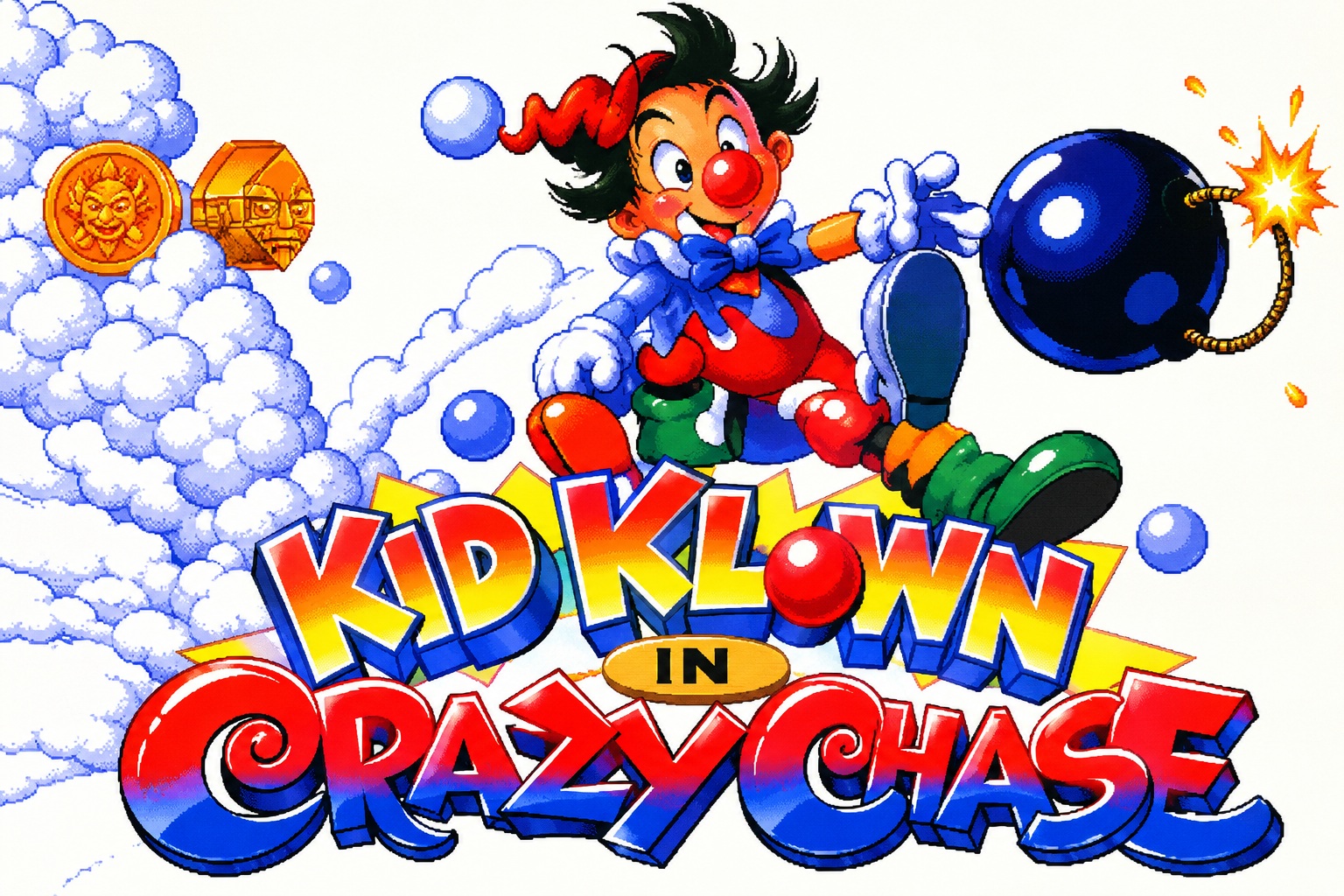
Kid Klown in Crazy Chase is one of the more unusual platform games on the Super Nintendo, replacing traditional side-scrolling movement with a fast isometric chase where nearly every second feels like a race against disaster. Released in 1994 by Kemco, the game follows Kid Klown as he attempts to rescue Princess Honey from the villainous space pirate Blackjack. Rather than exploring large open stages, Kid Klown is pushed forward through narrow diagonal courses filled with banana peels, rolling hazards, pits, enemies, explosions, and other ridiculous traps. The result is a fast, colourful action game where reaction speed, route awareness, and precise jumping matter more than conventional platforming exploration.
The central gimmick is the burning fuse that runs through every stage. Blackjack has placed a massive bomb at the end of the course, and Kid Klown must reach it before the flame reaches the explosive. Simply surviving the run is not always enough, however, because four card-suit symbols are also hidden throughout each stage and need to be collected before the level can be properly completed. This gives every chase two simultaneous objectives: move quickly enough to beat the fuse while remaining observant enough to gather the required symbols.
Now playable online through Lemon Web Games, Kid Klown in Crazy Chase brings its isometric obstacle courses, cartoon hazards, card-suit collectibles, frantic fuse races, colourful animation, and distinctive 16-bit platforming directly into the web browser. Players can guide Kid Klown through five increasingly dangerous stages while dodging traps, jumping over obstacles, collecting useful items, and trying to reach each bomb before the burning fuse catches up. The short stage count is balanced by demanding level design and the constant possibility of losing time to even a small mistake. For players who enjoy fast arcade-style platformers with unusual mechanics, Kid Klown in Crazy Chase remains a memorable SNES curiosity.
A Platformer Built Around Constant Forward Pressure
Kid Klown in Crazy Chase feels different from a conventional platformer almost immediately because the player is rarely encouraged to stop and study the environment for long. The burning fuse keeps the entire stage moving forward, creating a sense of urgency from beginning to end.
This pressure changes how players approach obstacles. A safe route may take slightly longer, while a dangerous shortcut can save valuable seconds. Even a small stumble can become important if it allows the fuse to gain too much ground.
The result is closer to an obstacle-course race than a traditional platform adventure. The player is constantly balancing speed against control.
The Isometric Perspective Gives the Game Its Identity
The game uses a diagonal isometric viewpoint rather than a flat side view. Kid Klown moves along paths that appear to stretch into the distance, with hazards approaching from different angles.
This perspective gives each stage a stronger sense of depth, but it also makes jumping more demanding. Players need to judge both horizontal and vertical positioning while moving at speed.
Once the perspective becomes familiar, it gives the game a distinctive rhythm. Obstacles can appear to come directly toward the player, making every run feel more immediate than a standard left-to-right platformer.
Kid Klown Is Always One Mistake Away From Trouble
The character himself fits the tone perfectly. Kid Klown is expressive, accident-prone, and surrounded by hazards that seem designed specifically to embarrass him.
A failed jump or collision does more than reduce momentum. It often triggers a humorous animation that briefly stops the run and allows the fuse to move closer to the bomb.
These exaggerated reactions add personality while also increasing tension. The game is funny to watch, but every slapstick mistake costs precious time.
The Burning Fuse Creates the Main Time Limit
Each stage revolves around reaching the bomb before the fuse burns all the way to the end. This provides an immediate and easy-to-understand objective.
The fuse acts like a visible countdown rather than a conventional clock. Players can see exactly how much danger remains, which makes late-stage mistakes especially stressful.
The system also encourages repeated attempts. Once the stage layout becomes familiar, players naturally begin shaving off wasted movements and avoiding hazards that previously slowed them down.
Four Card-Suit Symbols Must Be Collected
Speed alone does not guarantee success. Each stage contains four card-suit symbols—heart, diamond, club, and spade—that must be gathered during the run.
Missing even one can force the player to repeat the stage or continue with incomplete progress, depending on the situation. This makes memorization especially important because some symbols are positioned in areas that are easy to overlook.
The collectibles prevent players from simply following the shortest line through every course. Sometimes the best route is the one that passes through the required symbol rather than the one that saves the most time.
The Card System Encourages Route Learning
After several attempts, players begin remembering where the four suits appear and planning around them. This changes the stage from a chaotic obstacle course into something more controlled.
The first attempt may be about survival. The second may focus on finding a missing card symbol. Later runs can then combine both goals into one efficient route.
This learning process gives the short campaign much more replay value than the stage count might initially suggest.
Jumping Is the Most Important Skill
Kid Klown can avoid many hazards simply by jumping at the right moment. Rolling objects, pits, obstacles, and other dangers often require precise timing.
Jump too early and the character may land directly on the hazard. Jump too late and there may not be enough room to clear it.
Because the game keeps moving quickly, players need to make these decisions almost instantly. Good timing becomes far more important than complicated controls.
Banana Peels Turn Simple Paths Into Traps
One of the most recognizable hazards is the banana peel. It fits the clown-themed humour perfectly, but it is also dangerous because slipping wastes time.
The peel itself is simple to avoid once seen, yet the challenge comes from placing it among other hazards. A jump used to avoid one obstacle may land Kid Klown directly onto another.
This layered obstacle design becomes more common in later stages. The game gradually stops presenting threats individually and begins combining several at once.
Rolling Objects Demand Quick Reactions
Large rolling hazards frequently travel along the same path as Kid Klown, forcing the player to move or jump at the correct moment.
These obstacles can feel especially dangerous because their movement is easy to understand but difficult to avoid when the course becomes crowded. Players may know exactly what is coming and still mistime the response.
Repeated play helps because rolling patterns become easier to anticipate. What feels chaotic at first eventually becomes another memorized part of the route.
Pits Punish Poor Positioning
The isometric perspective makes gaps and pits more challenging than they might appear. Players need to align Kid Klown properly before jumping.
A slightly incorrect angle can result in missing the safe landing area. This is especially punishing when the player is already under pressure from the fuse.
Later sections often combine pits with moving hazards, increasing the need for accurate positioning rather than blind speed.
Enemies Are Another Kind of Obstacle
Kid Klown in Crazy Chase is not built around heavy combat. Enemies mainly exist to disrupt movement and force the player to react.
Most are better avoided than confronted directly. The objective is always reaching the end quickly, so stopping to deal with unnecessary threats usually works against the player.
This design keeps the focus on movement. The game is about navigating danger rather than clearing every enemy from the screen.
Power-Ups Can Make a Run Much Easier
Scattered items provide temporary advantages that can help Kid Klown survive difficult sections or recover from mistakes.
Some improve the player's chances of reaching the end safely, while others provide additional scoring opportunities. Collecting them often requires leaving the most direct route.
This creates another risk-versus-reward decision. A helpful item may be worth chasing, but only if the detour does not cost too much time.
Balloons and Bonus Items Reward Exploration
Balloons and other pickups are positioned throughout the courses, giving players reasons to look beyond the immediate path.
These items add a scoring element to the chase and make repeated runs more interesting. Once the required card symbols are memorized, players can begin focusing on higher-value routes.
The collectibles also help fill the stages visually, making them feel more like lively cartoon obstacle courses than empty tracks.
Hidden Areas Add Another Layer
Some stages contain less obvious routes or bonus opportunities that reward players who experiment with movement rather than always staying on the most direct line.
These areas can provide extra items or scoring opportunities, but they also consume time. Players need enough confidence in the rest of the stage to justify exploring them.
The hidden elements add depth to an otherwise straightforward structure. Even after completing a stage, there may still be more to discover.
Five Stages Keep the Campaign Focused
Kid Klown in Crazy Chase contains five main stages, which may sound short compared with many platformers. However, each stage is designed around repeated attempts and mastery.
The challenge is not simply seeing every area once. Players are expected to learn the route, remember card locations, avoid delays, and improve their completion time.
This structure gives the game an arcade-like quality. A stage becomes something to perfect rather than simply pass through once.
Later Stages Demand Much Better Timing
The early game gives players time to understand the unusual perspective and movement. Later courses become considerably more demanding.
Hazards arrive closer together, jumps become less forgiving, and the fuse leaves less room for hesitation. The player is expected to react based on memory rather than constant improvisation.
The difficulty curve therefore comes from execution rather than introducing many new controls. The same basic skills simply need to be performed more accurately.
The Bomb Creates a Dramatic Finish
Reaching the bomb at the end of the stage provides a clear and satisfying conclusion to each chase. The fuse has been threatening the player throughout the run, and the bomb becomes the final reminder of the time pressure.
Arriving with plenty of time remaining feels completely different from reaching it only moments before the fuse. The same stage can therefore produce very different levels of tension depending on performance.
This simple finish line works because the player has been watching the danger build from the beginning.
Blackjack Gives the Adventure a Cartoon Villain
The villain Blackjack fits the exaggerated presentation perfectly. As a space pirate responsible for kidnapping Princess Honey and setting up the explosive chases, he provides the excuse for each increasingly ridiculous obstacle course.
The game does not need a complicated story because the conflict is easy to understand. Kid Klown needs to survive Blackjack's traps and rescue the princess.
The simple setup allows the humour and action to remain the focus. Every stage feels like another elaborate trap created specifically to slow Kid Klown down.
Princess Honey Provides the Rescue Objective
Princess Honey represents the traditional rescue goal behind the entire chase. Her kidnapping gives Kid Klown a reason to keep pushing through Blackjack's dangerous stages.
The story is intentionally lighthearted and fits the cartoon style. There are no lengthy cutscenes or serious dramatic moments interrupting the gameplay.
The simplicity works well because the stages themselves provide most of the personality. The player always knows why Kid Klown is running.
The Cartoon Animation Makes Every Mistake Entertaining
One of the game's strongest presentation elements is its exaggerated character animation. Kid Klown reacts visibly to hazards, collisions, slips, and other failures.
These animations turn mistakes into small comedy scenes. Even when losing time is frustrating, the character's reaction can still be entertaining.
This helps soften the difficulty. Failure is not presented as a serious punishment but as another ridiculous moment in Kid Klown's disastrous race.
Bright SNES Graphics Give the Game Strong Personality
The game uses colourful environments, large sprites, and clear visual hazards that fit its cartoon theme.
Each course is filled with objects designed to be readable at speed. Because the player has very little time to study the screen, hazards need to be recognizable immediately.
The visual style also makes the game stand out among darker or more serious SNES action titles. Kid Klown in Crazy Chase is bright, playful, and intentionally silly from beginning to end.
The Soundtrack Matches the Fast Pace
Music supports the frantic nature of each chase, keeping the energy high while the fuse burns toward the bomb.
Sound effects reinforce collisions, jumps, pickups, and comedic accidents. The audio contributes heavily to the cartoon atmosphere.
Because stages are short and intense, the soundtrack rarely needs to create slow or atmospheric moments. The game wants players to keep moving, and the audio reflects that urgency.
Memorization Turns Chaos Into Control
The first attempt at a stage can feel overwhelming because obstacles appear one after another with little warning.
After repeated runs, the course begins to make sense. Players remember where the banana peel appears, when the rolling hazard enters, where the card symbols are located, and which jumps require special care.
This transformation is one of the most satisfying parts of the game. A stage that initially feels unpredictable eventually becomes something the player can perform almost automatically.
Speed and Precision Need to Stay Balanced
Running as quickly as possible is not always the best strategy. Moving too aggressively can result in repeated collisions that waste far more time than cautious movement would have.
At the same time, excessive caution allows the fuse to continue burning. Players cannot simply stop before every obstacle and wait for the perfect moment.
The challenge is finding the right rhythm between speed and control. That balance defines nearly every successful run.
The Game Feels Closer to an Arcade Challenge Than a Traditional Platformer
Kid Klown in Crazy Chase has platforming mechanics, but its structure is heavily influenced by arcade design. Stages are short, failure encourages immediate retrying, and improvement comes through repetition.
The fuse creates constant time pressure, while the card symbols provide secondary objectives. Both systems encourage players to replay stages until they can complete them efficiently.
This makes the game especially suited to short sessions. A player can attempt one stage several times and still feel meaningful improvement.
Playing Kid Klown in Crazy Chase Online Today
Through Lemon Web Games, Kid Klown in Crazy Chase can now be played directly in your web browser with no downloads or setup required. Features of the web-based version include:
New players should focus first on surviving each course rather than collecting everything immediately. Learn where the major hazards appear, become comfortable with the isometric jumping, and then begin adding the card-suit symbols into the route.
It is also useful to avoid overcorrecting after a mistake. One collision may cost a few seconds, but panicking can easily cause several additional errors. Staying calm usually preserves more time than trying to recover everything instantly.
Who Should Play Kid Klown in Crazy Chase
Kid Klown in Crazy Chase is particularly suitable for players who enjoy learning stages through repetition. The controls are simple, but completing each chase efficiently requires memorizing hazards, card locations, and safe routes.
It should also appeal to players looking for something different from a standard left-to-right platformer. The isometric perspective and constant race against the fuse give the game a personality that remains unusual even within the large SNES library.
Play Kid Klown in Crazy Chase Online Now
Kid Klown in Crazy Chase turns every stage into a frantic race between one unlucky clown and an increasingly dangerous burning fuse. Dodge banana peels, leap over pits, avoid rolling hazards, collect all four card suits, grab useful bonuses, and reach the bomb before Blackjack's trap explodes.
Through Lemon Web Games, players can experience this colourful 1994 SNES adventure directly in a modern browser. The controls are easy to understand, but mastering the diagonal courses takes practice, memory, and precise timing. Every replay offers another opportunity to find a cleaner route and finish with more time remaining.
Final Thoughts
Kid Klown in Crazy Chase stands out because it takes familiar platforming ideas and rearranges them around an unusual perspective and constant time pressure. Instead of slowly exploring stages, players are pushed forward by a burning fuse while simultaneously searching for card symbols and avoiding a seemingly endless collection of ridiculous traps. The concept is simple, but it creates a surprisingly intense rhythm.
The bright visuals and exaggerated animation keep the tone playful even when the difficulty rises. Kid Klown may slip on banana peels, crash into obstacles, or fall victim to Blackjack's traps, but every failure looks like part of a cartoon comedy routine. That combination of frustration and humour gives the game much of its charm.
Through Lemon Web Games, Kid Klown in Crazy Chase can now be enjoyed directly in the browser as one of the stranger and more memorable platformers of the 16-bit era. Its five stages may be compact, but each one rewards practice and route mastery. For players who enjoy fast reactions, repeated attempts, colourful presentation, and obstacle courses that never stop trying to ruin a perfect run, Kid Klown's crazy chase is still worth taking.











Comments 0