

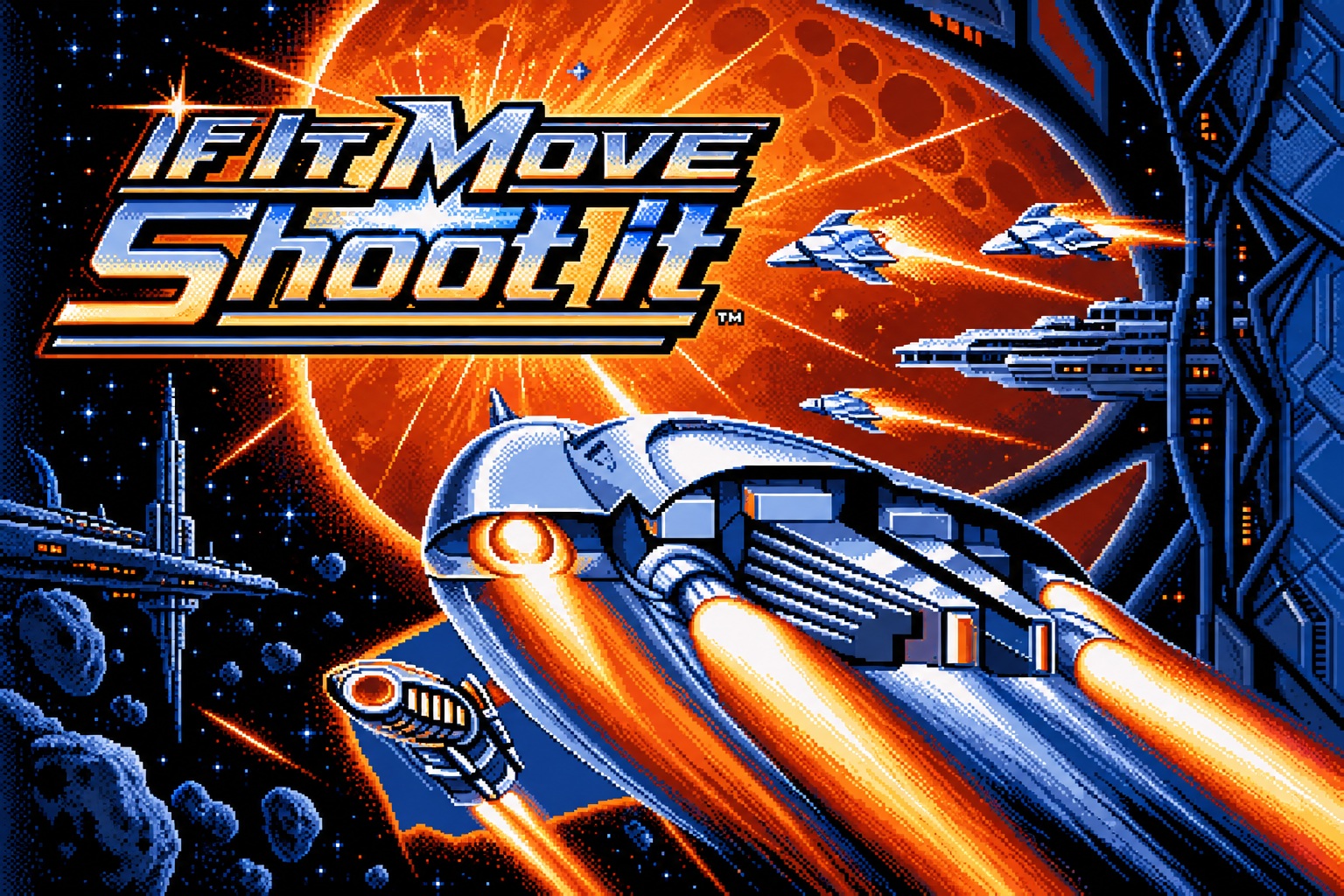
If It Moves, Shoot It! is a 1989 DOS shoot 'em up that understands exactly what kind of game it wants to be. Developed by Emerald Software and published for DOS by Brøderbund, it throws the player into a hostile science-fiction battlefield filled with attacking alien formations, incoming projectiles, and a straightforward mission: destroy practically everything moving across the screen. There are no complicated tactical menus or lengthy story sequences interrupting the action. From the moment the battle begins, survival depends on movement, accurate firing, quick reactions, and the ability to keep track of several threats simultaneously.
The player takes control of a combat craft sent against the Korts, an alien force threatening the settlers of the Valley of the Ancients. Enemy formations continually enter the battlefield while the scenery scrolls beneath the ship, creating a constant sensation of forward movement. Destroying successive waves eventually provides access to increasingly powerful weaponry, giving the player more ways to deal with the growing opposition. The result is a classic arcade shooter built around an immediately understandable loop of dodging, firing, surviving, and pushing forward toward the next wave.
Now playable online through Lemon Web Games, If It Moves, Shoot It! brings its fast DOS shooting, alien formations, scrolling environments, weapon progression, and pure arcade action directly into the web browser. Players can pilot the combat craft through successive encounters, dodge bullets and other incoming attacks, destroy Korts before they overwhelm the screen, and gradually gain access to stronger weapons. The game requires very little explanation because its title effectively provides the entire strategy. Keep moving, keep firing, and never assume something approaching the ship is friendly.
A Title That Explains the Entire Game
Few video game titles communicate their design philosophy as clearly as If It Moves, Shoot It! The name is not merely a joke or marketing slogan. It accurately describes how the player is expected to approach almost every encounter.
Enemies appear from different directions and move across the battlefield in formations. Hesitation gives them additional opportunities to fire or manoeuvre into dangerous positions, so aggressive shooting is usually the safest response. The game encourages players to maintain constant offensive pressure while simultaneously avoiding incoming attacks.
That simplicity makes the experience easy to understand within seconds. There is no need to memorize complicated objectives before beginning. The player controls a ship, enemies appear, and almost everything hostile needs to be destroyed.
The Korts Provide the Alien Opposition
The primary enemies are the Korts, hostile aliens threatening the settlers connected to the Valley of the Ancients. Their forces appear in numerous shapes and formations, creating a constant stream of targets.
Different enemies approach the player in different ways. Some sweep across the screen, others dive toward the ship, and many attack with projectiles that force the player to reposition quickly. The danger therefore comes not only from the number of enemies but also from how their movement patterns overlap.
As more threats appear simultaneously, the screen can become increasingly difficult to read. Players need to distinguish between safe movement space, enemy positions, and incoming fire almost instantly. The Korts turn what begins as simple shooting into a demanding test of awareness.
Top-Down Shooting Keeps the Action Easy to Read
If It Moves, Shoot It! presents the battlefield from above, giving players a clear view of the combat craft and the enemies approaching around it. The perspective is well suited to the constant movement required by a shoot 'em up.
The scrolling scenery creates the impression of travelling deeper into enemy territory rather than fighting inside a fixed arena. Objects and terrain continually pass underneath while alien formations enter the combat space.
Because the player can see threats developing across much of the screen, success often depends on anticipating danger rather than responding only after an enemy has already reached the ship. Watching where a formation is moving can be more valuable than simply shooting at its current position.
Constant Movement Is Essential
Remaining stationary for too long is dangerous. Enemy bullets, bombs, beams, and moving formations can quickly converge on one location, forcing the player to remain mobile.
Movement is therefore defensive as much as offensive. Shifting away from incoming fire creates safe openings while also changing the angle from which enemies can be attacked.
The best movement is controlled rather than random. Panicking and travelling too far across the screen can carry the ship directly into another projectile or enemy formation. Small, deliberate adjustments are often safer than large reactions.
Shooting Never Really Stops
Unlike slower shooters where ammunition conservation dominates the experience, If It Moves, Shoot It! encourages almost constant firing. The battlefield regularly presents new enemies, making sustained offensive pressure useful.
Continuous fire also increases the chance of destroying targets before they fully enter dangerous positions. Enemy formations become much harder to manage when several are allowed to remain active simultaneously.
The challenge lies in aiming that fire while continuing to dodge. Players cannot concentrate entirely on attacking because survival still requires awareness of incoming projectiles. Shooting and movement need to happen together.
Enemy Formations Create Predictable Patterns
Many Korts arrive in organized formations rather than appearing randomly. Observing these patterns allows experienced players to anticipate where enemies will travel next.
A formation may initially look overwhelming, but understanding its path can reveal safe areas and effective firing positions. This turns repeated attempts into a learning process.
Players gradually begin recognizing common movements and adjusting before the enemies arrive. What initially requires frantic reactions can eventually become much more controlled. Pattern recognition is one of the most important skills in classic shoot 'em ups, and it plays a major role here.
New Weapons Reward Continued Survival
Destroying more waves of enemies gradually gives the player access to newer and more advanced weapons. This provides a simple but effective sense of progression without interrupting the arcade flow.
More powerful weapons become particularly valuable as enemy density increases. Clearing formations quickly reduces the number of projectiles that can be fired toward the player.
Weapon progression also gives players a reason to survive beyond simply chasing a higher score. Staying alive long enough to reach stronger equipment changes the way later encounters can be approached.
Power Progression Changes the Rhythm of Battle
Early stages naturally require more careful shooting because the player begins with less powerful offensive capabilities. As stronger weapons become available, enemy formations can often be cleared more efficiently.
This creates a satisfying escalation. The game becomes more dangerous, but the player's ability to respond also improves. The result is not simply increasing difficulty but a gradual expansion of destructive potential.
Losing progress can therefore feel significant because it may also mean returning to weaker capabilities. Preserving the ship and maintaining momentum becomes increasingly important.
Projectiles Demand Constant Attention
The Korts do not simply move toward the player. They attack with bullets, bombs, laser-like weapons, and other dangerous projectiles that transform open areas into temporary hazards.
The player needs to monitor both enemy ships and what those enemies are firing. Destroying one target is not useful if the ship immediately moves into the projectile that target launched moments earlier.
This creates layered danger. An enemy may already be destroyed, yet its attack can remain on screen long enough to cause problems. Good players track threats until they are completely gone.
Dodging Is Just as Important as Shooting
The title emphasizes shooting, but survival depends equally on avoiding damage. Aggressive players who ignore enemy fire rarely survive for long.
Dodging involves reading the direction of incoming attacks and moving into safe openings before those openings disappear. Because several projectiles may arrive together, the safest path can change quickly.
The most effective play combines offense and defense into one continuous motion. The player keeps firing while adjusting position, eliminating threats without losing awareness of the surrounding battlefield.
The Scrolling Backgrounds Give the Game Visual Character
For an early DOS shooter, If It Moves, Shoot It! makes good use of detailed scrolling environments. The scenery gives each stretch of combat more visual energy than a simple static starfield would provide.
The backgrounds originated from technology and artwork connected to Emerald Software's earlier Phantom Fighter project, although If It Moves, Shoot It! uses its own player ship, enemy formations, and power-up structure. This connection gives the game an interesting place within Emerald Software's small catalogue.
The scrolling also strengthens the illusion of travelling continuously through hostile territory. Even when the fundamental objective remains unchanged, the environment creates a sense that the player is progressing somewhere.
A Pure Arcade Design
If It Moves, Shoot It! comes from a period when many games were designed around immediate mechanical challenges rather than cinematic storytelling. The focus here is almost entirely on playing well.
There are no lengthy dialogue sequences between battles. The game does not require players to manage a complicated inventory or spend time choosing character upgrades from menus. Action remains the priority.
This makes it especially easy to revisit today. A player can begin a session, understand the objective immediately, and start improving through practice. The game wastes very little time before delivering its central experience.
Keyboard and Joystick Controls Reflect the DOS Era
The DOS version supports keyboard play and was also designed to work with joystick input. Both approaches suit the straightforward arcade structure.
Movement and firing are essentially all the player needs to understand. The challenge is not remembering controls but executing them accurately when the screen becomes crowded.
This is one reason the game remains approachable despite its age. Modern players may need a brief period to adjust to the speed and responsiveness, but there is very little mechanical complexity standing between them and the action.
Difficulty Comes From Increasing Pressure
The basic rules do not become dramatically more complicated as the game continues. Instead, difficulty grows through faster action, more dangerous formations, heavier incoming fire, and increasingly demanding situations.
This is classic arcade design. Rather than constantly introducing new systems, the game asks the player to perform familiar actions more accurately.
The approach creates a clear skill curve. Improvement can be felt through longer survival, cleaner dodging, more efficient destruction of formations, and better control when several threats overlap.
Losing a Life Can Disrupt Momentum
Arcade shooters often feel easiest while the player has established a rhythm. Weapons are upgraded, enemy patterns feel familiar, and movement becomes automatic. Losing a life can interrupt that confidence.
Recovering requires quickly returning attention to the battlefield rather than dwelling on the mistake. Another formation may already be approaching.
This psychological element matters more than it initially appears. One error can easily lead to several additional mistakes if frustration disrupts concentration. Remaining calm is one of the best ways to extend a run.
The Continue Feature Encourages Persistence
One notable feature is the ability to continue playing even after losing all available lives. This keeps the game from becoming overly punishing for players who simply want to experience more of the action.
Continues also provide opportunities to practise difficult sections without repeatedly starting from the beginning. Players can learn enemy patterns and gradually improve their reactions.
At the same time, completing longer stretches without relying on continues remains satisfying. The feature lowers the barrier to learning without removing the challenge of performing well.
Scoring Gives Every Enemy Additional Value
Although survival and progression are the main immediate goals, scoring provides another reason to destroy as many enemies as possible. Leaving targets alive means losing potential points as well as allowing threats to remain active.
This encourages aggressive play. Skilled players can chase better scores while still maintaining enough caution to preserve their ship.
Score chasing also adds replay value once the basic game becomes familiar. Instead of simply trying to reach the next section, players can focus on improving how efficiently they clear each wave.
The DOS Presentation Has Strong Retro Appeal
If It Moves, Shoot It! reflects the technical limitations and possibilities of late-1980s DOS gaming. Its graphics use the colourful computer display modes available at the time, while sound is considerably simpler than what later PC hardware would provide.
Rather than diminishing the experience, these limitations give it a distinctive identity. Bright sprites, patterned terrain, simple effects, and direct arcade presentation immediately place the game within its era.
For retro players, that authenticity is part of the attraction. The experience feels unmistakably like an early DOS action game rather than a modern title pretending to be one.
A Different Kind of PC Game for 1989
DOS computers were often associated with adventures, simulations, RPGs, and strategy games, partly because smooth arcade action could be difficult to reproduce on early PC hardware. A dedicated shoot 'em up therefore stood out from many other games available on the platform.
If It Moves, Shoot It! attempted to bring the immediate appeal of arcade-style shooting into that environment. The emphasis on scrolling backgrounds, enemy waves, and constant movement gave PC players something closer to the action experiences common on other systems.
That makes the game interesting historically even beyond its straightforward mechanics. It represents developers trying to push the DOS platform toward faster forms of action gaming.
Emerald Software's Short but Interesting History
Emerald Software was an Irish development studio active during the late 1980s and responsible for several games and conversions across different computer platforms. Its catalogue included action games as well as licensed projects.
If It Moves, Shoot It! arrived during this relatively brief period of activity. The DOS edition was released in North America by Brøderbund in 1989.
Although Emerald Software never became one of the industry's long-running development giants, games such as this provide an interesting snapshot of European computer development during the late 1980s.
The Game Rewards Memorization and Reflexes Together
Pure reflexes can carry a player through early encounters, but later survival becomes much easier when enemy formations are remembered. Knowing what is likely to appear next gives the player time to prepare.
This creates the classic shoot 'em up cycle of repeated attempts and gradual mastery. Each failure provides information that can improve the next run.
Eventually, sections that once seemed chaotic become recognizable sequences. The player begins positioning the ship before danger arrives rather than reacting afterward. That transformation is one of the most satisfying aspects of the genre.
There Is Very Little Downtime
If It Moves, Shoot It! rarely asks players to stop and perform unrelated tasks. Enemy encounters follow one another quickly, preserving the arcade rhythm.
This makes sessions feel energetic even when they are relatively short. A few minutes can contain dozens of enemies, numerous dodges, weapon upgrades, and several near misses.
The lack of downtime also makes concentration essential. There are few opportunities to mentally disengage once a difficult sequence begins. Staying focused is part of the challenge.
Simple Rules Create Immediate Replayability
Because the objective is so easy to understand, restarting never feels like repeating a lengthy introduction. The player can quickly return to shooting and attempt to perform better.
One run may end because of poor positioning, while the next survives much longer because the player remembers the same formation. Improvement becomes obvious.
This gives the game the kind of replayability associated with traditional arcade machines. The mechanics do not need to change between attempts because the player's own performance is what changes.
Why If It Moves, Shoot It! Still Works Today
The central appeal of a good shoot 'em up is largely timeless. Moving targets, incoming projectiles, escalating weapons, recognizable patterns, and the satisfaction of surviving a crowded screen remain enjoyable regardless of graphical age.
If It Moves, Shoot It! benefits from keeping those elements uncomplicated. There are few barriers between the player and the action.
Its greatest strength is therefore also its simplest idea. The title makes a promise about constant shooting, and the game consistently delivers that experience.
Playing If It Moves, Shoot It! Online Today
Through Lemon Web Games, If It Moves, Shoot It! can now be played directly in your web browser with no downloads or setup required. Features of the web-based version include:
New players should concentrate on staying alive rather than trying to destroy every enemy immediately. Keep moving, watch the direction of incoming projectiles, and avoid trapping the ship near the edge of the screen. A missed enemy is usually less dangerous than moving directly into an attack while trying to destroy it.
Once the movement feels comfortable, begin studying enemy formations. Recognizing where enemies are likely to travel makes it easier to position the ship for safe attacks. The game becomes considerably more manageable when players begin anticipating patterns rather than reacting to every threat individually.
Who Should Play If It Moves, Shoot It!
If It Moves, Shoot It! is especially suitable for players who appreciate games that can be understood almost immediately but still require practice to master. The controls are straightforward, yet surviving later enemy formations demands good reactions and pattern recognition.
It is also worth experiencing for players interested in DOS history. Fast scrolling shooters were less common on early PCs than strategy, adventure, or role-playing games, giving this title a somewhat unusual place within the platform's late-1980s library.
Play If It Moves, Shoot It! Online Now
If It Moves, Shoot It! strips the shoot 'em up formula down to its essentials and keeps the action moving. Pilot the combat craft across hostile territory, blast incoming Korts, weave between bullets and bombs, survive increasingly dangerous formations, and unlock stronger weapons as more enemy waves are destroyed. There is little time for hesitation because the next threat is rarely far away.
Through Lemon Web Games, this 1989 DOS shooter can be experienced directly in a modern browser, preserving its original focus on reflexes, pattern recognition, and relentless arcade action. Whether the goal is reaching farther, improving a score, or simply enjoying a forgotten PC shooter, the mission remains wonderfully straightforward: if it moves, shoot it.
Final Thoughts
If It Moves, Shoot It! is not complicated, and that is precisely why its design works. Emerald Software built the experience around movement, shooting, enemy patterns, escalating weapons, and the constant danger of incoming projectiles. There are no unnecessary systems distracting from the central challenge, allowing every session to focus on how well the player can read the battlefield and react.
The game also represents an interesting period in DOS history when developers were still exploring how effectively IBM-compatible PCs could deliver arcade-style action. Its scrolling backgrounds and colourful combat may look modest today, but they helped give PC players a genuine shoot 'em up experience at a time when the platform was better known for slower genres.
Through Lemon Web Games, If It Moves, Shoot It! remains an enjoyable reminder that an action game does not need complicated mechanics to create excitement. Give the player a ship, fill the screen with hostile aliens, provide increasingly powerful weapons, and keep the battlefield moving. More than three decades later, the title still contains all the instructions anyone really needs.











Comments 0