

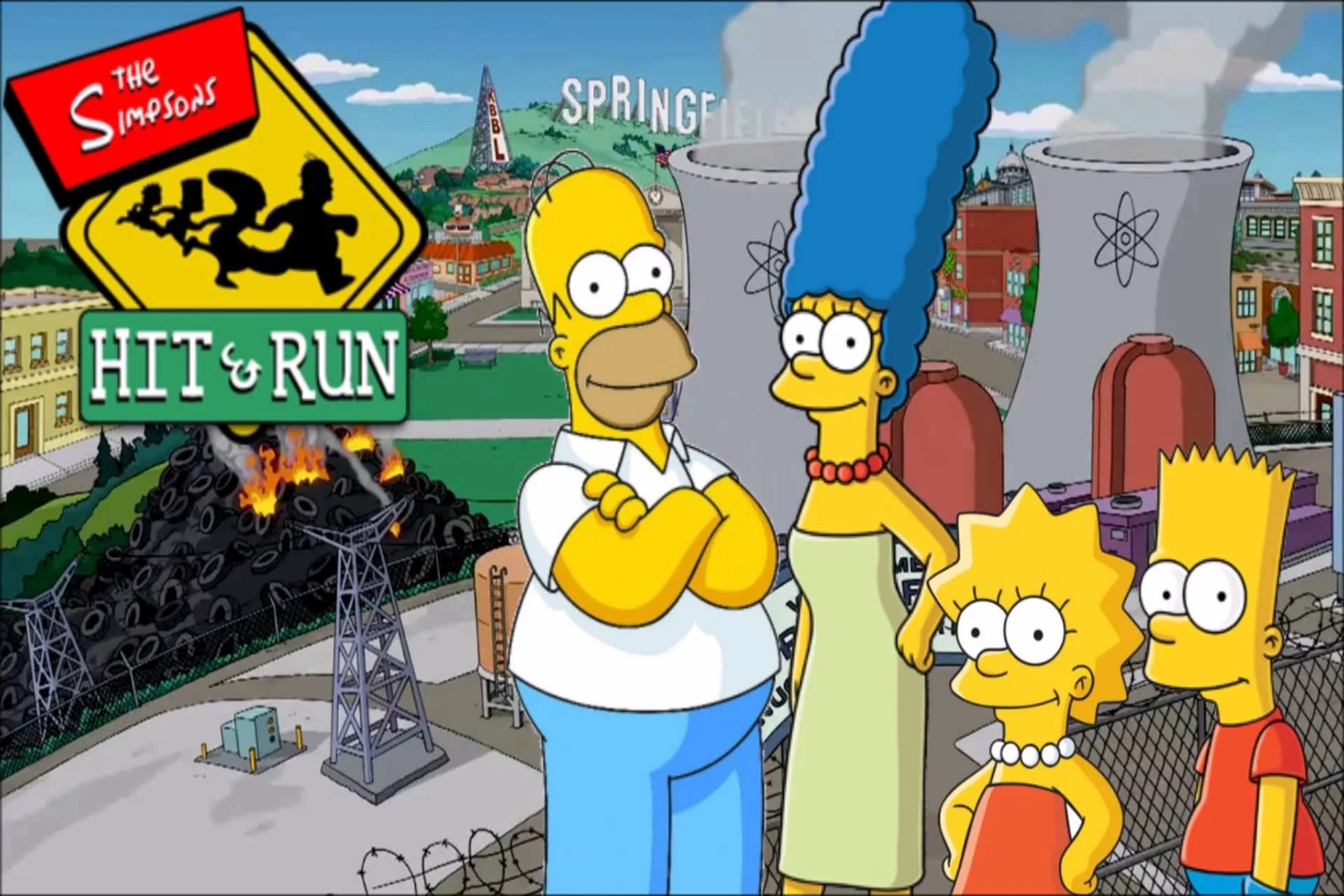
The Simpsons: Hit & Run is one of those rare licensed games that managed to capture the personality of its source material while also becoming an excellent game in its own right. Released in 2003 and developed by Radical Entertainment, the adventure transforms Springfield into a collection of explorable open environments filled with familiar locations, vehicles, characters, hidden collectibles, and the irreverent humor that defines The Simpsons. Players spend much of their time driving through the streets, completing missions, racing against the clock, chasing suspicious vehicles, and causing the kind of accidental destruction that seems perfectly normal in Springfield. Rather than simply recreating individual television episodes, the game tells its own increasingly ridiculous story involving surveillance cameras, black vans, Buzz Cola, and eventually a full extraterrestrial conspiracy.
The campaign is divided across seven story levels and gives players control of Homer, Bart, Lisa, Marge, and Apu at different points in the adventure. Each character receives their own missions and access to different vehicles and outfits, while familiar supporting characters frequently appear to provide objectives or additional comedy. The game mixes arcade driving with on-foot exploration, platforming, collectible hunting, street races, bonus missions, and hidden secrets scattered throughout Springfield. This variety keeps the adventure moving while making the world feel like a playable interpretation of the television series rather than simply a collection of racing tracks.
Now playable online through Lemon Web Games, The Simpsons: Hit & Run brings its memorable Springfield adventure directly into modern web browsers. Players can explore familiar neighborhoods, complete story missions, unlock vehicles and costumes, destroy wasp cameras, collect hidden cards, and gradually uncover the bizarre conspiracy behind the unusual activity appearing throughout town. The browser-playable experience provides a convenient way to revisit one of the most beloved television-based games of the early 2000s without depending on the original console hardware. Whether you remember racing through Springfield years ago or are discovering the game for the first time, its combination of driving, exploration, comedy, and recognizable Simpsons locations remains enormously entertaining.
A Playable Version of Springfield
One of the biggest attractions of The Simpsons: Hit & Run is the opportunity to freely explore Springfield rather than simply seeing familiar locations appear in the background of missions. The game recreates numerous landmarks from the television series and connects them through drivable streets, shortcuts, alleys, ramps, and hidden areas. The Simpsons' house, the Kwik-E-Mart, Springfield Elementary School, the Nuclear Power Plant, and many other recognizable locations become places players can actually visit. For longtime fans, simply driving around and identifying references can be as entertaining as following the main story.
Springfield is divided into several large areas that are reused in different story levels with altered characters, missions, traffic, atmosphere, and environmental details. Returning to a familiar neighborhood later in the campaign does not necessarily mean experiencing exactly the same environment. Changes in time of day and story context help make repeated locations feel different. This structure allowed the developers to build relatively detailed environments while still supporting a substantial campaign.
The world is also filled with smaller references that reward players who know the television series well. Signs, buildings, businesses, vehicles, and background jokes frequently reference characters or episodes without interrupting the gameplay. The result is a Springfield that feels deliberately packed with recognizable details. Even players who ignore the collectibles will constantly encounter something familiar.
Homer Begins the Investigation
Homer Simpson naturally becomes the first playable character, introducing players to the game's basic driving and exploration mechanics. Strange wasp-shaped surveillance cameras have begun appearing around Springfield, while mysterious black vans seem to be watching residents. Homer becomes suspicious and begins investigating, although his approach to detective work is naturally much less organized than anyone might expect. His early missions establish the strange events that eventually connect the entire story.
These opening stages provide an accessible introduction to driving, collecting coins, purchasing vehicles, and completing timed objectives. Homer receives missions from familiar characters while gradually encountering more evidence that something unusual is happening around Springfield. The story remains deliberately comedic, but the mystery gives the missions enough continuity to feel connected. By the end of Homer's first chapter, it becomes clear that the surveillance activity is only the beginning.
Homer's personality also establishes the game's tone immediately. Dialogue constantly references his laziness, appetite, questionable driving, and tendency to misunderstand whatever is happening around him. The original voice performances make even ordinary mission instructions entertaining. It rarely feels like a generic action game with Simpsons character models placed on top.
Bart Takes the Mystery Further
Bart becomes the next major playable character and continues investigating the mysterious activity across Springfield. His missions shift the campaign toward different parts of the town and introduce another selection of vehicles and objectives. Bart's personality gives these stages a faster and more mischievous tone, particularly when his missions involve racing or pursuing suspicious characters. The story also begins moving much closer toward the larger conspiracy.
Eventually, Bart becomes directly involved with the alien mystery, pushing the storyline into increasingly strange territory. His disappearance becomes an important turning point and gives Lisa a reason to continue the investigation. The game uses character switching effectively here because the perspective changes naturally with the story rather than simply changing the playable character for variety. Each chapter feels connected to the previous one.
Bart later returns as a playable character as the campaign progresses, allowing players to experience another set of missions from his perspective. This repetition works because the world and story have changed significantly by that point. The player is no longer simply investigating strange vans. The threat has become much clearer.
Lisa Searches for Bart
Lisa's section of the campaign begins with a more personal objective: finding her missing brother. Her investigation takes players through another major portion of Springfield while continuing to reveal information about the mysterious surveillance and alien involvement. Lisa's intelligence naturally makes her a much more believable investigator than Homer, although the game never abandons its humor. Her missions combine driving, exploration, and interactions with a wide range of supporting characters.
The change of protagonist also helps the campaign feel different even though the fundamental controls remain the same. Lisa has access to her own costumes and vehicles, while her dialogue reflects a much more thoughtful personality. Her reactions to Springfield's absurd residents provide a different kind of comedy from Homer's confusion or Bart's mischievous attitude. Character personality remains one of the game's strongest sources of variety.
Lisa's chapter also reinforces how widely the conspiracy has spread. What originally seemed like a local mystery involving cameras and vans begins connecting to much stranger events. Players gradually realize that Springfield is being observed for a reason. The story continues escalating while maintaining the playful tone of the television series.
Marge Takes Matters into Her Own Hands
Marge becomes playable during another important stage of the investigation. Her involvement demonstrates that the conspiracy has begun affecting the entire Simpson family rather than remaining something Homer and the children can treat as an unusual adventure. Marge's missions send players back through familiar areas under new circumstances, giving the world another visual and narrative variation. Her personality provides yet another contrast with the previous protagonists.
Marge is particularly entertaining because she approaches many of the game's ridiculous situations with the practical concern expected from her television character. She may be participating in dangerous driving missions, but her dialogue still reflects the responsible member of the Simpson household. This contrast makes her chapter surprisingly memorable. The game consistently understands how each playable character should react to the same bizarre world.
Her involvement also helps connect the increasingly strange alien storyline with more grounded concerns around Springfield. Buzz Cola and other suspicious developments become more important as the campaign progresses. Marge's chapter therefore acts as another step toward uncovering the actual purpose behind the conspiracy.
Apu Becomes an Unexpected Hero
Apu Nahasapeemapetilon is perhaps the most surprising member of the playable cast. The Kwik-E-Mart owner becomes directly involved in the investigation and eventually takes responsibility for dealing with consequences connected to suspicious products being distributed around Springfield. His chapter gives players another perspective on the story while introducing missions associated with different parts of town. It is an unusual but entertaining choice that demonstrates how willing the game is to use supporting characters meaningfully.
Apu's role also expands the adventure beyond the Simpson family. Springfield itself becomes part of the conflict, with ordinary residents and businesses affected by the strange events taking place. Apu gradually becomes more involved than he probably expected, leading to increasingly dangerous missions. His storyline provides another important piece of the overall mystery.
Controlling Apu also adds further variety to character dialogue and mission interactions. His responses to other residents are very different from those of Homer or Bart. The game continuously uses personality to make similar gameplay objectives feel fresher. This attention to character is one reason the campaign avoids becoming merely a long sequence of driving missions.
Kang and Kodos Bring the Alien Conspiracy into Focus
The story eventually reveals that Kang and Kodos are deeply connected to the strange events occurring throughout Springfield. The two aliens have long been associated with some of The Simpsons' most absurd science-fiction stories, making them perfect villains for a game willing to push Springfield into increasingly ridiculous territory. Their involvement explains many of the strange cameras, suspicious vehicles, and other unexplained events encountered earlier. What began as a small mystery develops into a full alien conspiracy.
The plot becomes progressively more exaggerated as their plan unfolds. Buzz Cola, surveillance technology, and Springfield's population all become part of something much larger than the characters initially understood. The game embraces the same kind of escalating absurdity often seen in the television series' more fantastical episodes. By the final chapters, the adventure bears little resemblance to the relatively ordinary errands of Homer's opening missions.
This escalation works because the campaign spends enough time gradually introducing the mystery. Players see suspicious objects before understanding their purpose and encounter strange events long before receiving the full explanation. The story never becomes overly complicated, but it provides enough momentum to connect all seven levels. The final missions feel like the culmination of something that has been building since the beginning.
Driving Is the Heart of the Experience
Although players can explore Springfield on foot, driving forms the core of most missions. Objectives frequently require racing toward destinations, chasing vehicles, collecting objects before time expires, escaping pursuers, or destroying another car. The arcade-style handling makes vehicles easy to control without requiring simulation-level knowledge. Players can concentrate on navigating Springfield rather than learning complex driving physics.
Different vehicles offer noticeable differences in speed, handling, toughness, and acceleration. A fast sports car may be excellent for races but comparatively fragile during missions involving collisions. Heavier vehicles can withstand more punishment but may struggle through tight shortcuts. Choosing the right vehicle can therefore make certain missions significantly easier.
Driving also becomes more enjoyable as players learn the layout of each Springfield area. Shortcuts can dramatically reduce travel time, while ramps and alleys allow skilled players to avoid crowded roads. Repeated missions naturally teach these routes. Eventually, navigating Springfield becomes almost instinctive.
Street Races Provide Optional Competition
Each major area contains street races that can be completed outside the main storyline. These events challenge players to compete against familiar Springfield residents across routes built around the existing road network. Unlike many story missions, races focus almost entirely on driving performance. Players need to understand shortcuts and maintain control rather than worrying about additional objectives.
Winning all available street races within an area provides useful rewards. This creates a strong incentive to step away from the main story and test driving skills against the local competition. Some races are relatively straightforward, while others become much easier once a faster vehicle has been unlocked. Players can therefore decide when they feel ready.
The races also provide another reason to learn the city thoroughly. Knowing which corners can be cut or where hidden routes appear creates a major advantage. A player following the obvious road may lose to someone willing to drive through parks, alleys, or alternative paths. Springfield itself becomes part of the strategy.
Bonus Missions Expand the Side Content
Bonus missions provide additional objectives beyond the seven main story missions typically found in each level. These activities usually involve familiar supporting characters and can reward the player with useful vehicles. Completing them is optional, but the rewards can make later exploration or racing more enjoyable. They also introduce additional character interactions that would otherwise be absent from the campaign.
Because these missions are not required for story progression, they have greater freedom to embrace unusual ideas. Supporting characters can request help with problems unrelated to the alien conspiracy. This gives players more opportunities to experience the everyday absurdity of Springfield. The side content helps the world feel broader than the central plot.
Unlocking another vehicle is also a meaningful reward because cars remain useful throughout the current level. A bonus vehicle may offer different performance characteristics from those already available. Players interested in completing everything therefore gain both entertainment and practical advantages.
The Hit & Run Meter Punishes Excessive Chaos
The game may encourage reckless driving, but Springfield does respond when players cause too much destruction. Smashing vehicles, hitting objects, damaging the environment, and creating general chaos gradually fills the Hit & Run meter. Once the meter reaches its limit, the police begin pursuing the player. This creates an entertaining consequence for overly destructive behavior.
Escaping requires avoiding police vehicles long enough for the meter to decrease. Officers can ram the player's car and make already difficult driving even more chaotic. Being caught also costs coins, making repeated police attention expensive. The system therefore encourages players to control their destruction when they are saving money.
At the same time, deliberately triggering a Hit & Run can be entertaining. Springfield's police response creates spontaneous pursuits completely separate from formal missions. Players can test how long they can escape or simply enjoy the chaos. The mechanic functions as both punishment and another source of sandbox entertainment.
On-Foot Exploration Reveals Hidden Details
Players can exit vehicles and explore much of Springfield on foot. The playable characters can run, jump, kick objects, and interact with various parts of the environment. This is necessary for reaching collectibles hidden on rooftops, behind buildings, or inside areas inaccessible by car. The platforming is simple but provides a useful break from constant driving.
Many familiar locations contain small interior or semi-interior areas that can be explored. Visiting the Kwik-E-Mart or wandering around the Simpsons' neighborhood allows players to see references that would be easy to miss from inside a moving vehicle. Environmental details reward curiosity. Springfield becomes something to investigate rather than simply drive through.
Characters can also kick certain objects to reveal coins. This gives exploration a practical purpose because money is needed for vehicles and costumes. Players quickly learn to attack vending machines, boxes, and suspicious environmental objects. The game turns even casual wandering into a potential source of progression.
Coins Drive the Unlock System
Coins are the main currency and can be collected throughout Springfield. Destroying wasp cameras, smashing specific objects, completing activities, and exploring the environment all provide opportunities to earn more. Because vehicles and character outfits cost coins, collecting them becomes an important part of progression. Players who spend everything immediately may eventually need to search for additional money before continuing.
This system encourages exploration rather than simply following story missions. A hidden rooftop area containing several coins suddenly becomes worth reaching, while destroying another wasp camera provides both progress and currency. Players gradually learn efficient places to collect money. The open environments support this resource hunt naturally.
Coins also give environmental destruction a more purposeful side. Breaking certain objects is not only entertaining; it can contribute toward the next purchase. The system is simple but effective. Almost every activity in Springfield can help move the player toward another unlock.
Vehicles Can Be Purchased from Familiar Characters
Different vehicles become available throughout the campaign and can often be purchased from recognizable characters standing around Springfield. These interactions reinforce the connection to the television series because vehicles are frequently associated with the people selling them. Some are ordinary cars, while others are intentionally ridiculous. Building the full collection becomes one of the game's most enjoyable optional goals.
Vehicle statistics help players compare performance. Speed, acceleration, handling, and toughness influence how useful a car will be during different missions. A vehicle that looks appealing may not necessarily be the best choice for every objective. Players gradually develop favorites for racing, destructive missions, or general exploration.
Once a vehicle has been obtained, phone booths located around the environment allow it to be summoned. This prevents players from needing to search the entire map for a preferred car. The system makes experimenting with different vehicles easy. It also gives collecting them practical value beyond completion percentage.
Character Costumes Add More Simpsons References
Each playable character can purchase alternate outfits inspired by appearances from the television series. These costumes provide no major gameplay advantage, but they allow players to customize how characters look while exploring Springfield. Fans will recognize many designs immediately. Unlocking them becomes another enjoyable use for collected coins.
The costume system also demonstrates how thoroughly the game mines the television series for recognizable material. Instead of inventing unrelated outfits, many choices reference specific situations or recurring jokes. This gives even cosmetic content a connection to The Simpsons. Players familiar with the source material receive additional entertainment from recognizing each appearance.
Costumes can be changed at specific locations around the map. The process is straightforward and encourages players to experiment. Some players may use one favorite outfit throughout a level, while others change regularly. It is a small feature that adds considerable personality.
Wasp Cameras Are More Than Simple Collectibles
Mechanical wasp cameras are scattered throughout Springfield and act as recurring targets. Destroying them rewards coins and contributes toward level completion. They are often positioned in locations that require players to leave their vehicles and explore on foot. This makes them part collectible and part environmental challenge.
The cameras also connect directly to the story. Their presence reinforces the idea that Springfield's residents are being monitored long before the full explanation becomes clear. Destroying them therefore feels relevant to the larger mystery rather than functioning as a completely arbitrary side activity. The collectible has a narrative purpose.
Finding every camera can require substantial exploration. Some are placed in obvious locations, while others hide behind buildings or on elevated structures. Players interested in achieving full completion need to understand each map thoroughly. Hunting for them can reveal areas that normal missions never visit.
Collector Cards Reward Simpsons Fans
Every story level contains seven hidden Collector Cards referencing characters, objects, and moments from the television series. These cards are scattered across the environment and often require exploration or platforming to reach. Finding them provides another completion challenge beyond missions and wasp cameras. Their references make them especially enjoyable for longtime fans.
Collecting all seven cards in a level gradually builds toward a larger reward. Players who find the entire set across the campaign unlock additional bonus content. This gives completionists a reason to search every corner of Springfield. The collectible system feels more meaningful because of the recognizable references printed on each card.
The cards also encourage players to slow down. A player focused only on missions may drive past dozens of interesting locations without noticing what is hidden nearby. Card hunting transforms the same environment into an exploration challenge. Familiar maps can reveal new details long after their story missions have been completed.
Gags Bring the Television Humor into the Environment
Interactive gags are scattered around Springfield and allow players to trigger short comedic animations. These usually reference recurring jokes, characters, or situations from the television show. They do not provide major progression rewards, but they contribute heavily to the feeling of exploring a living version of Springfield. Discovering them becomes part of the fun.
Some gags are immediately obvious, while others require players to interact with unusual objects. The resulting animations are usually brief but memorable. They give locations additional personality beyond their usefulness in missions. A building can contain jokes rather than simply functioning as scenery.
Completion-focused players can attempt to trigger every gag in each level. This adds another objective to the already substantial collection list. More importantly, it gives Simpsons fans another reason to examine environments carefully. The humor is integrated directly into exploration.
Voice Acting Makes Springfield Feel Authentic
One of the game's greatest strengths is its use of voice performances associated with the television series. Homer, Bart, Lisa, Marge, Apu, and the huge supporting cast sound immediately familiar, helping the game feel like an interactive Simpsons episode. Characters frequently deliver lines while driving, receiving missions, colliding with objects, or wandering through the world. The amount of dialogue gives Springfield considerable personality.
Repeated lines can naturally become familiar during long sessions, but many of them remain memorable precisely because of their delivery. Homer shouting after another collision or Bart celebrating a successful jump contributes to the lighthearted tone. The characters constantly react to what the player is doing. This prevents them from feeling like silent avatars.
Mission conversations benefit even more from authentic performances. Supporting characters can appear briefly yet immediately feel recognizable because their voices and personalities are intact. The writing also reflects the humor of the television series. Licensed games rarely feel this connected to their source material.
The Soundtrack Supports Both Racing and Comedy
Music changes depending on the playable character, environment, and mission situation. Tracks often incorporate themes or instruments suited to the character being controlled. Faster missions naturally receive more energetic arrangements, while free exploration can feel more relaxed. The soundtrack gives each level additional identity.
Some compositions reference musical styles associated with The Simpsons without simply repeating television themes continuously. This allows the game to sound familiar while still developing its own musical personality. The result works particularly well during driving, where players may spend significant time listening to the same environment. Music keeps those journeys lively.
Sound effects also contribute heavily to the arcade atmosphere. Vehicle collisions, coin collection, wasp destruction, character reactions, and environmental interactions all provide immediate feedback. Springfield sounds constantly busy. The audio design reinforces the cartoon world rather than pursuing strict realism.
Mission Variety Keeps the Campaign Moving
Most story missions involve driving, but the objectives vary enough to prevent every challenge from feeling identical. Players may need to race another vehicle, follow someone without losing them, collect objects before time expires, destroy a target car, deliver items, or reach several destinations quickly. The same driving mechanics are repeatedly applied toward different goals. This keeps missions easy to understand while providing variation.
Timed missions can become particularly challenging because one collision or wrong turn may cost enough seconds to force a restart. Learning shortcuts becomes extremely useful. Players who know the map can often complete difficult objectives much more comfortably. Repetition gradually transforms frustration into familiarity.
Later missions combine multiple objectives within one sequence. A player may chase one vehicle before suddenly needing to collect items or escape another threat. These transitions create more dramatic missions as the story escalates. The campaign becomes increasingly demanding without introducing completely new control systems.
Shortcuts Become Essential on Harder Missions
Springfield's maps contain many routes that are faster than following ordinary roads. Parks, alleys, parking areas, ramps, dirt paths, and narrow passages can save substantial time during races and timed objectives. Discovering these routes is one of the most rewarding parts of learning each area. The world gradually becomes a network of possible shortcuts rather than a collection of streets.
Some shortcuts carry additional risk. A narrow path may be difficult to enter at high speed, while another route could contain destructible objects or awkward jumps. Players need to decide whether the potential time savings justify the danger. Experienced drivers can use these routes confidently.
Mission difficulty often assumes that players will eventually discover better paths. An objective that seems almost impossible while staying on the main road can become manageable after finding one useful shortcut. Exploration therefore directly improves performance. The open-world layout and mission design support one another.
The Cars Are Designed for Arcade Fun
The Simpsons: Hit & Run does not attempt realistic vehicle simulation. Cars are responsive, collisions are exaggerated, and vehicles can survive impacts that would end an ordinary road trip immediately. This arcade handling keeps missions fast and approachable. Players spend more time learning routes than managing complicated vehicle physics.
Different cars still possess enough variation to make selection meaningful. High-speed vehicles can dominate races, while tougher cars perform better during destructive missions. Handling influences how confidently a vehicle can move through narrow shortcuts. The statistics provide useful distinctions without overwhelming the player.
Damage gradually affects the appearance of vehicles as well. Continued collisions can eventually destroy the car, forcing the player to find another vehicle. This creates some consequence for reckless driving without becoming excessively punishing. Springfield remains a place where ridiculous crashes are expected.
Familiar NPCs Fill the Streets
Springfield is populated by a huge selection of recognizable characters from the television series. Some provide missions or sell vehicles, while others simply appear around the environment. Seeing characters such as Chief Wiggum, Comic Book Guy, Professor Frink, Moe, and numerous others contributes significantly to the sense of authenticity. Even brief appearances can be entertaining.
Pedestrians react when the player drives aggressively through the city. Characters can be knocked aside in exaggerated cartoon fashion without introducing the darker violence associated with more adult open-world games. The tone remains appropriate to The Simpsons. Chaos is encouraged, but it remains cartoon chaos.
The density of familiar characters also rewards fans. Players frequently encounter someone they recognize while travelling toward another mission. Springfield feels populated by the same eccentric residents who appear throughout the television series. That continuity is a major part of the game's appeal.
The Game Balances Parody with Genuine Open-World Design
The Simpsons has always been built around parody, and Hit & Run naturally pokes fun at open-world crime games while borrowing several of their ideas. Driving freely through a city, collecting vehicles, triggering police pursuits, and completing mission-based objectives clearly resemble the broader open-world action genre. However, everything is filtered through Springfield's cartoon logic. The result feels playful rather than derivative.
The Hit & Run meter is a perfect example. Instead of creating a realistic criminal justice system, the game uses police pursuits as a temporary consequence for excessive destruction. Vehicles can be purchased from random familiar characters standing beside the road, while phone booths instantly deliver cars. The game understands that convenience and comedy are more important than realism.
At the same time, the open-world design is genuinely effective. Shortcuts matter, exploration is rewarded, collectibles are well distributed, and the different districts are easy to learn. The game could not rely entirely on the Simpsons license and still remain enjoyable. Its underlying systems are strong enough to support the humor.
Why The Simpsons: Hit & Run Became So Beloved
Many television-based games from the same era were criticized for relying too heavily on familiar characters without providing strong gameplay. Hit & Run stands out because it succeeds as both a Simpsons adaptation and an entertaining open-world driving game. Players who love the television series can enjoy the references and characters, while someone primarily interested in arcade driving can still appreciate the missions and exploration. Neither side completely depends on the other.
The writing and voice performances provide exceptional authenticity. Springfield feels recognizable not merely because buildings look correct but because characters behave and speak as expected. The game understands Homer's incompetence, Bart's rebelliousness, Lisa's intelligence, Marge's practicality, and Apu's increasingly unfortunate involvement in the conspiracy. Their personalities influence the entire campaign.
Nostalgia has certainly contributed to the game's long-term reputation, but nostalgia alone does not explain why players continue returning. The driving remains enjoyable, the world rewards exploration, and the campaign offers enough variety to maintain momentum. It is simply a well-designed licensed game. That combination is rarer than it should be.
Playing The Simpsons: Hit & Run Online Today
Through Lemon Web Games, The Simpsons: Hit & Run can now be played directly in your web browser with no downloads or setup required. Features of the web-based version include:
Playing The Simpsons: Hit & Run through a browser provides a convenient way to return to Springfield and immediately begin exploring without depending on aging original hardware. The game works particularly well for shorter sessions because players can complete a mission, search for collectibles, participate in a street race, or simply drive around causing chaos. Longer sessions naturally allow the alien conspiracy to unfold across multiple story levels. The open structure makes it easy to decide how much progress to pursue.
For returning players, familiar locations and dialogue can immediately bring back memories of discovering the game during the early 2000s. Newcomers can instead experience why it developed such a strong reputation among Simpsons fans and retro gaming enthusiasts. The graphics naturally reflect their era, but the colorful art direction and cartoon setting have aged comfortably. The humor and exploration remain particularly effective.
Who Should Play The Simpsons: Hit & Run
The Simpsons: Hit & Run is particularly suitable for players who enjoy discovering everything hidden inside an open environment. Story missions provide the main progression, but Collector Cards, wasp cameras, gags, street races, bonus missions, costumes, and vehicles give completion-focused players much more to pursue. Exploring Springfield thoroughly also reveals many references that can easily be missed while driving quickly between objectives. The game rewards familiarity with both the maps and the television series.
It is equally enjoyable for players who simply want an accessible arcade driving game. Vehicle handling is straightforward, missions begin quickly, and the world is filled with shortcuts that reward experimentation. Players do not need extensive knowledge of The Simpsons to understand the objectives. The license adds enormous personality, but the underlying gameplay remains strong.
Play The Simpsons: Hit & Run Online Now
The Simpsons: Hit & Run turns Springfield into a surprisingly convincing open-world playground filled with racing, exploration, collectibles, familiar characters, and increasingly ridiculous story missions. Players can switch between Homer, Bart, Lisa, Marge, and Apu as the mystery of the wasp cameras, black vans, Buzz Cola, and alien interference gradually unfolds. Driving remains central to the experience, but street races, on-foot exploration, hidden cards, vehicle collecting, and bonus missions ensure there is always something else to pursue. Few licensed games provide this much freedom while remaining so faithful to their source material.
Through Lemon Web Games, players can revisit Springfield directly through a modern browser and decide whether to follow the story or simply explore. One session might involve completing a difficult timed mission, while another could be spent destroying wasp cameras or collecting coins for a new vehicle. Learning shortcuts gradually transforms the way each map is navigated, and familiar locations continually provide reasons to stop and look around. The game remains just as capable of producing spontaneous fun as it is of delivering structured missions.
Final Thoughts
The Simpsons: Hit & Run remains one of the finest examples of how a television license can be transformed into a genuinely excellent video game. The developers clearly understood that Simpsons fans wanted more than recognizable character models and recycled jokes. Springfield needed to feel explorable, characters needed to sound authentic, and the humor needed to emerge naturally from the missions and environment. The result succeeds because the game respects its source material while still prioritizing enjoyable driving and exploration.
Its seven-level campaign constantly changes perspective through Homer, Bart, Lisa, Marge, and Apu, while the gradually escalating alien conspiracy gives those chapters a shared direction. Vehicle missions are varied enough to remain entertaining, and the large number of optional activities gives completion-focused players substantial additional content. Collector Cards, wasp cameras, street races, bonus missions, costumes, vehicles, and environmental gags provide reasons to investigate almost every corner of Springfield. Even revisiting familiar areas feels worthwhile because the campaign changes their atmosphere and context.
More than two decades after its original release, The Simpsons: Hit & Run still feels like the Simpsons game many fans had always wanted: funny, recognizable, chaotic, and enjoyable even when nothing productive is happening. Through Lemon Web Games, players can once again drive through Springfield, annoy Chief Wiggum, search for hidden collectibles, uncover the alien conspiracy, and experience one of the most beloved licensed adventures of its era directly in their browser.











Comments 0