

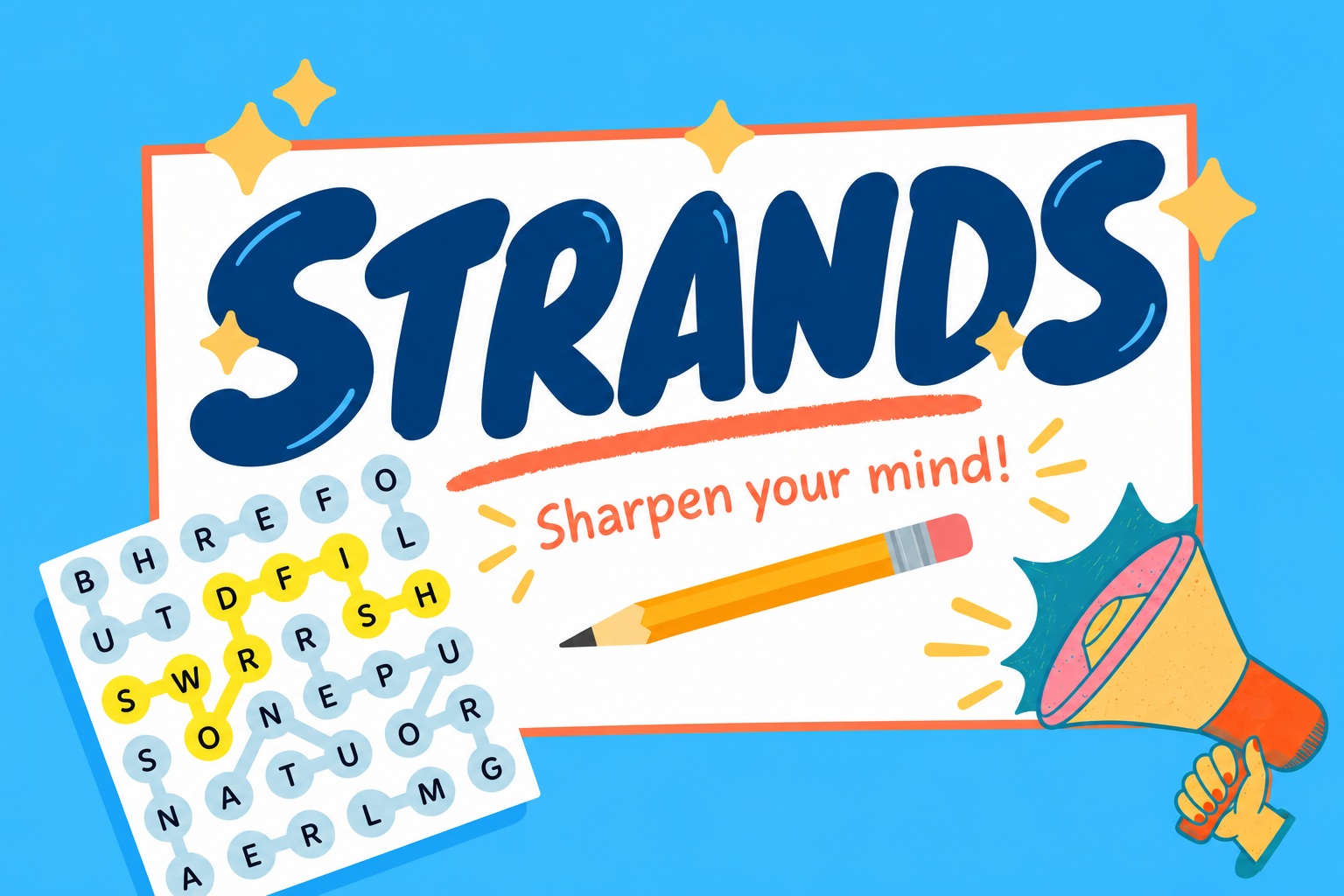
Strands takes the familiar idea of a word search and gives it a much more strategic twist. Instead of scanning a grid for words arranged neatly in straight lines, players connect adjacent letters horizontally, vertically, and diagonally to uncover words that can bend and twist across the board. Every puzzle is built around a hidden theme, so finding one correct answer often provides the clue needed to discover several more. What initially looks like a random collection of letters gradually becomes an interconnected set of themed words.
The challenge comes from combining vocabulary with deduction. Players are not simply searching for any valid word; they are trying to identify the specific answers connected to the puzzle's theme while eventually uncovering the special spangram that describes that theme. Every letter on the board belongs to one of the intended answers, meaning the completed puzzle leaves nothing unused. This creates a satisfying sense of order as the grid slowly transforms from visual chaos into a fully solved pattern.
Now playable online through Lemon Web Games, Strands brings its themed word searches, flexible letter connections, hidden spangram, hint system, and satisfying grid-solving mechanics directly into the web browser. Players can trace words through adjacent letters, use discovered answers to narrow down the remaining possibilities, and gradually reveal the relationship connecting everything on the board. Because words can change direction repeatedly, familiar word-search habits are not always enough. Success depends on noticing patterns, thinking about the theme, and learning how remaining letters might connect.
A Word Search Where Words Can Bend
Traditional word searches usually place answers horizontally, vertically, diagonally, or occasionally backward along a straight line. Strands removes that restriction.
Letters only need to be adjacent to one another, allowing the path to turn in almost any direction. A word might begin horizontally, move diagonally, turn downward, and then continue sideways before finishing.
This creates far more possibilities inside a relatively small grid. Players need to see potential paths rather than simply scanning straight rows and columns.
The 6-by-8 Grid Looks Simple but Hides Plenty of Complexity
Each puzzle uses a compact 6-by-8 arrangement of letters. Forty-eight letters may not initially look intimidating, but the number of possible connections between neighbouring tiles creates a huge search space.
The smaller board actually helps the game remain focused. Every letter eventually matters, so players can use elimination rather than searching an enormous field filled with irrelevant characters.
As more words are discovered, the remaining spaces become increasingly informative. Late in the puzzle, a strange group of unused letters may practically reveal the final answer by itself.
Every Puzzle Revolves Around a Theme
The theme is the most important clue available. Correct answers are connected conceptually rather than being a random collection of vocabulary.
A theme might relate to objects, activities, places, expressions, categories, or another shared concept. Finding the first themed word often makes the rest of the puzzle considerably easier.
The challenge is that themes can sometimes be playful or indirect. Players may need to reinterpret the clue after discovering the first few answers.
One Correct Word Can Unlock the Entire Puzzle
The beginning is often the hardest part because there are so many possible letter combinations and very little confirmed information.
Once one theme word is found, however, players can begin thinking about related vocabulary. A second correct answer may make the relationship obvious.
This produces some of Strands' most satisfying moments. What appeared completely mysterious seconds earlier can suddenly become understandable after one successful connection.
The Spangram Is the Key to Understanding Everything
Every puzzle contains a special answer known as the spangram. This word or phrase represents the overall theme rather than simply being another example within it.
The spangram connects two opposite sides of the board, making it visually distinctive once discovered. Depending on the puzzle, it may stretch from top to bottom or from one side to the other.
Finding it early can provide a major advantage because it clarifies exactly what the remaining answers should represent. Finding it late instead provides a satisfying confirmation of the theme the player has already deduced.
The Spangram Can Be More Than One Word
Players should not always assume that the spangram will be a single dictionary word. It can represent a phrase when that phrase best describes the relationship between the themed answers.
This makes searching more interesting because an apparently strange group of letters may actually be part of a longer expression.
Thinking conceptually rather than searching exclusively for standalone words is therefore important. The spangram exists to summarize the puzzle, not necessarily to behave like every other answer.
Every Letter Belongs Somewhere
One of the smartest design rules is that every tile contributes to a correct theme answer or the spangram.
There are no meaningless filler letters occupying space simply to confuse players. This makes the board increasingly solvable through elimination.
Once several answers have been removed, the remaining letters create smaller and smaller possibilities. The puzzle effectively helps solve itself as progress continues.
Unused Letters Become Clues
Players often focus entirely on the words they have already found, but the remaining letters can be even more informative.
An isolated group may strongly suggest a particular word once other tiles have been claimed. Shapes and paths formed by unused letters can also reveal how a longer answer might twist through the grid.
This makes late-game solving feel different from the opening. Early progress depends more on vocabulary, while later progress increasingly depends on spatial deduction.
Words Can Twist in Unexpected Directions
A correct answer may make several sharp turns rather than following the most obvious path.
This means recognizing the letters of a likely word is only half the challenge. Players still need to determine whether those letters actually connect legally.
Sometimes the expected path seems impossible until the board is viewed from another direction. Training yourself to follow curved letter sequences is one of the main skills Strands develops.
Diagonal Connections Are Easy to Overlook
Horizontal and vertical connections are naturally easier to notice because people are accustomed to reading in those directions.
Diagonal tiles dramatically expand the possible paths. A word that appears broken may actually continue through a corner that was initially ignored.
Checking all eight neighbouring positions around a letter can reveal answers that would otherwise remain invisible.
Starting From Unusual Letter Combinations Can Help
When the theme is unclear, it can be useful to search for distinctive letter groups rather than attempting to identify complete words immediately.
Rare letters or unusual combinations can reduce the number of plausible answers. Once a partial sequence looks promising, players can test nearby tiles to see whether it develops into something related to the theme.
This approach is especially useful when common letters create too many possibilities. Sometimes beginning with the strangest part of the grid is the easiest route forward.
Non-Theme Words Can Still Be Useful
Strands allows players to identify valid words that are not part of the actual theme set.
These discoveries may not remove tiles from the board, but accumulating enough of them can contribute toward earning a hint. This means experimentation is rarely completely wasted.
A word that turns out not to be an answer can still help indirectly. The game rewards vocabulary even when the guess does not solve the puzzle immediately.
Hints Prevent Difficult Puzzles From Becoming Dead Ends
When enough valid non-theme words have been found, players can gain access to assistance.
Hints can reveal information about one of the hidden theme words, giving players a new starting point when the board has become frustrating.
This system creates a good balance between challenge and accessibility. Players are encouraged to keep experimenting before asking for direct help.
Hints Are Most Valuable When the Theme Is Still Unclear
Using assistance immediately after finding several answers may not provide as much value as saving it for a genuine roadblock.
A single hint early in a difficult puzzle can reveal enough information to identify the theme. Once that happens, multiple additional answers may follow naturally.
Players therefore benefit from treating hints strategically. The goal is not simply revealing one word but obtaining the piece of information most likely to unlock everything else.
The Puzzle Becomes Easier as It Becomes Emptier
Unlike many games where difficulty continually increases, an individual Strands puzzle often becomes easier near completion.
Every solved word removes possibilities from the remaining grid. The final few answers may be forced almost entirely by the unused letters.
This creates a satisfying acceleration. The first answer may take several minutes, while the last three can appear within seconds once the overall structure becomes clear.
Theme Knowledge Can Be More Important Than Vocabulary
Knowing many words obviously helps, but the strongest players also understand how categories relate.
If the clue suggests a particular topic, thinking of several possible members of that category can be more effective than scanning the board randomly.
Players can then search specifically for those predicted words. The process becomes a combination of brainstorming and spatial verification.
Sometimes the Theme Clue Is Deliberately Playful
Theme clues do not always describe the answers in the most literal way possible.
A phrase may contain wordplay, double meaning, or a deliberately broad description designed to make the solution less obvious.
Players should therefore remain willing to reinterpret the clue. Discovering several answers may reveal that the original wording was pointing toward the theme from an unexpected angle.
Finding the Spangram Early Changes the Entire Experience
When the spangram appears near the beginning, the puzzle becomes much more focused.
Instead of asking, "What could these letters possibly mean?" players can ask, "Which words belong to this specific category?" That dramatically narrows the possibilities.
It can therefore be useful to occasionally search for longer paths that appear capable of stretching across the board. The spangram may be hiding in plain sight.
Finding the Spangram Last Is Equally Satisfying
Other puzzles reveal their themed words first and leave the spangram for the end.
In those cases, players already understand the category and need to identify the phrase that best summarizes everything they discovered.
The final connection often feels like completing the title of the puzzle. It provides a clean conclusion rather than simply filling the final unused letters.
There Is No Need to Solve Words in a Particular Order
Strands generally allows players to attack whichever answer they recognize first.
This freedom matters because different people notice different patterns. One player may immediately identify a long word in the centre while another begins with a short answer near the edge.
Every valid discovery contributes equally toward reducing the board. There is rarely one required route through the puzzle.
The Game Rewards Slow Observation
Although words can sometimes appear instantly, Strands rarely benefits from frantic clicking.
Spending a few moments examining letter clusters can reveal paths that were invisible while scanning too quickly.
This makes the game relaxing despite being mentally demanding. There is no need for fast reactions or precise timing.
Wrong Ideas Are Part of the Process
A sequence of letters may look promising but fail before forming a complete word. That does not necessarily mean the attempt was useless.
Testing incorrect possibilities teaches players which regions of the board are unlikely to connect in a particular way.
Because the game allows experimentation without severe penalties, players can safely explore hypotheses until something fits.
The Puzzle Encourages Pattern Recognition
Repeated play gradually changes how players view the board.
Instead of seeing isolated letters, experienced players begin noticing likely prefixes, suffixes, common letter combinations, and paths that resemble familiar words.
This skill develops naturally. The more puzzles completed, the easier it becomes to recognize how answers are likely to snake through the grid.
Strands Blends Vocabulary With Spatial Thinking
Many word games primarily test spelling or vocabulary. Strands adds a strong spatial element because knowing the correct word is useless if the letters cannot be connected correctly.
Players need to think both linguistically and geometrically.
That combination gives the game its distinctive personality. It is neither a conventional crossword nor a normal word search.
A Small Grid Can Produce a Surprisingly Long Puzzle
Because each answer can twist across multiple directions, the compact board can hide words remarkably well.
Players may stare directly at all the necessary letters without recognizing the path connecting them.
This makes successful discoveries especially rewarding. The answer was always visible; the challenge was learning how to see it.
Completed Boards Feel Extremely Satisfying
When the final word is found, every letter has been assigned and the entire puzzle becomes organized.
There is something particularly satisfying about seeing a previously confusing grid transformed into clearly defined word paths.
The completed board demonstrates that the puzzle was carefully constructed rather than randomly generated. Every tile had a purpose from the beginning.
Strands Works Well for Short Sessions
A single puzzle provides a complete experience without requiring a lengthy campaign or complicated setup.
Players can spend a few minutes finding obvious words or remain with a difficult puzzle until every answer is discovered.
This compact structure makes Strands especially comfortable as a browser game. Starting another puzzle requires very little commitment.
It Is Also Excellent for Relaxed Brain Training
Strands exercises vocabulary, pattern recognition, association, and spatial reasoning without feeling like a formal educational exercise.
Players naturally practise these skills simply by trying to uncover the theme.
Because there is no combat, timer pressure, or complex controls, the game works well when something mentally engaging but physically relaxing is desired.
Playing Strands Online Today
Through Lemon Web Games, Strands can now be played directly in your web browser with no downloads or setup required. Features of the web-based version include:
New players should begin by searching for any recognizable themed word rather than immediately attempting to identify the spangram. One confirmed answer can reveal enough context to make the rest of the theme much easier to understand. If nothing obvious appears, look for distinctive letter combinations and remember that words can change direction repeatedly.
As the puzzle fills, pay increasing attention to unused tiles. Since every letter belongs to a correct answer, the remaining shapes often provide stronger clues than the original full grid. The final words may effectively reveal themselves through elimination.
Who Should Play Strands
Strands is particularly suitable for players who find conventional word searches too predictable. Allowing words to bend across the grid creates enough additional complexity to make every discovery feel earned.
It should also appeal to players who enjoy uncovering themes. The connection between answers provides an extra layer of deduction beyond simply identifying words.
Play Strands Online Now
Strands turns a small grid of letters into a surprisingly deep word puzzle. Connect neighbouring letters in any direction, uncover the hidden theme words, use non-theme discoveries to earn hints, and search for the spangram that explains how everything fits together.
Through Lemon Web Games, players can experience Strands directly in the browser and tackle each board entirely at their own pace. What begins as forty-eight seemingly unrelated letters gradually becomes a carefully constructed network where every tile belongs somewhere.
Final Thoughts
Strands succeeds because it takes the instantly familiar idea of a word search and changes one fundamental rule. Allowing words to bend across adjacent letters transforms a simple scanning exercise into a genuine puzzle involving vocabulary, spatial reasoning, theme recognition, and deduction.
The spangram gives each board a particularly satisfying structure. Instead of finding unrelated answers, players are gradually uncovering pieces of one larger idea. Every solved word makes that idea clearer until the entire grid finally fits together.
Through Lemon Web Games, Strands can now be enjoyed directly in the browser as a relaxing but surprisingly thoughtful word challenge. Its controls are simple, its boards are compact, and there is no need to rush, yet a difficult theme can still demand serious concentration. For players who enjoy discovering order inside a seemingly random collection of letters, Strands offers exactly the right kind of puzzle.











Comments 0