


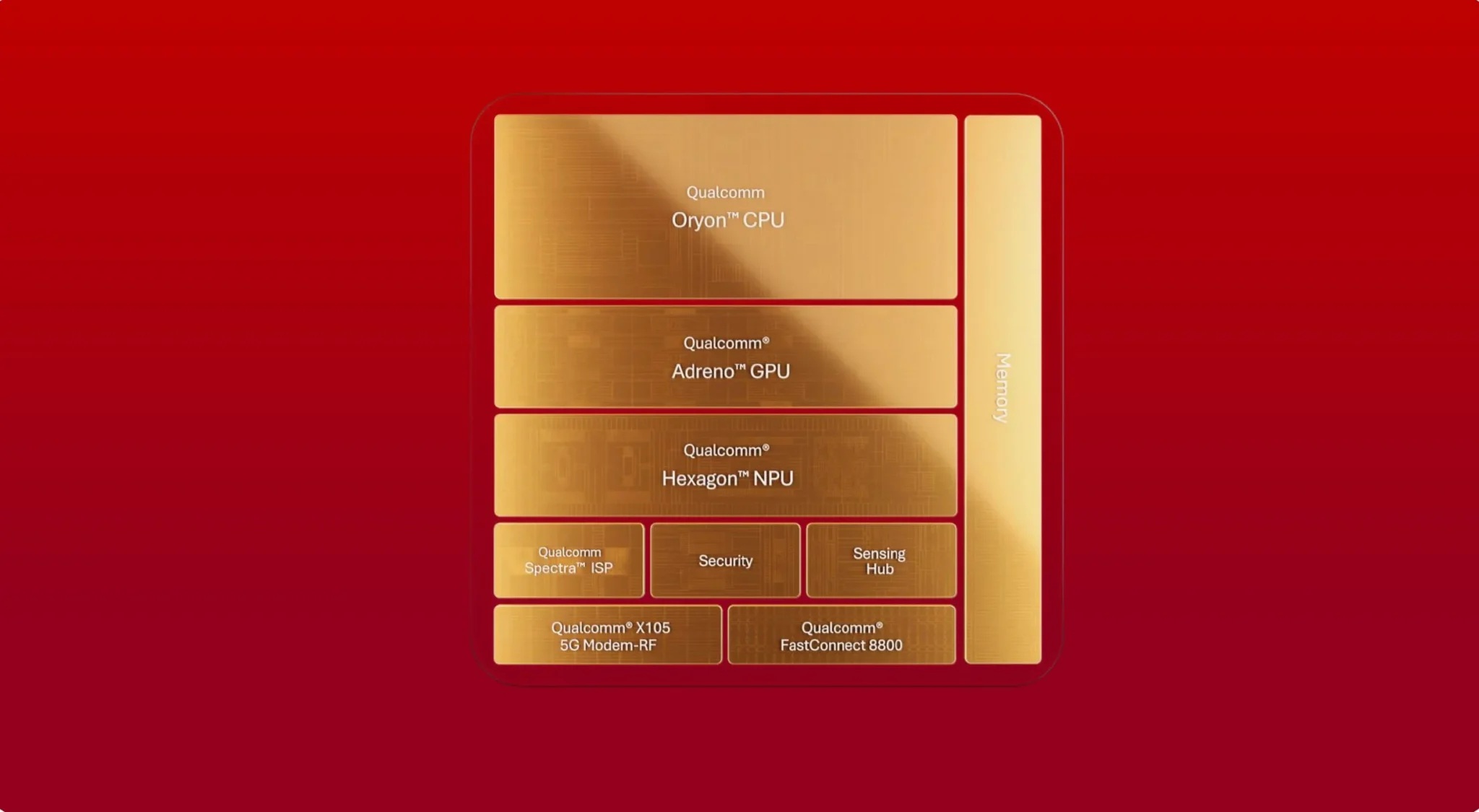
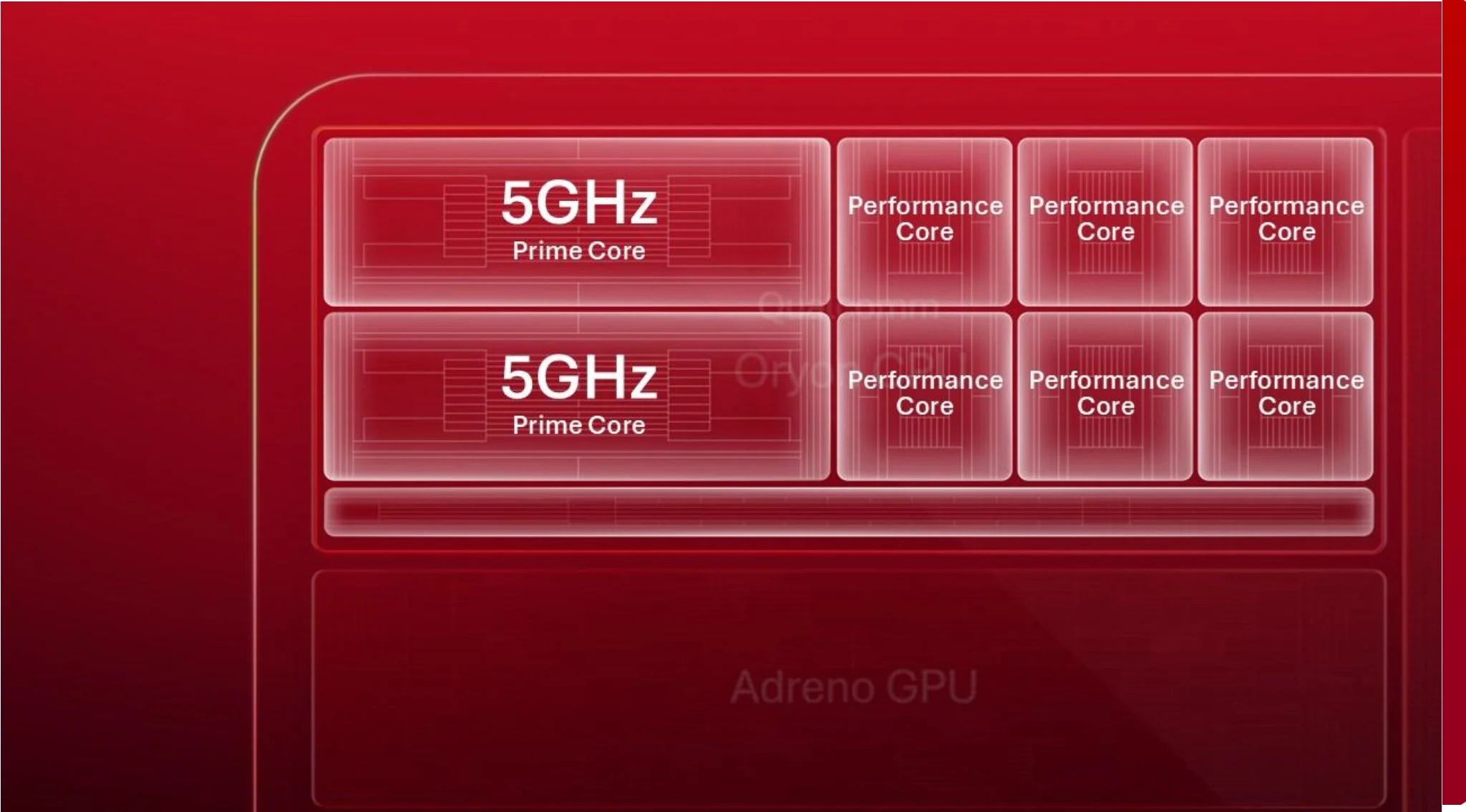
Qualcomm has started revealing some of the technology behind its next-generation Snapdragon flagship processor, even though the company has yet to officially confirm the final product name. One of the biggest upgrades is already clear: the next generation of Qualcomm Oryon CPU cores will be capable of reaching clock speeds of up to 5GHz, setting a new milestone for the company's mobile processors.
Qualcomm says the upcoming platform will use a configuration consisting of two Prime cores and six Performance cores, with its highest-performance cores capable of reaching that 5GHz figure.
Oryon Reaches the 5GHz Milestone
Reaching 5GHz inside a smartphone-class processor is notable because mobile chips operate under much tighter thermal and power limitations than desktop CPUs.
A desktop processor can rely on large heatsinks, active cooling and significantly higher power consumption.
A smartphone has none of those luxuries.
Qualcomm says the achievement is not simply the result of moving to a newer manufacturing process.
Instead, the company credits the milestone to its increasingly customised Oryon CPU architecture.
Because Qualcomm controls the microarchitecture, implementation choices and wider CPU subsystem, it can optimise the different parts of the processor together rather than relying entirely on an off-the-shelf CPU design.
According to the company, that level of control is what allows its next-generation mobile CPU to reach 5GHz while still operating within the constraints of a smartphone chipset.
Qualcomm Is Betting Heavily on Custom CPU Design
Oryon has become increasingly important to Qualcomm's processor strategy.
Rather than simply using standard CPU designs and adapting them for Snapdragon products, Qualcomm has been investing in its own custom CPU architecture.
That gives the company greater freedom to determine how the processor behaves across different workloads.
Clock speed is only one part of that equation.
Efficiency, cache design, instruction scheduling and how performance cores interact with the rest of the system can all influence real-world performance.
The 5GHz number will inevitably attract attention, but Qualcomm is also introducing architectural changes that could have a larger impact on how the processor behaves during demanding tasks.
One of those changes is a new technology called Oryon FlexCache.

Introducing Oryon FlexCache
The upcoming Snapdragon platform will introduce a redesigned cache architecture known as Qualcomm Oryon FlexCache.
Cache is extremely fast memory located close to the CPU.
Processors use it to keep frequently accessed data nearby rather than repeatedly retrieving everything from slower system memory.
The more effectively a processor can manage its cache, the less time its cores may spend waiting for information.
Qualcomm says FlexCache allows different types of Oryon CPU cores to access a shared cache pool, with capacity dynamically allocated depending on the workload.
Instead of assigning rigid amounts of cache to specific cores, the architecture can adjust where resources are needed.
This should theoretically make the processor more responsive when workloads suddenly become more demanding.
FlexCache Can Adapt to Heavier Workloads
Qualcomm describes the system as dynamically scaling according to workload requirements.
If an application demands additional processing resources, FlexCache can allocate more of the available cache to the cores performing that work.
This could help prevent performance from falling away as applications become more demanding.
Rather than having a workload exceed the resources originally available to one section of the CPU, the architecture can adapt and make better use of the shared cache.
That kind of flexibility could be particularly important for modern smartphones, where applications increasingly jump between very light workloads and extremely demanding tasks.
One moment the processor may simply be handling messaging and background notifications.
A few seconds later, the same device could be processing an AI model, rendering a game or exporting a high-resolution video.
Agentic AI Is One of the Main Targets
Unsurprisingly, Qualcomm is highlighting agentic AI as one of the workloads expected to benefit from the new architecture.
Smartphone manufacturers are increasingly interested in AI systems capable of doing more than generating text or editing photographs.
Agentic AI can potentially perform several steps in sequence, interact with applications and make decisions based on the task it has been given.
Those workloads can involve sustained CPU, GPU and neural-processing activity.
A processor capable of dynamically allocating cache and maintaining higher performance could therefore become increasingly valuable as more AI processing happens directly on the device.
Qualcomm has already been pushing on-device AI heavily across its Snapdragon platforms, so the next-generation Oryon CPU appears to continue that direction.
Gaming Should Also Benefit
Gaming is another area Qualcomm specifically mentions.
Modern mobile games are becoming increasingly demanding, with higher-resolution textures, more advanced physics, larger environments and increasingly sophisticated graphics.
The GPU naturally handles much of the rendering work, but the CPU remains responsible for areas such as game logic, physics calculations, background simulation and feeding information to the GPU.
A faster CPU with improved cache behaviour can therefore contribute to smoother overall performance.
The 5GHz peak clock speed will undoubtedly become a major marketing point for gaming-focused smartphones.
However, sustained performance will matter more than the peak number.
If the processor can reach 5GHz briefly but immediately throttle because of heat, the practical advantage may be limited.
FlexCache and Qualcomm's broader CPU optimisations may therefore prove more important than the headline clock speed itself.
Multitasking Is Becoming More Demanding
Qualcomm also says the new platform will bring improvements to multitasking.
Modern smartphones already run large numbers of processes simultaneously.
Users may move between messaging apps, browsers, cameras, social media, games and productivity software while numerous background services continue operating.
Foldable smartphones make multitasking even more important because their larger displays increasingly allow several applications to remain visible simultaneously.
A processor capable of dynamically sharing cache resources among heterogeneous cores could potentially handle these workloads more efficiently.
Rather than giving every application the same amount of processing attention, the system can concentrate resources where demand is highest.
That could improve responsiveness when switching applications or running several demanding tasks at once.
Video Editing Is Another Major Focus
Mobile video editing has also become far more sophisticated.
Smartphones can now capture high-resolution HDR footage, high-frame-rate video and increasingly advanced codecs.
Users are also editing more content directly on their phones instead of transferring everything to a PC.
That places sustained pressure on multiple parts of the processor.
Video editing may involve decoding footage, applying effects, processing AI enhancements and encoding the final result.
Qualcomm says the combination of its next-generation Oryon CPU and FlexCache architecture will improve these kinds of workloads.
If the processor can maintain stronger performance for longer periods, export times and editing responsiveness could potentially improve significantly.
5GHz Does Not Tell the Whole Performance Story
While reaching 5GHz is impressive, raw clock speed alone does not determine how fast a processor actually feels.
Two CPUs operating at exactly the same frequency can deliver very different performance depending on their architecture.
Factors such as instructions per clock, cache efficiency, memory latency and power management all matter.
That is why Qualcomm's emphasis on the fully custom nature of Oryon is significant.
The company is not simply increasing frequency.
It is redesigning the CPU subsystem around that performance target.
The real question will be how much additional performance the new architecture delivers while remaining efficient enough for everyday smartphone use.
Battery life and thermal behaviour will be just as important as benchmark scores.
Qualcomm Is Preparing for Its Annual Snapdragon Summit
The company has not yet revealed every detail about the processor.
More information is expected to arrive over the coming weeks as Qualcomm approaches its annual Snapdragon Summit.
That event traditionally serves as the main showcase for Qualcomm's flagship mobile processor technology.
We can therefore expect additional details surrounding the CPU architecture, GPU, AI processing, connectivity and overall platform efficiency closer to the event.
Smartphone manufacturers using the new Snapdragon platform will likely begin announcing their own flagship devices soon afterwards.
Competition in Mobile Silicon Is Getting Fiercer
Qualcomm's push toward 5GHz comes at a time when competition across mobile processors is becoming increasingly intense.
Apple continues developing its own A-series processors, while MediaTek has become increasingly competitive in flagship Android devices.
Samsung continues working on Exynos, while companies such as Xiaomi are also investing in custom silicon.
That means Qualcomm can no longer rely simply on incremental annual improvements.
Custom CPU architectures such as Oryon give the company greater control over how its processors compete across performance, AI capability and efficiency.
Reaching 5GHz makes for an attention-grabbing headline, but the larger story is Qualcomm's increasingly deep control over its own CPU technology.
Final Thoughts
Qualcomm's next-generation Snapdragon platform is shaping up to deliver one of the company's biggest CPU upgrades yet.
Its new Oryon cores will reportedly become the first mobile CPU from the company to reach 5GHz, using a configuration of two Prime cores and six Performance cores.
But the more interesting development may be Oryon FlexCache, which dynamically shares cache resources across different CPU cores depending on workload demands.
Qualcomm says the architecture will help improve areas including agentic AI, gaming, multitasking and video editing.
The 5GHz milestone will inevitably dominate the headlines, but sustained performance, efficiency and thermal management will determine whether the new Snapdragon platform actually feels significantly faster in everyday use.
With Qualcomm promising more details ahead of its annual Snapdragon Summit, we should soon get a clearer picture of whether this next-generation Oryon architecture represents another incremental upgrade — or a much bigger leap for mobile processing performance.











Comments 0