

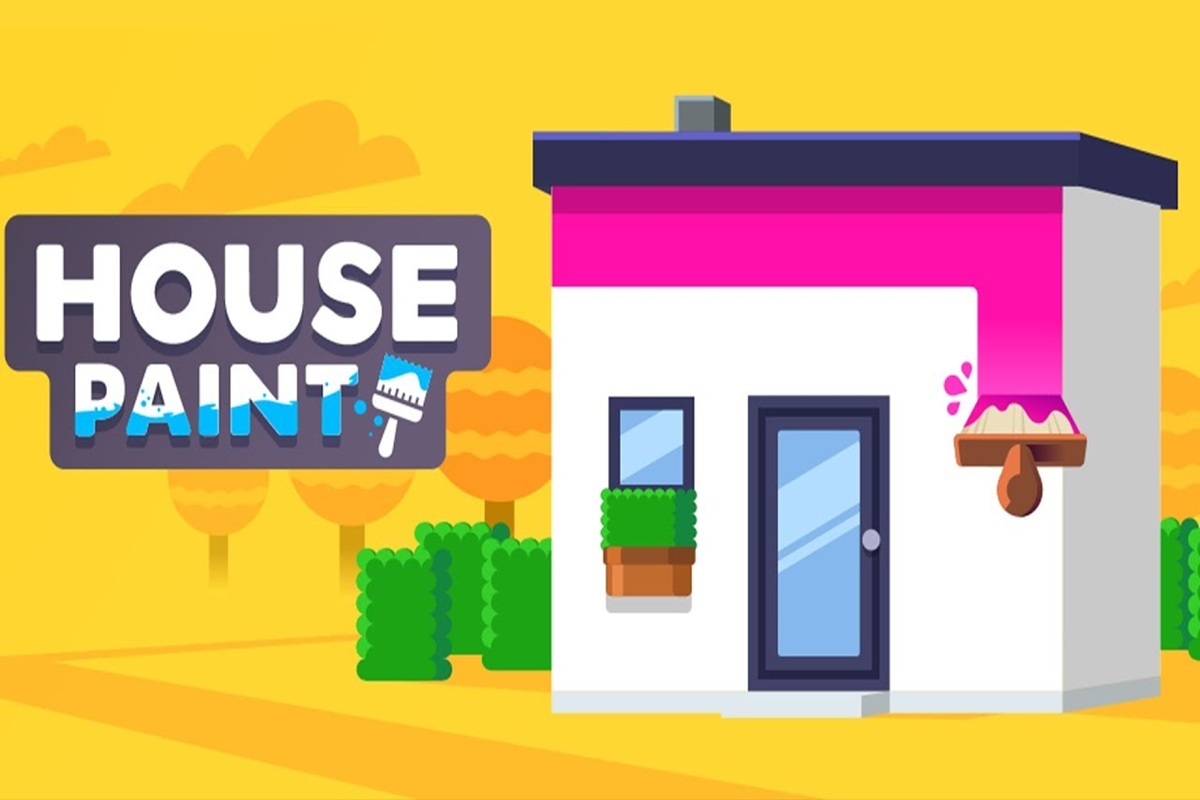
House Paint is a relaxing puzzle game where the goal is to transform plain white houses into colorful finished homes by moving a paint sponge across every unpainted section of the wall. The controls are extremely simple because the sponge moves with directional swipes, but completing each stage becomes more interesting once walls contain corners, windows, obstacles, and awkward sections that cannot be covered in a single movement. Every level asks the player to find an efficient route that reaches every remaining white area without getting stuck in an inconvenient position. The result is an easy-to-understand puzzle experience that combines simple movement with the satisfying visual reward of watching an entire building gradually fill with color.
The appeal of House Paint comes from how quickly it turns a basic painting idea into a small spatial puzzle. The sponge continues moving in a straight line until it reaches an edge or obstruction, so players need to think about where each swipe will leave it before making the next move. Early levels can be completed almost instinctively, but more complicated layouts gradually encourage better route planning and a stronger understanding of how the sponge moves around the wall. This balance between accessibility and light problem solving makes the game suitable for quick casual sessions while still giving players something to think about.
Now playable online through Lemon Web Games, House Paint can be experienced directly in your web browser as part of a growing collection of puzzle, casual, relaxing, arcade, color, and browser-playable games. Its short levels and straightforward controls make it especially well suited to browser play because there is almost no learning curve before the first house can be painted. Players can complete a few stages during a short break or continue much longer while progressing through increasingly varied wall layouts. Whether you enjoy puzzle solving, satisfying visual transformations, or simple games that are easy to pick up, House Paint provides a calm and rewarding experience.
A Puzzle Game Built Around Complete Coverage
The basic objective in House Paint is to cover every white section of the wall. That sounds extremely simple, but the sponge cannot usually be placed freely wherever the player wants. Instead, each swipe sends it moving in a straight line until something stops it, meaning the position where one movement ends determines what becomes possible next. This turns the act of painting into a route-planning puzzle rather than a freehand coloring activity.
Every successful swipe changes the state of the wall and reveals which sections still need attention. Large open areas are easy to cover, but narrow strips or isolated corners can be much more troublesome if the sponge approaches them from the wrong direction. Players therefore begin looking ahead instead of simply swiping toward the nearest white space. The challenge comes from reaching complete coverage while adapting to the shape of each house.
The Sponge Moves Until Something Stops It
One of the most important mechanics to understand is that the paint sponge does not stop halfway through a movement. Once a direction is chosen, it keeps travelling until it reaches the edge of the wall or another obstacle. This makes every swipe predictable, but it also means players cannot correct a poor decision until the movement has finished. The game becomes much easier once this rule is treated as the foundation of every puzzle.
Predictable movement is what allows players to plan several swipes ahead. If you know exactly where the sponge will finish, you can already think about which direction should follow next. This creates a smooth rhythm when the route is understood, allowing the sponge to move around the house almost continuously. A good solution often feels satisfying because each swipe seems to naturally lead into the next.
White Areas Show Exactly What Still Needs Work
House Paint communicates progress very clearly by leaving unpainted sections white. Players can immediately see which parts of the wall have already been covered and which still need attention. This simple visual language prevents confusion and allows the puzzle itself to remain the focus. There is never much doubt about what the objective is because any remaining white space represents unfinished work.
As the wall becomes more colorful, the remaining gaps become easier to identify. Sometimes only a tiny section remains, forcing the player to work out how to return the sponge to the correct position. These final pieces can be more challenging than painting the majority of the house because previous movements may have left the sponge somewhere awkward. Completing the last white patch therefore provides a surprisingly strong sense of satisfaction.
Windows and Obstacles Change the Route
Windows and other wall features prevent the sponge from moving freely across the entire surface. These obstacles break large areas into smaller sections and create boundaries that determine where the sponge can stop. Rather than being purely decorative, they become an important part of the puzzle layout. A window may block one approach while creating exactly the stopping point needed to reach another difficult section.
More complicated houses use these obstacles to create routes that are not immediately obvious. Players may need to move away from an unfinished area before approaching it from another side. This encourages experimentation without making the controls more complicated. The puzzle grows through smarter level design rather than adding unnecessary buttons or mechanics.
Corners Require Careful Positioning
Corners are often where the route planning becomes most noticeable. A narrow corner may be easy to paint if the sponge approaches from the correct direction, but difficult to reach after other parts of the wall have already been completed. Players soon learn that certain sections should be handled early because leaving them until the end can make the route less convenient. This creates a subtle sense of strategy beneath the game's casual presentation.
The best solutions often involve thinking about where the sponge needs to be after each swipe rather than focusing only on what gets painted immediately. A movement that covers a large area can still be a poor choice if it leaves the sponge unable to access a troublesome corner. Recognizing this difference between immediate progress and good positioning is part of mastering the game. It gives even small levels more depth than they first appear to have.
Simple Controls Make the Game Easy to Learn
House Paint requires very little explanation because the controls are based on simple directional swipes. There are no complicated menus, character abilities, or long tutorials standing between the player and the puzzle. Within a few moments, anyone can understand that the goal is to move the sponge around until the wall is completely painted. This accessibility is one of the game's strongest qualities.
Simple controls also make the game suitable for a wide range of players. Casual players can enjoy the visual satisfaction without worrying about complex mechanics, while puzzle fans can focus on finding cleaner and more efficient routes. Because the difficulty comes from the level layouts rather than the input system, the game can become more challenging without becoming harder to control. That keeps the experience approachable even as the puzzles grow more involved.
Painting Feels Visually Rewarding
One of the most satisfying parts of House Paint is the immediate visual feedback produced by every successful movement. White sections are replaced with bright color as the sponge passes over them, making progress easy to see and pleasant to watch. The transformation from an unfinished wall into a fully colored house gives each level a clear before-and-after effect. This makes completion feel rewarding even when the puzzle itself is relatively simple.
The painting effect also helps create a relaxing rhythm. Each swipe produces visible progress, so the player is constantly receiving small signs of success. There is something inherently satisfying about filling an empty surface cleanly and completely. House Paint builds almost its entire presentation around that simple pleasure.
The Game Encourages Experimentation
Not every level requires players to discover the perfect route immediately. Trying a direction and seeing where the sponge ends can reveal useful information about the layout. Because the rules are consistent, failed approaches are easy to understand and usually provide clues for the next attempt. This makes experimentation feel natural rather than frustrating.
Players gradually begin predicting the results of moves without needing to test them first. What starts as trial and error becomes deliberate planning as familiarity grows. This transition is one of the game's most satisfying forms of progression because it comes from understanding the movement system rather than unlocking new abilities. The player simply becomes better at seeing the route.
Short Levels Keep the Pace Comfortable
House Paint is structured around compact stages that can usually be completed without a large time commitment. This makes it easy to play one or two puzzles whenever there is a spare moment. At the same time, finishing a level quickly creates a natural desire to continue into the next one. The short format encourages repeated play without making any single puzzle feel exhausting.
This pacing works especially well for a relaxing game. Players can stop whenever they want without feeling as though they are abandoning a long mission or complicated objective. Returning later is equally easy because the controls and goal are immediately understandable. House Paint therefore fits naturally into both brief and extended gaming sessions.
Increasing Complexity Keeps the Concept Interesting
The early levels focus mainly on teaching movement and allowing players to enjoy the painting effect. As new houses appear, their wall shapes become more complicated and the number of awkward sections increases. This gradual progression introduces challenge without suddenly changing the fundamental rules. Players continue doing the same basic actions but need to think more carefully about how those actions are combined.
This is an effective way to build difficulty because the player never feels as though they need to learn an entirely different game. Greater complexity comes from smarter layouts, more obstacles, and less obvious routes. The simple movement system remains familiar throughout. That consistency helps House Paint maintain its relaxing character even when a stage requires more thought.
Planning Ahead Reduces Unnecessary Swipes
Although the main objective is simply to paint everything, experienced players naturally begin thinking about efficiency. A route that constantly revisits the same areas may still succeed, but a cleaner sequence of swipes feels much more satisfying. Looking ahead helps reduce unnecessary movements and makes the entire process smoother. This creates an optional layer of optimization for players who enjoy refining their solutions.
Efficient play also demonstrates a stronger understanding of the puzzle. When every swipe has a clear purpose, the sponge appears to flow naturally around the wall. Reaching complete coverage with a clean route can feel almost like solving a small maze. This gives players another reason to replay or rethink a level beyond merely finishing it.
The Game Is Relaxing Without Being Completely Mindless
House Paint is often calming because there are no enemies, combat sequences, or complicated time pressures demanding constant attention. Players can focus on one small visual problem at a time and enjoy the gradual transformation of the house. However, the route-planning mechanics ensure that the experience still requires some thought. This makes it more engaging than simply dragging color freely across a picture.
The level of concentration can vary depending on the puzzle. Some stages can be completed almost automatically, while others encourage players to pause and consider the next few movements. This variation helps maintain interest without turning the game into a stressful challenge. It sits comfortably between a traditional logic puzzle and a simple satisfying activity.
Mistakes Are Easy to Recover From
A poor swipe rarely creates a long-term problem because the player can continue moving and look for another route toward the remaining white areas. This forgiving design keeps frustration low and encourages experimentation. Even if a level takes several extra movements, progress is rarely completely lost. The game remains focused on eventual completion rather than punishing imperfect play.
This makes House Paint particularly welcoming for younger or more casual players. There is little pressure to perform perfectly, yet players can still challenge themselves to find more elegant solutions if they choose. The ability to recover from mistakes helps preserve the relaxing tone. It also means difficult sections feel approachable rather than intimidating.
Bright Colors Give Every Completion a Clear Reward
The colorful presentation plays a major role in making the game satisfying. Each level begins with large white surfaces that gradually become bright and complete as the sponge moves across them. By the time the puzzle is solved, the house looks noticeably different from where it started. This clear visual transformation acts as an immediate reward for finishing the route.
Color also keeps repeated stages from feeling too visually dull. Even though the same basic mechanic is used throughout, the changing houses and bright painted surfaces create a cheerful atmosphere. The game feels more like completing a colorful craft project than solving a dry logic exercise. That presentation contributes strongly to its casual appeal.
The Puzzle Is About Positioning as Much as Painting
New players often concentrate entirely on covering white spaces, but positioning becomes increasingly important as layouts grow more complex. Where the sponge finishes after a swipe determines what it can reach next, so a move that paints a large area may not always be strategically useful. Good positioning often matters more than immediate coverage. This makes the game feel closer to a movement puzzle than a traditional painting activity.
Once players understand this, they begin thinking in sequences rather than individual swipes. The question changes from "Which white area should I paint next?" to "Where do I need to finish this move so I can reach the next section?" This small shift in thinking makes harder levels much easier to solve. It also reveals more depth in the game's simple design.
There Is Satisfaction in Complete Coverage
Humans naturally tend to notice unfinished patterns, and House Paint uses that instinct extremely well. A single remaining white square can become impossible to ignore once the rest of the house has been painted. Completing that final section creates a strong sense of closure because the entire surface suddenly looks finished. The game repeatedly uses this simple visual reward to encourage players through level after level.
That sense of completion is one of the reasons the game can become addictive. Finishing one house feels neat and satisfying, which immediately creates curiosity about the next layout. Players are not chasing complicated rewards; they are chasing the feeling of making something complete. Sometimes the simplest goals are the easiest to repeat.
Why House Paint Works So Well as a Casual Game
House Paint understands that casual games benefit from immediacy. The player can recognize the objective, learn the controls, and make meaningful progress within seconds. There is no need to remember complicated systems between sessions, which makes returning to the game effortless. This accessibility allows the puzzle design itself to remain the main attraction.
At the same time, the game includes enough structure to avoid feeling like a completely passive activity. Players still need to choose routes, manage positioning, and solve increasingly unusual wall layouts. That combination of simplicity and light strategy is ideal for casual play. It provides just enough challenge to remain engaging without demanding constant intense concentration.
A Good Fit for Touch and Browser Play
Swipe-based movement feels particularly natural for a game about directing a sponge around a flat surface. The same straightforward input also adapts well to browser play because it does not require a complicated control setup. Players can focus on the wall rather than worrying about remembering numerous commands. This directness makes the experience easy to understand across different devices.
Browser access also complements the short-level structure. House Paint does not require lengthy preparation before becoming enjoyable, so players can begin solving puzzles almost immediately. That makes it particularly suitable when someone wants a quick and relaxing game without installing anything. The interaction remains simple while the level designs provide the variety.
Why House Paint Still Feels Fun
House Paint remains enjoyable because it turns a very ordinary activity into a clean and satisfying puzzle mechanic. Painting a wall is normally repetitive work, but restricting how the sponge moves transforms the process into a spatial challenge. Every finished house provides both a solved puzzle and a clear visual transformation. That combination makes success feel immediate and easy to appreciate.
The game also benefits from allowing players to approach it at their own pace. There is room for casual experimentation, but players who prefer efficiency can look for cleaner routes and fewer unnecessary movements. This flexibility helps the same simple concept appeal to different types of players. Whether you are solving carefully or simply enjoying the painting effect, the central loop remains satisfying.
Playing House Paint Online Today
Through Lemon Web Games, House Paint can now be played directly in your web browser with no downloads or setup required. Features of the web-based version include:
• Browser-based play for quick access
• No installation required
• Simple directional swipe controls
• Puzzle stages built around complete wall coverage
• Windows, corners, edges, and obstacles that influence movement routes
• Bright and satisfying painting effects with short, casual-friendly levels
• Accessible play through Lemon Web Games
Playing House Paint online today makes it easy to jump directly into a relaxing puzzle without spending time learning complicated systems. The browser format suits the game particularly well because every level can be understood at a glance and completed using only a few simple directional movements. Players can enjoy the game casually or focus more carefully on planning efficient routes through increasingly complicated wall designs.
Who Should Play House Paint
• Players who enjoy relaxing puzzle games
• Fans of casual swipe-based and color-filling challenges
• Players who like short levels that can be completed in quick sessions
• Fans of satisfying visual transformations and complete-coverage puzzles
• Players who enjoy light route planning without complicated controls
• Anyone looking for a browser game that is simple to learn but still encourages thoughtful movement
House Paint is particularly suitable for players who want something calm and accessible without giving up all sense of challenge. Its simple controls make it easy for almost anyone to start playing, while the more complicated wall layouts provide enough variety to keep puzzle fans interested. The combination of bright colors, clear objectives, and forgiving gameplay makes it a strong choice for casual browser sessions.
Play House Paint Online Now
House Paint is now available to play online through Lemon Web Games, giving players an easy way to experience this colorful puzzle game directly in the browser. Its web-based format makes it possible to start painting almost immediately, with no complicated setup standing between the player and the first puzzle. Every level presents another plain house waiting to be transformed through careful swipes and complete wall coverage.
For players exploring the Lemon Web Games library, House Paint offers a relaxing alternative to action-heavy or competitive games. The challenge comes from understanding movement, planning routes, and reaching every remaining white area rather than reacting quickly to enemies or racing against complicated objectives. Whether you play only a few stages or continue through many houses in one session, the steady cycle of planning, painting, and completing each wall remains satisfying.
Final Thoughts
House Paint succeeds because it takes an extremely simple concept and gives it just enough structure to become genuinely engaging. Swiping a sponge across a wall is easy to understand, but the movement restrictions, obstacles, corners, and positioning requirements transform each house into a small spatial puzzle. Players gradually become better at recognizing efficient routes, anticipating where the sponge will stop, and avoiding awkward unfinished sections. The result is a game that feels relaxing without becoming completely passive.
Its greatest strength is the satisfaction of watching a plain white house slowly become complete. Every swipe produces visible progress, while the final remaining patch creates a strong sense of anticipation before the level is finished. The bright presentation, short stages, and forgiving design make the experience easy to return to whenever you want something simple and calming. At the same time, more complicated layouts provide enough problem solving to keep the game interesting.
Through Lemon Web Games, House Paint becomes easy to access and enjoy directly in the browser. It remains a strong choice for players who enjoy casual puzzles, relaxing games, color-filling challenges, and short experiences that reward careful movement. For anyone looking for a browser-playable game built around simple swipes, clever routes, complete coverage, and the satisfying transformation of plain houses into colorful finished designs, House Paint delivers exactly that.











Comments 0