

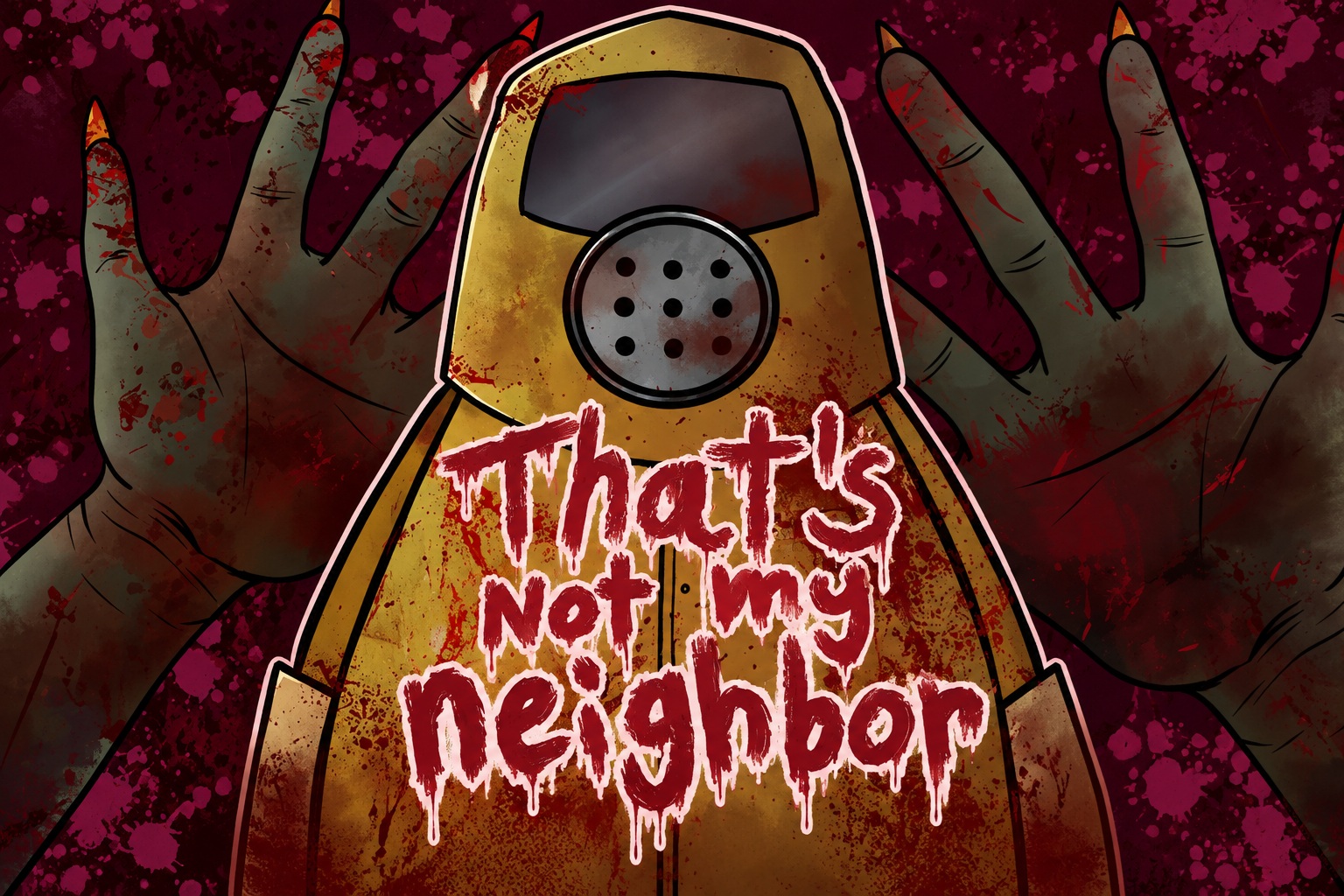
That's Not My Neighbor transforms an ordinary apartment-building job into a tense psychological horror experience where a single overlooked detail can have deadly consequences. Set in an alternate version of 1955, the world has become plagued by doppelgangers capable of closely imitating ordinary people, forcing authorities to establish the Doppelganger Detection Department, or D.D.D. You work behind the front desk of an apartment building and are responsible for deciding who is allowed through the entrance. Every visitor may look completely normal at first glance, but something as small as an incorrect name, unusual facial feature, mismatched apartment number, or suspicious document can reveal that the person standing in front of you is not who they claim to be.
The concept feels simple at first: check identification, compare information against resident files, inspect the visitor's appearance, confirm whether they are expected to enter, and make a decision. That simplicity quickly turns into paranoia as residents arrive one after another and increasingly convincing impostors begin testing how carefully you are paying attention. Some doppelgangers make obvious mistakes, while others reproduce their target so convincingly that only a tiny inconsistency gives them away. The player is therefore constantly forced to decide whether something genuinely looks suspicious or whether they are becoming overly cautious.
Now playable online through Lemon Web Games, That's Not My Neighbor brings its document-checking horror, suspicious residents, deceptive doppelgangers, telephone verification, D.D.D. intervention, and unsettling 1950s atmosphere directly into the web browser. Players need to inspect every visitor carefully, compare their details against official records, contact apartments when necessary, and decide whether to approve entry or report a possible impostor. The mechanics are simple enough to understand almost immediately, but the pressure increases dramatically once the game starts presenting near-perfect duplicates. For players who enjoy observation games where attention to detail matters more than reflexes, That's Not My Neighbor creates an unusually effective combination of deduction, dark humor, and psychological tension.
A Doorman Job With Deadly Responsibility
The player's job is technically straightforward. Residents approach the reception window, present themselves for entry, and expect to be allowed into the building. Under normal circumstances, this would involve little more than recognizing the people who live there. The doppelganger crisis changes everything.
Every person needs to be treated as a potential threat until their identity has been verified. The player becomes the building's first and most important line of defense. Letting a genuine resident enter is routine, but accidentally allowing a doppelganger through can place everyone inside the building at risk.
This creates tension from the very first shift. The player cannot simply assume familiar-looking faces are safe. Appearance is only one part of the verification process, and trust becomes increasingly dangerous.
The D.D.D. Exists Because Doppelgangers Are Everywhere
The Doppelganger Detection Department provides the larger context for the game's unusual world. Doppelgangers have become common enough that a dedicated organization is required to identify and eliminate them. Apartment buildings therefore operate under strict entry procedures rather than allowing residents to simply walk inside. The player's desk effectively becomes a security checkpoint.
The D.D.D. is contacted whenever a visitor appears to be an impostor. Instead of confronting the suspected creature directly, the doorman reports the situation and allows specialists to handle the threat. This creates an additional layer of procedure around the player's decisions. Suspicion needs to lead to action.
The organization also contributes heavily to the game's unsettling atmosphere. Its existence implies that the problem extends far beyond this one building. The strange faces appearing at the reception window are part of a much larger crisis.
Resident Records Become Your Most Important Tool
The building contains legitimate residents who are documented through official records. These files provide essential information such as names, appearances, apartment details, and other identifying information. Whenever someone arrives, the player can compare what they see and what has been presented against these records. A mismatch can be the first warning sign.
This turns information management into the foundation of the gameplay. Instead of fighting monsters directly, players compare details. A suspicious photograph, incorrect apartment assignment, or unfamiliar name can be as important as any weapon in a conventional horror game.
The challenge becomes increasingly psychological because the player needs to remember what has already been checked. Repeatedly moving between documents and the person standing at the window can create uncertainty. The more similar everything appears, the more carefully the information needs to be examined.
Identification Documents Cannot Always Be Trusted
Visitors can present identification that appears completely legitimate at first glance. Names, photographs, numbers, and other information may seem correct, encouraging the player to approve entry quickly. Doppelgangers exploit exactly that confidence. A convincing document can still contain one subtle mistake.
The player therefore needs to compare the document against the official resident information rather than assuming paperwork is automatically valid. Even small inconsistencies matter. A person can look perfect while carrying incorrect identification, or possess apparently correct paperwork while looking slightly different from the real resident.
This constant contradiction between visual appearance and documented information creates much of the game's tension. Neither source can be considered completely reliable on its own. Verification requires comparing everything together.
The Daily Entry List Provides Another Layer of Verification
Another important question is whether the visitor is actually expected to enter the building that day. A resident may exist in the official records, but that does not automatically mean the person standing outside should be returning at that particular moment. Checking the daily information can therefore reveal suspicious activity. The player needs to consider context as well as identity.
This makes the verification process more interesting than simply matching faces. Several pieces of evidence need to agree before the visitor can be considered safe. When one detail conflicts with another, further investigation may be necessary.
Doppelgangers can exploit the fact that players naturally become more comfortable after recognizing a familiar resident. The game repeatedly punishes assumptions. Recognition should begin the verification process rather than end it.
Small Facial Differences Can Reveal an Impostor
Some doppelgangers are surprisingly poor imitations. Their appearance may contain obvious distortions, strange expressions, unnatural features, or characteristics that clearly do not match the resident file. These visitors are easier to identify and often provide a brief moment of relief. The player knows exactly what they are looking at.
More dangerous impostors change only a tiny detail. A feature may be positioned differently, a facial element may be missing, or something about the expression may simply feel slightly wrong. These differences can be extremely easy to overlook when the player is moving quickly.
That visual uncertainty is one of the strongest parts of That's Not My Neighbor. The game trains players to study every face closely. Before long, even completely legitimate residents start looking suspicious.
The Game Turns Familiar Faces Into Sources of Paranoia
Seeing the same residents repeatedly should theoretically make identification easier. Players become familiar with hairstyles, facial structures, clothing, and personality. However, that familiarity also creates another vulnerability. Once the brain recognizes someone, it tends to stop checking every detail.
Doppelgangers exploit that mental shortcut. A visitor can look almost exactly like someone encountered several times before, encouraging a quick approval. Only a careful comparison reveals the problem. Familiarity becomes both useful and dangerous.
This creates genuine paranoia. Players eventually begin questioning even residents they are almost certain they recognize. The game succeeds when the ordinary becomes suspicious.
Telephone Verification Can Save You From a Mistake
When something feels wrong but the evidence is not conclusive, the telephone becomes one of the player's most valuable investigative tools. Apartments can be contacted to verify whether a particular resident is already inside or whether the person at the window should actually be returning. A simple call can expose an impossible situation. If the real resident answers from upstairs while someone identical stands outside, the conclusion becomes obvious.
Telephone verification introduces a satisfying detective element. Instead of immediately accepting or rejecting someone, players can gather additional information. This reduces the need for blind guessing and rewards careful investigation.
The mechanic also creates some of the game's most unsettling moments. Hearing evidence that proves the visitor cannot possibly be genuine instantly transforms an ordinary conversation into a threat. The person outside has not changed appearance, but the player's understanding of them has changed completely.
Sometimes Nobody Answers the Phone
Telephone verification does not always provide a perfect answer. An apartment may not respond, leaving the player with the same uncertainty they had before calling. This prevents the phone from becoming an automatic solution to every suspicious situation. Other evidence still matters.
A missing response can also create additional doubt. Perhaps the resident really is outside and nobody remains inside to answer. Alternatively, something may already have happened within the apartment. The game leaves enough uncertainty for players to continue questioning their interpretation.
This limitation strengthens the observation mechanics. The telephone supports the verification process but does not replace it. Players still need to make the final decision themselves.
Approving Entry Can Be More Stressful Than Rejecting It
Pressing the button that allows someone into the building is deceptively simple. Once the decision is made, the player is effectively declaring that the visitor has passed every relevant check. If something was missed, the consequences may not become clear until later. That delay makes approval surprisingly stressful.
Rejecting someone feels safer when suspicion exists, but excessive caution creates its own problems. Genuine residents are simply trying to return home. Treating everyone as an impostor defeats the purpose of careful identification. Players need to distinguish legitimate suspicion from paranoia.
This balance makes the game much more interesting than simply searching for obvious monsters. The player is not rewarded for saying no to everyone. Good performance requires accurate judgment.
Calling the D.D.D. Is a Serious Decision
When enough evidence suggests that a visitor is a doppelganger, the player can contact the D.D.D. The suspected impostor is then handled by the organization rather than being permitted into the building. Mechanically, this feels like the correct response to a confirmed threat. Psychologically, however, the decision still carries weight.
If the player has misinterpreted the evidence, they may be reporting an innocent resident. The game therefore encourages confidence before escalating the situation. Every report should ideally be supported by something concrete.
The D.D.D. procedure gives the player's observations real consequences. Detecting an anomaly is not simply worth points. It determines what happens to the individual standing outside.
The Reception Window Creates an Effective Horror Setting
That's Not My Neighbor places most of the action behind a small reception window. The player does not explore dark hallways or walk through an enormous haunted environment. Instead, danger comes directly to the desk. This limited space becomes surprisingly effective.
Because the player cannot simply move away from a suspicious visitor, attention remains fixed on the face staring through the opening. The window acts as both protection and a reminder that only a thin barrier separates the player from whatever is outside. The entire horror experience becomes extremely personal.
The confined viewpoint also reinforces the doorman role. Everything important happens through paperwork, conversation, observation, and decisions. The job itself becomes the game.
The 1955 Setting Gives the Game a Distinct Personality
Placing the story in 1955 creates a memorable visual and thematic identity. The documents, apartment records, telephone, office equipment, clothing, and general presentation all reflect an older bureaucratic environment. There are no modern biometric scanners or digital databases automatically verifying identity. The doorman must perform the work manually.
This makes the central premise more believable within its fictional world. The player relies on photographs, paper records, handwritten or typed information, and direct telephone calls. Human attention becomes the security system.
The mid-century aesthetic also contrasts strongly with the supernatural premise. An ordinary apartment building from the 1950s becomes the setting for an organized battle against creatures capable of copying human beings. That contradiction gives the game much of its charm.
Paperwork Becomes a Horror Mechanic
Document checking is normally associated with administrative work rather than fear. That's Not My Neighbor changes the context completely. A small clerical error may indicate that the visitor is not human. Suddenly paperwork becomes a survival tool.
This works because documents naturally contain many details that can be compared. Names, photographs, numbers, addresses, and other information provide opportunities for subtle inconsistencies. The player is constantly scanning for something that does not fit.
The more routine this process becomes, the more effective the horror feels when something is wrong. A familiar form can suddenly contain one impossible piece of information. Bureaucracy becomes suspense.
Observation Matters More Than Fast Reflexes
That's Not My Neighbor does not rely primarily on quick movement or complicated combat controls. The player's most important skill is attention. Taking a few extra seconds to compare a visitor against the resident file can prevent a catastrophic mistake. Speed is less valuable than accuracy.
This makes the game accessible to players who may not enjoy action-oriented horror. There is still tension, but it comes from uncertainty and decision-making rather than being chased through corridors. The threat is intellectual before it becomes physical.
The challenge is maintaining concentration across repeated visitors. A long sequence of legitimate residents can make the player complacent. The doppelganger arriving immediately afterward benefits from that reduced attention.
Memory Becomes Increasingly Useful
Although the official records remain available, players naturally begin memorizing frequent residents. Recognizing a face immediately can speed up verification and help identify obvious abnormalities. Familiarity becomes a practical skill. The building gradually develops a community of recognizable characters.
However, relying entirely on memory can be dangerous. Human memory is imperfect, and doppelgangers may differ only slightly from the people they imitate. A player who thinks they remember a face perfectly may discover otherwise. Checking the record remains worthwhile.
This creates an interesting tension between efficiency and certainty. Experienced players can process residents more quickly, but overconfidence creates mistakes. The game rewards memory without making reference materials irrelevant.
Doppelgangers Range From Obvious to Nearly Perfect
Not every impostor provides the same level of challenge. Some contain bizarre or unmistakable abnormalities that immediately reveal their identity. These encounters can be darkly funny because the creature's attempt at imitation is so clearly unsuccessful. The correct decision is obvious.
Others are considerably more dangerous because the differences are tiny. A nearly perfect doppelganger forces players to inspect documents, appearance, and apartment information extremely carefully. These encounters create the real psychological pressure.
The mixture is important. If every impostor were nearly impossible to distinguish, the experience could become exhausting. Obvious fakes provide moments of relief before another difficult inspection appears.
Dark Humor Keeps the Horror From Becoming Too Heavy
That's Not My Neighbor contains plenty of disturbing ideas, but it also uses humor effectively. Some doppelgangers look absurd, certain situations are intentionally strange, and the exaggerated bureaucracy surrounding supernatural identity theft can be amusing. The game is comfortable being funny and unsettling at the same time.
This tonal mixture makes individual encounters more memorable. A ridiculous impostor can produce laughter before the next visitor creates genuine uncertainty. The player never knows exactly what kind of encounter is approaching the window.
Dark humor also fits the visual style. The characters can appear quirky even when the situation surrounding them is dangerous. That contradiction gives the game personality beyond straightforward horror.
The Residents Become Familiar Characters
Repeated interactions with the building's inhabitants gradually make them feel like actual neighbors rather than generic verification targets. Players begin recognizing individuals and remembering which apartment belongs to whom. Familiar residents can even create a sense of relief when all their information appears correct. The building develops its own small social world.
That familiarity makes doppelgangers more effective. Seeing a distorted or incorrect version of someone already known creates a stronger reaction than encountering a completely unfamiliar monster. The horror depends partly on recognition. Something familiar has been copied incorrectly.
The residents therefore serve two functions simultaneously. They provide information the player needs to memorize and emotional reference points for identifying what does not belong.
A Perfect-Looking Visitor Can Be the Most Dangerous
Obvious abnormalities are easy to catch, which means the most frightening visitors are often the ones who look completely normal. When a face matches perfectly, the player may relax and begin processing the documents more casually. That is exactly when a small administrative discrepancy becomes dangerous.
This reverses the usual visual logic of horror games. The scariest character is not necessarily the one covered in monstrous features. Sometimes the most dangerous person is the one who looks exactly like somebody you trust.
That idea gives the game psychological depth. It is not simply asking whether the player can spot monsters. It is asking whether they can continue questioning something even when every instinct says it looks familiar.
Checking Every Detail Can Become Obsessive
As players make mistakes, they often respond by becoming increasingly cautious. Every photograph gets inspected more closely, every number is compared twice, and every visitor begins receiving a telephone verification. The game can gradually change the player's behaviour from efficient screening to near-paranoid investigation. That transformation is part of the experience.
The interesting question becomes how much verification is enough. Spending too little time creates mistakes, but treating every visitor as an elaborate mystery can make the job feel exhausting. Players naturally develop their own workflow.
Experienced players often learn which pieces of information provide the fastest reliable confirmation. Their process becomes more efficient without abandoning caution. Mastery is largely about building a good inspection routine.
A Strong Routine Reduces Mistakes
One useful approach is to examine visitors in a consistent order. Start with the face, compare identification, check apartment information, verify whether the person is expected, and investigate anything inconsistent before making a decision. A repeatable routine makes it less likely that one category will be forgotten. Consistency becomes protection.
This also helps during stressful moments. Instead of panicking because a visitor looks suspicious, the player can simply follow the same process used for everyone else. Evidence becomes more important than instinct. A structured approach reduces unnecessary errors.
The game naturally teaches this behaviour through repetition. Players who skip steps eventually encounter an impostor specifically designed to exploit that shortcut. Mistakes refine the routine.
One Small Detail Can Change Everything
Some of the strongest moments occur when the player is about to approve someone and notices one tiny inconsistency at the last second. Perhaps an identifier does not match, a facial characteristic is slightly wrong, or another record contradicts what the visitor claims. Suddenly a routine inspection becomes an emergency. The entire interpretation changes because of one detail.
These discoveries are satisfying because they make careful observation feel meaningful. The game does not need to announce that the player was clever. Recognizing the inconsistency provides its own reward.
They also encourage even more attention during future encounters. Once a player has nearly missed a convincing doppelganger, every subsequent visitor receives greater scrutiny. The game gradually trains its own paranoia.
Mistakes Can Have Consequences Beyond a Single Visitor
Allowing the wrong person into the building is not simply a minor scoring error. Doppelgangers are dangerous, and the player's responsibility exists precisely because residents can be harmed. A failed inspection therefore carries narrative weight. The building's safety depends on repeated correct decisions.
This makes each approval more meaningful than answering a simple quiz. The player is not only trying to identify visual differences. They are deciding whether a potential threat gains access to an occupied apartment building. The consequences are implied every time the entry button is pressed.
That pressure grows as players become more attached to familiar residents. Protecting them becomes another reason to remain careful. The job starts feeling personal.
The Game Creates Tension Without Constant Jump Scares
Many horror games rely heavily on sudden loud noises or creatures appearing unexpectedly. That's Not My Neighbor builds most of its tension through anticipation. The player knows that doppelgangers are coming but does not know which visitor will be one. Every new face therefore carries uncertainty.
This can be more sustained than a conventional jump scare. The fear exists throughout the inspection rather than only during one surprising moment. Even a completely normal-looking person can keep the player tense until all evidence has been checked.
The result is a slower kind of horror focused on doubt. The player is always asking the same unsettling question: is this really my neighbor?
The Concept Rewards Repeated Play
Returning to the game becomes interesting because players gradually memorize residents and become faster at identifying inconsistencies. What initially required repeated consultation of files can eventually be recognized almost instantly. This creates genuine skill progression even though the character never levels up. The player becomes the better doorman.
Repeated play also makes deceptive doppelgangers more interesting because the player has stronger expectations about how each resident should look. Subtle deviations become easier to notice. Experience improves observation.
At the same time, familiarity creates new opportunities for overconfidence. A veteran player may approve someone too quickly because they believe they already know the resident perfectly. The game remains capable of exploiting shortcuts.
The Horror Comes From Doubting Your Own Judgment
The most effective threat in That's Not My Neighbor is not the doppelganger itself but uncertainty. The player may notice something that seems wrong without being sure whether it actually is. Staring at a face for too long can make completely ordinary features begin looking suspicious. Confidence starts disappearing.
This is especially powerful when the documents appear correct. The player may feel that something about the visitor is strange but lack clear evidence. Should they trust instinct or trust the paperwork? The game repeatedly creates situations where certainty feels difficult.
That psychological effect persists beyond individual shifts. After enough suspicious encounters, the player learns that apparently normal information can still deserve another look. Paranoia becomes part of the gameplay loop.
The 1950s Bureaucracy Makes the Situation More Believable
Everything about the security procedure feels intentionally old-fashioned. Paper files need to be consulted manually, telephone calls provide verification, and the doorman personally decides whether someone enters. There is no automated system providing a final answer. Human judgment remains essential.
This makes the doppelganger problem much more interesting. A modern setting might rely heavily on digital surveillance or biometric technology, potentially reducing the importance of visual inspection. In 1955, the person behind the desk becomes the technology. Their eyes and attention determine security.
The bureaucracy also contributes to the dark humor. A supernatural invasion is being handled with forms, checklists, filing systems, and telephone calls. The absurdity feels completely natural within the game's world.
The Interface Makes Investigation Feel Physical
Even though the game takes place on a screen, manipulating documents and moving attention between records creates a tactile feeling. The player is effectively organizing a small workspace while someone waits outside. Each file becomes part of an investigation. The reception desk feels like a real place.
This physical arrangement makes multitasking important. Information may be spread across several sources rather than presented in one convenient summary. Players need to compare details manually. The process is intentionally bureaucratic.
The interface also reinforces pressure because the visitor remains visible while the player investigates. The suspected doppelganger is effectively watching the entire process. That creates an unusual feeling of being observed while observing.
Suspicious Visitors Can Still Speak Normally
One of the unsettling qualities of doppelgangers is that they do not necessarily behave like obvious monsters. They can present themselves normally, provide explanations, and stand patiently at the reception window. Their outward behaviour can appear completely ordinary. This makes visual and documentary evidence even more important.
The contrast becomes disturbing when the player already knows the visitor is fake. The creature may continue behaving casually despite the evidence. That calmness makes the impostor feel more dangerous than something openly aggressive.
The player is therefore forced to maintain the procedural role of the doorman even when the situation has become supernatural. Check the evidence, make the call, and contact the D.D.D. The horror remains wrapped inside routine.
The Player Is Both Security Guard and Detective
Although the job title is essentially doorman, the actual gameplay resembles investigative work. Every visitor represents a small case. Evidence needs to be gathered, claims need to be compared, and contradictions need to be resolved. The player acts as a detective before making a security decision.
Unlike a traditional detective game, however, the investigation is extremely compressed. Each case may last only a few minutes. The satisfaction comes from solving many small identity puzzles rather than one enormous mystery.
This structure makes the game highly replayable. Every new visitor immediately creates another question to answer. The central mechanic remains consistent while individual evidence changes.
The Best Players Learn to Trust Evidence Over Panic
Paranoia is useful up to a point because it encourages careful inspection. However, panic can lead to poor decisions. A strange-looking feature is not automatically evidence of a doppelganger if the official resident record shows the same characteristic. Players need to distinguish unfamiliarity from inconsistency.
This makes documentation extremely important. The records provide a baseline against which strange appearances can be judged. A resident may genuinely look unusual. The question is whether they look like themselves.
Experienced players therefore become methodical rather than simply suspicious. They learn to investigate before acting. Evidence becomes the most reliable defense against both doppelgangers and false accusations.
Speed Becomes Tempting Once Residents Feel Familiar
After several successful shifts, players naturally begin processing visitors more quickly. Recognizing someone immediately can create the impression that the rest of the verification process is unnecessary. This saves time but introduces risk. The game quietly waits for that shortcut.
A near-perfect doppelganger is particularly dangerous in this situation. Familiarity creates confidence, confidence reduces verification, and reduced verification creates the opening. The game effectively turns experience into another possible weakness.
The best balance is efficient caution. Players can use memory to speed up the process but still confirm the most important details. Mastery does not mean abandoning procedure.
The Game Can Become Surprisingly Stressful
There are no complicated action sequences required for That's Not My Neighbor to create stress. Simply having several pieces of information to verify while wondering whether a dangerous impostor is waiting outside can be enough. The pressure comes from responsibility. Every decision feels final.
Stress increases when the evidence is almost completely correct. Obvious doppelgangers are easy. The difficult visitors are the ones who force the player to spend several minutes doubting one tiny detail.
This mental pressure is what makes the game effective as horror. The player may never be running away from something, yet they remain uncomfortable. Uncertainty does the work.
The Character Designs Make Residents Easy to Remember
The residents use distinctive facial features and visual characteristics that help players gradually memorize them. This is essential because recognition becomes part of gameplay. If every person looked extremely similar, verification would become tedious rather than interesting. Strong character designs turn memory into a useful tool.
Those memorable faces also make incorrect versions more effective. A doppelganger may copy most of a recognizable design while changing one element. The player immediately senses that something is wrong even before identifying exactly what it is. Familiarity creates visual expectations.
The exaggerated style also supports dark humor. Characters can look unusual without necessarily being impostors. Players need to learn that strange does not automatically mean fake.
Doppelgangers Can Be Unsettling Without Realistic Graphics
That's Not My Neighbor demonstrates that horror does not require photorealism. Its illustrated character style allows doppelgangers to become disturbing through small distortions and impossible features. Because the legitimate residents are already stylized, subtle changes can become surprisingly effective. The player's imagination fills in much of the discomfort.
The limited viewpoint strengthens this effect. The visitor's face occupies a large portion of the player's attention, encouraging close inspection. A tiny abnormality becomes difficult to ignore once noticed.
This visual approach gives the game a strong identity. Screenshots are immediately recognizable. The horror belongs specifically to this world rather than imitating conventional realistic horror.
Every Shift Feels Like a Test of Concentration
The biggest enemy over a long session can simply be fatigue. Checking names, photographs, entry lists, apartments, and facial details repeatedly requires sustained attention. The player may perform perfectly for many visitors and then miss something obvious because concentration slipped. The game understands this vulnerability.
Doppelgangers appearing after long stretches of legitimate residents are especially effective. Routine encourages autopilot. The player begins approving visitors faster until one unusual detail breaks the pattern.
This makes the game almost a test of mental endurance. Success requires maintaining the same careful process even when nothing suspicious has happened for several minutes. Consistency is essential.
Learning From Mistakes Is Part of Becoming a Better Doorman
An incorrect decision often teaches the player exactly which part of the verification routine needs improvement. Perhaps identification was checked but appearance was ignored. Maybe the resident existed but was not supposed to be entering. Each mistake exposes a weakness.
The next shift becomes an opportunity to correct that weakness. Players naturally build increasingly reliable routines through failure. The game rarely needs a formal skill tree because the player's observation method evolves instead.
This creates meaningful progression. The doorman has no numerical level, but the person playing becomes dramatically more capable. Experience translates directly into accuracy.
That's Not My Neighbor Works as Both Horror and Puzzle Game
The supernatural premise provides the horror, but the actual mechanics function like a series of logic and observation puzzles. The player receives evidence and needs to determine whether everything is consistent. Each visitor is effectively a small problem to solve. The tension comes from knowing that the answer matters.
This makes the game appealing even beyond traditional horror audiences. Players who enjoy spot-the-difference challenges, document inspection, deduction, and memory can appreciate the mechanics independently of the creepy atmosphere. The horror then gives those mechanics higher stakes.
The combination works because neither side overwhelms the other. Without the puzzles, the doppelgangers would lose much of their interactive tension. Without the horror, the paperwork would feel far less important.
Why That's Not My Neighbor Became So Memorable
The premise can be explained in one sentence: check whether the person outside is really your neighbor. That clarity makes the game immediately interesting. Players understand the objective before knowing how complicated the verification can become. The doppelganger concept naturally creates curiosity.
The character designs and strange impostors also make individual encounters highly shareable. Players remember bizarre faces, near-perfect copies, and embarrassing mistakes where an obvious inconsistency was missed. Every shift can generate its own stories.
Most importantly, the game understands how to make observation feel consequential. Spotting one tiny difference can save an entire building. Few games make checking paperwork feel this dramatic.
Playing That's Not My Neighbor Online Today
Through Lemon Web Games, That's Not My Neighbor can now be played directly in your web browser with no downloads or setup required. Features of the web-based version include:
New players should avoid approving someone simply because the face looks familiar. Build a consistent verification routine and use it for every visitor, including residents encountered many times before. Compare appearance, identification, apartment information, and expected entry status before deciding. If something remains unclear, use the telephone to gather more evidence rather than guessing.
Experienced players can become much faster without abandoning caution. Memorizing residents helps reduce the time needed to search records, while familiarity with common document layouts makes inconsistencies easier to notice. The biggest danger is becoming overconfident and skipping a check that previously felt unnecessary. That's Not My Neighbor rewards efficiency only when accuracy remains intact.
Who Should Play That's Not My Neighbor
That's Not My Neighbor is particularly suitable for players who enjoy being given information and trusted to reach their own conclusion. The game rarely needs complicated controls because the interesting decisions happen inside the player's head. A photograph, name, apartment number, telephone response, and facial detail may all need to be considered together. The satisfaction comes from catching the contradiction before approving entry.
It is also a strong choice for horror fans who prefer paranoia over chase sequences. The player spends much of the experience sitting safely behind a desk, yet the uncertainty surrounding every visitor can still create substantial tension. There is nowhere to run because running is not the point. The challenge is knowing exactly who should be feared.
Play That's Not My Neighbor Online Now
That's Not My Neighbor turns an ordinary apartment reception desk into the front line of a supernatural identity crisis. Players inspect every visitor, compare their face against official resident records, check identification and apartment details, confirm whether they are expected, and investigate suspicious situations through telephone calls. If the evidence points toward a doppelganger, the D.D.D. can be contacted before the impostor gains access to the building. Every correct decision protects the residents, while one careless approval can create serious consequences.
Through Lemon Web Games, players can experience this distinctive horror game directly in a modern browser and discover how tense paperwork can become when the person handing it over might not actually be human. The mechanics remain straightforward, but increasingly convincing doppelgangers demand greater concentration. Familiar faces stop feeling automatically safe, and ordinary administrative inconsistencies become potential warnings. Few games turn careful observation into such an effective source of paranoia.
Final Thoughts
That's Not My Neighbor succeeds because it builds horror from doubt rather than constant action. The reception desk appears safe, the paperwork looks ordinary, and many visitors genuinely are the people they claim to be. The fear comes from knowing that some are not. Every face must therefore be examined with enough skepticism to catch an impostor without treating every legitimate resident like a monster.
The document-checking mechanics strengthen that tension by giving players several independent sources of evidence. A visitor can look correct but present the wrong information, or carry convincing documents while displaying one subtle physical abnormality. Telephone verification provides another investigative option without guaranteeing that every situation will become obvious. Success depends on combining evidence rather than trusting one detail.
Through Lemon Web Games, That's Not My Neighbor can be experienced directly in the browser as a memorable mixture of psychological horror, deduction, bureaucracy, and dark humor. Its alternate 1955 setting gives the world a distinctive atmosphere, while the doppelganger premise makes even familiar residents increasingly difficult to trust. For players who enjoy games that reward careful observation and make one tiny inconsistency feel terrifyingly important, That's Not My Neighbor turns a simple question into an unforgettable one: are you absolutely sure that person belongs here?











Comments 0