

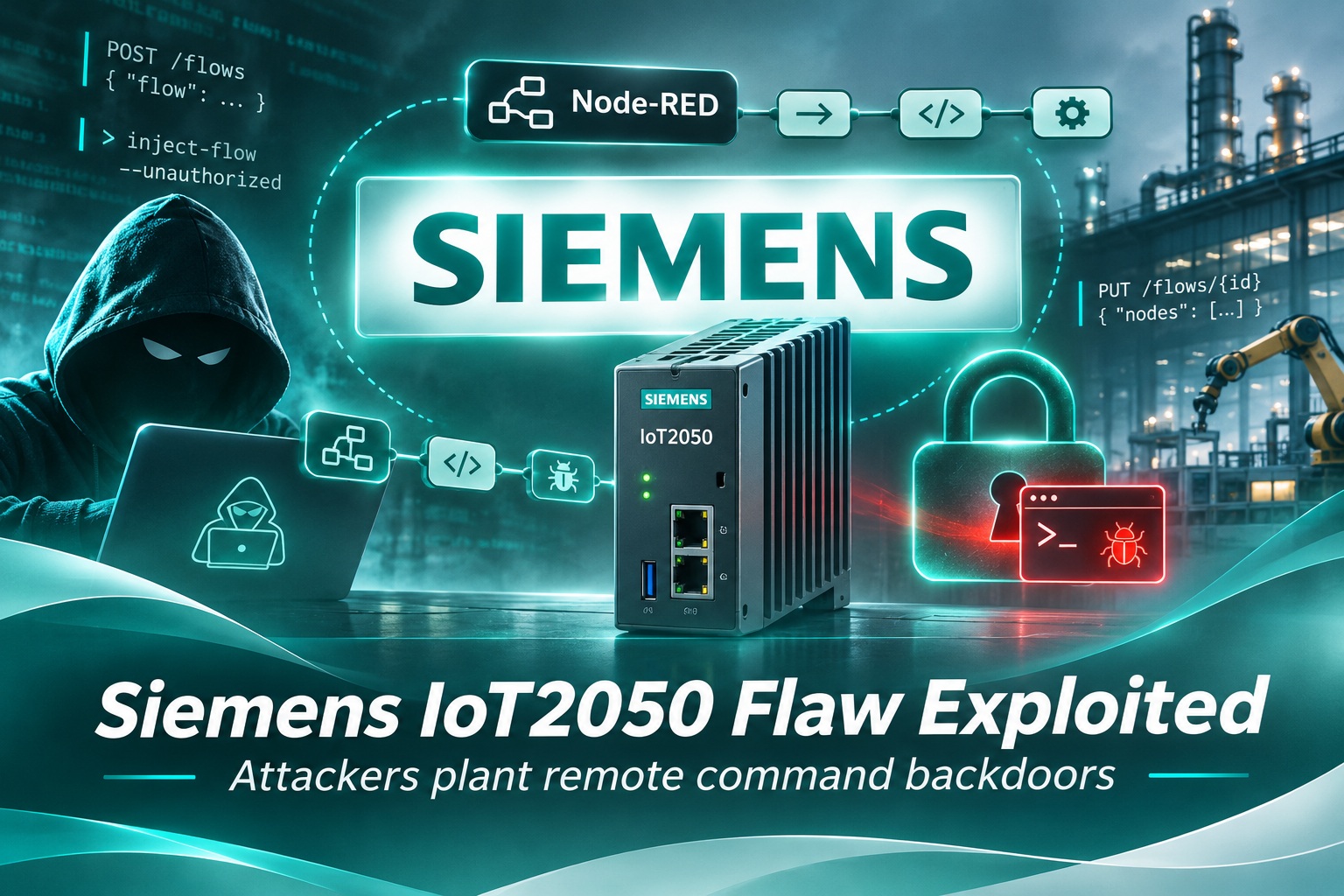
A maximum-severity vulnerability affecting Siemens SIMATIC IoT2050 Advanced industrial devices is now being actively exploited by attackers, according to security researchers. The flaw, tracked as CVE-2026-58115, carries the maximum CVSS score of 10.0 and can allow an unauthenticated remote attacker to execute arbitrary code on vulnerable systems. Researchers have already observed attempts to weaponise the vulnerability against exposed devices, including attacks designed to download Linux botnet malware and create persistent remote-command backdoors.
The Vulnerability Requires No Authentication
CVE-2026-58115 stems from missing authentication for a critical function within the Node-RED HTTP interface available on affected SIMATIC IoT2050 Advanced systems. A remote attacker does not need a valid account or stolen administrator credentials before attempting exploitation. If the vulnerable interface is reachable, the attacker can potentially create malicious Node-RED flows and use those flows to execute arbitrary code on the underlying device. Siemens says the commands can run with maximum privileges, making successful exploitation particularly dangerous.
Node-RED Is At The Centre Of The Problem
The vulnerability affects SIMATIC IoT2050 Advanced devices running Industrial OS with Node-RED installed. Node-RED is commonly used to build automation workflows by connecting different services, devices and functions through visual flows. That flexibility becomes dangerous when an attacker can modify those flows without authentication because the same workflow system can be turned into a mechanism for executing commands. In this case, attackers can effectively transform a legitimate industrial automation feature into their own remote-code execution platform.
Attackers Can Create Malicious Flows Remotely
Instead of exploiting a conventional memory corruption vulnerability, attackers abuse the normal capabilities of Node-RED after bypassing the missing authentication control. They can create new flows containing command-execution components, trigger those flows and run commands directly on the Siemens device. Because the underlying service operates with powerful privileges, the resulting commands may have extensive control over the system. This makes the vulnerability particularly serious for industrial environments where IoT2050 devices may be connected to operational technology or automation networks.
Siemens Patched The Vulnerability In August 2026
Siemens disclosed the vulnerability in an advisory released in August 2026 and provided a corrected software version. The issue is fixed in version 4.3.4.1 and later, meaning customers running older vulnerable releases should upgrade as soon as possible. The existence of a patch is especially important now that attackers are actively attempting exploitation. Systems that remain unpatched after a vulnerability becomes widely known are increasingly likely to be identified through automated internet scanning.
Removing Node-RED Is One Mitigation Option
For organisations that do not require Node-RED, Siemens recommends uninstalling it completely. Removing the vulnerable component eliminates the attack surface associated with the affected interface and may be the simplest option for systems where Node-RED is unnecessary. This also follows a general security principle of disabling software and services that are not required for normal operations. The fewer components exposed on an industrial device, the fewer opportunities attackers have to exploit them.
Node-RED Can Also Be Hardened Instead
Organisations that need Node-RED can reduce exposure by strengthening its configuration. Siemens recommends enabling HTTPS, protecting the editor and administrative API with credential-based authentication or an OAuth/OpenID provider, and requiring basic authentication for HTTP Nodes and the Node-RED Dashboard. These controls help prevent unauthorised users from reaching sensitive management functionality. However, hardening should complement rather than replace upgrading to a patched release wherever possible.
Attackers Were Observed Weaponising The Flaw In October
Security company VulnCheck reported that by 30 October 2026, attackers were already attempting to exploit CVE-2026-58115 against its honeypot infrastructure. The observed request was not simply probing whether a system was vulnerable; researchers described it as a complete working exploit. The attack created a malicious Node-RED flow, triggered it automatically and used the resulting command execution to retrieve malware from an attacker-controlled server. This confirms that the vulnerability has moved from theoretical risk into practical exploitation attempts.
The Exploit Used Several Layers Of Encoding
According to VulnCheck researcher Patrick Garrity, the malicious request was hidden behind three layers of encoding. Attackers often use encoding and obfuscation to make malicious payloads harder for security products and analysts to recognise quickly. Once decoded and executed, the flow launched a shell script wrapper that attempted to retrieve the next-stage malware. The use of multiple encoding layers does not necessarily make the exploit more sophisticated technically, but it can make detection and analysis more difficult.
The First Observed Payload Downloaded A Linux Bot
The malicious flow initially executed a shell script that used wget to download a Linux botnet binary designed for AMD64 systems. The file was retrieved from the attacker-controlled IP address 85.215.73[.]250. If wget failed, the script attempted to use curl as a fallback, increasing the chances that the malware would still be downloaded successfully. Using several download tools is a common attacker technique because different Linux installations may not have exactly the same utilities available.
The Malware Was Hidden In Shared Memory
After downloading the botnet binary, the attack saved it as /dev/shm/.b before executing it. The /dev/shm directory is backed by memory rather than conventional persistent disk storage on many Linux systems, making it attractive for attackers who want temporary files to be less obvious. The leading dot in .b also causes the file to appear hidden in normal directory listings. These techniques are relatively simple but can make malicious activity less noticeable during casual inspection.
Attackers Later Changed To A Two-Stage Infection Process
Researchers subsequently observed the campaign changing its delivery method. Instead of downloading the final bot binary directly, attackers began retrieving another shell script named wget.sh from the same server. This created a two-stage infection chain where the first command downloaded a script and that script could then perform additional actions. Multi-stage attacks give operators greater flexibility because they can modify the later payload without changing the initial exploit itself.
Another Campaign Attempted To Disguise Malware As A Kernel Worker
VulnCheck also observed a separate request contacting 45.194.90[.]57:38472 using wget or curl to retrieve a payload called .sys_update. The malware was then saved to /tmp/.kworker, apparently attempting to disguise it as a normal Linux kernel worker process. Legitimate kernel worker threads commonly use names containing kworker, so attackers frequently imitate those names in the hope that malicious activity blends into ordinary system processes. The downloaded file was then executed, although researchers were unable to retrieve the payload for further analysis.
The Exact Purpose Of Some Payloads Remains Unknown
Researchers could not obtain copies of either wget.sh or the payload stored as .kworker, so their exact functionality has not been confirmed. They may have installed botnet malware, additional backdoors or other malicious tools, but there is currently not enough evidence to say precisely what they did. This uncertainty is important because security analysis should distinguish confirmed behaviour from assumptions based on filenames or attack patterns. What is confirmed is that attackers were using the Siemens vulnerability as a mechanism to download and execute additional code.
Some Attacks Did Not Download Malware At All
Not every observed exploit attempted to immediately install a conventional malware binary. Some malicious Node-RED flows instead created a new HTTP endpoint such as /cmd or another randomly generated path. The endpoint was connected through a function node to an execution node, allowing attackers to submit operating-system commands through a query parameter at a later time. This effectively transformed the vulnerable device into a remote command server controlled by the attacker.
The Backdoor Could Survive Loss Of A Memory-Only Implant
This remote-command approach is particularly concerning because it can remain available even if a temporary payload stored in memory disappears after the system restarts. A malware binary placed in /dev/shm, for example, may be lost during reboot because the directory is memory-backed. A malicious Node-RED flow stored within the application configuration can potentially remain and restore attacker access afterwards. This provides a more durable foothold than relying exclusively on a temporary executable.
Attackers Can Return Later And Run Arbitrary Commands
Once a malicious HTTP command endpoint exists, the attacker does not necessarily need to exploit CVE-2026-58115 again for every action. They can send commands directly to the newly created endpoint whenever the device is reachable. This creates a convenient persistent interface for installing more malware, changing configurations or gathering information from the system. The vulnerability therefore enables more than a one-time compromise; it can be used to establish continuing remote access.
Industrial Devices Are Particularly Sensitive Targets
SIMATIC IoT2050 devices are designed for industrial environments, where they may act as gateways between information technology and operational technology systems. A compromise could therefore create risks beyond the device itself depending on how it is connected to the surrounding network. Industrial systems can interact with manufacturing equipment, sensors, controllers and other operational components that may have very different security requirements from ordinary office computers. Any device positioned between these environments deserves especially careful network segmentation and access control.
A Root-Level Compromise Can Have Wide Consequences
The vulnerability allows arbitrary code execution with maximum privileges, effectively giving attackers root-level control over the affected system. Root access enables extensive modification of the operating system, including installing software, altering network settings, reading files and creating additional accounts or persistence mechanisms. An attacker with this level of access can potentially disable security controls or use the compromised device as a stepping stone towards other systems. The eventual impact therefore depends heavily on what networks and resources the IoT2050 device can reach.
Internet Exposure Greatly Increases The Risk
Any vulnerable Node-RED interface directly reachable from the internet presents a significantly larger attack surface. Once vulnerability details become public, attackers can scan large ranges of IP addresses looking for systems that respond like the affected service. They do not need to know which organisation owns the device beforehand. Restricting management and automation interfaces to trusted internal networks or VPN connections can therefore dramatically reduce exposure.
Industrial Systems Should Not Expose Management Interfaces Unnecessarily
Administrative and automation interfaces should generally not be accessible directly from untrusted networks unless there is a specific operational requirement. Firewalls and access-control lists can limit which systems are allowed to communicate with Node-RED. Remote administrators can connect through secured VPN infrastructure instead of exposing management ports openly. These controls provide another defensive layer even when software vulnerabilities have not yet been patched.
Network Segmentation Can Limit The Damage
Industrial IoT gateways should also be isolated from unrelated corporate and operational systems wherever possible. If an attacker compromises one device, strong segmentation can prevent immediate lateral movement towards engineering workstations, file servers or industrial controllers. Firewall policies should permit only the connections the gateway genuinely needs for its intended purpose. This limits the number of targets available even when the device itself has already been compromised.
Honeypot Activity Shows Attackers Are Moving Quickly
The exploitation attempts detected by VulnCheck demonstrate how quickly attackers begin weaponising serious vulnerabilities after technical information becomes available. Siemens disclosed the issue in August, and by late October researchers were already observing complete exploit chains targeting exposed systems. This gives organisations relatively little time to treat critical industrial vulnerabilities as low-priority maintenance items. Once working attacks are circulating, every vulnerable internet-facing system becomes a potential target.
Attackers Are Already Experimenting With Different Payloads
The variation between direct bot downloads, secondary shell scripts, disguised payloads and persistent command endpoints suggests more than one attack technique is being tested against the vulnerability. This may indicate several operators are experimenting with CVE-2026-58115 or that one campaign is actively refining its infection strategy. Either way, defenders should not create detection rules around one specific filename or IP address and assume the problem is solved. The underlying exploit path needs to be removed.
Blocking One Malicious IP Address Is Not Enough
The attacker-controlled addresses observed in the campaign can certainly be blocked, but doing so provides only temporary protection. Attackers can move payloads to another server or register new infrastructure very quickly. Indicators such as 85.215.73[.]250 and 45.194.90[.]57 are useful for threat hunting and identifying previous contact, but they should not be treated as the primary remediation. Updating DSM—rather, in this case Siemens Industrial OS and Node-RED configuration—is what removes the underlying vulnerability.
Organisations Should Search Logs For Signs Of Exploitation
Administrators responsible for affected IoT2050 devices should review Node-RED configurations and system logs for unexpected flows, unfamiliar HTTP endpoints or suspicious command-execution nodes. Connections to the known attacker infrastructure may also indicate a compromise attempt. Unexpected files under locations such as /dev/shm or /tmp deserve investigation, particularly filenames resembling .b, .kworker or other hidden executables. If evidence of compromise is discovered, simply installing the patch may not be enough because the attacker could already have established persistence.
Unexpected Node-RED Flows Are A Major Warning Sign
Node-RED installations should contain only flows created for legitimate automation purposes. Administrators who discover unfamiliar workflows, especially those involving shell commands, exec nodes or externally accessible HTTP endpoints, should treat them as suspicious until proven otherwise. Attackers exploiting CVE-2026-58115 rely specifically on creating malicious flows, so reviewing the existing configuration provides a direct way to look for evidence. Comparison with known-good backups can make unusual changes easier to identify.
Compromised Devices May Need More Than A Software Update
If an organisation confirms that attackers successfully executed commands on a vulnerable device, updating to version 4.3.4.1 should be only one part of the response. Security teams should determine what commands were executed, whether additional files were installed and whether the device communicated with other systems after compromise. Credentials stored on or accessible from the gateway may also need to be rotated. In severe cases, rebuilding the device from a trusted image may provide stronger assurance than trying to remove individual malicious components.
Credential Rotation May Be Necessary After Root Compromise
An attacker with root access may be able to read configuration files or credentials stored on the system. Even after malware is removed, stolen passwords, API keys or tokens could continue giving the attacker access to other infrastructure. Organisations should therefore review what secrets were accessible from the compromised device and rotate them where necessary. This is a standard precaution after any privileged system compromise.
Industrial Incident Response Requires Extra Care
Rebuilding or disconnecting an industrial gateway is not always as simple as taking an ordinary server offline. The device may support production processes that cannot be interrupted without planning. Incident-response teams therefore need to coordinate closely with operations personnel before making changes that could affect physical processes. Security urgency must be balanced with operational safety, but that should not become an excuse to leave a confirmed compromise unaddressed.
Authentication Should Be Enabled Even After Patching
Installing the fixed release addresses CVE-2026-58115, but organisations should still follow Siemens' hardening recommendations afterwards. Node-RED editor and administration interfaces should require credentials or an approved identity provider, while HTTP nodes and dashboards should also be protected appropriately. HTTPS should be enabled to protect credentials and management traffic from interception. These measures improve the overall security posture even when the specific vulnerability has already been removed.
Security Should Be Designed Around The Possibility Of Another Flaw
A patched product can still contain future vulnerabilities, which is why defence in depth matters. If the Node-RED interface is restricted to trusted networks and protected by authentication, a future pre-authentication vulnerability may be significantly harder for an external attacker to reach. Network segmentation and monitoring provide additional protection when software controls fail. Industrial systems should therefore be designed so that one vulnerability does not automatically lead to complete network compromise.
Automatic Scanning Makes Obscurity Useless
Organisations should not assume that obscure industrial devices will remain unnoticed simply because few people know their IP addresses. Attackers routinely use automated scanners to identify exposed services across the internet. Once a vulnerability becomes valuable, scanning can find affected systems without any prior knowledge about the owner. Security through obscurity provides very little defence against this type of automated discovery.
IoT Devices Need The Same Patch Discipline As Servers
Industrial gateways are sometimes treated more like appliances than computers, leading organisations to leave them unchanged for years as long as they continue functioning. In reality, devices such as SIMATIC IoT2050 run complex software stacks that need ongoing security maintenance. Firmware, operating systems, runtime environments and applications such as Node-RED can all develop vulnerabilities. Asset owners therefore need patching processes that include industrial IoT devices rather than focusing only on traditional servers and workstations.
Asset Inventory Becomes Essential
Organisations cannot patch systems they do not know they have. Industrial environments often contain devices deployed by engineering or operational teams outside normal IT asset-management processes. Maintaining an accurate inventory of IoT2050 systems, software versions, Node-RED installations and network exposure makes vulnerability response considerably faster. It also helps identify devices that may have been forgotten after projects or facility changes.
Final Thoughts
The active exploitation of CVE-2026-58115 turns an already critical Siemens vulnerability into an immediate security concern for organisations using SIMATIC IoT2050 Advanced devices. The flaw carries the maximum CVSS score of 10.0 and allows unauthenticated attackers to create malicious Node-RED flows and execute arbitrary code with maximum privileges on vulnerable systems.
Siemens fixed the vulnerability in version 4.3.4.1 and later, but VulnCheck has already observed attackers using complete exploit chains against exposed systems. The attacks have attempted to download Linux botnet malware, deploy secondary scripts, disguise malicious payloads as kernel worker processes and create persistent HTTP command endpoints that allow attackers to return later.
Organisations should update affected devices immediately, remove Node-RED where it is unnecessary and harden installations that still require it with HTTPS and strong authentication. Administrators should also inspect existing Node-RED flows and system logs for suspicious changes because patching a device after successful exploitation does not automatically remove a backdoor that has already been installed.
The most concerning part of this campaign is not simply that attackers can execute malware. They can turn the legitimate Node-RED automation framework itself into a persistent remote command interface, leaving a backdoor behind even after temporary malware disappears.











Comments 0