

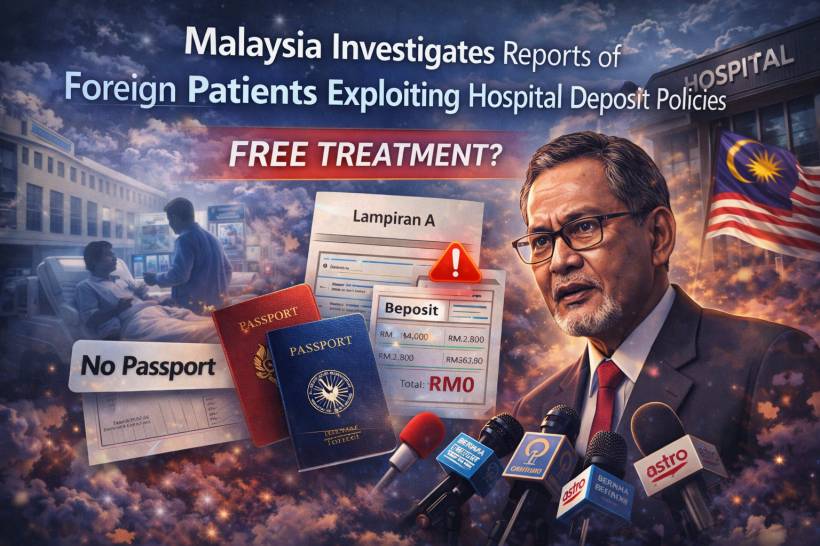
Malaysia's Health Ministry says it will investigate claims that some foreign patients may have been using administrative loopholes to avoid paying hospital deposits at public hospitals. The issue gained attention after social media posts, said to have come from a nurse at Kuala Lumpur Hospital, alleged that certain patients were sidestepping normal payment procedures by claiming they did not have passports.
The allegation quickly sparked public concern because it touches on a sensitive issue in Malaysia's healthcare system: how emergency care is provided, how public hospitals manage payment rules for non-citizens, and whether those procedures are being misused.
What Triggered the Controversy
The matter appears to have started with viral posts online that claimed some foreign patients were being processed in a way that allowed them to avoid upfront deposits. According to those claims, some individuals allegedly said they did not possess passports and were then handled using a form called Lampiran A.
That created the impression on social media that these patients were getting treatment without having to pay, leading to criticism and suspicion about whether hospital rules were being applied properly.
At this stage, however, Health Minister Datuk Seri Dr Dzulkefly Ahmad said the ministry has not yet confirmed whether the viral claims are genuine or accurate. Still, he made it clear that the allegations are serious enough to warrant a proper investigation.
He also emphasized that people who come forward with information should be respected, and that whistleblowers deserve protection. That is an important point because cases like this often come to light only when frontline staff feel safe enough to speak up.
What the Official Rules Actually Say
According to Dr Dzulkefly, the ministry's standard operating procedures are clear: foreign patients admitted to public hospital wards must pay a deposit first.
For third-class wards, the required deposit is RM1,400 for medical cases and RM2,800 for surgical cases. This payment must be made before the patient is admitted to the ward.
There are some limited exceptions and adjustments. Foreign patients holding a UNHCR card are eligible for a 50 percent discount on the deposit amount. In other situations, a waiver only applies if the patient is covered under certain insurance arrangements, such as the Foreign Workers Hospitalisation and Surgical Insurance Scheme, better known as SPIKPA, or specific refugee medical insurance programmes.
If a patient does not have insurance or enough money, the usual process is not to simply let the payment disappear. Instead, they are asked to contact family members or friends who can help provide the required deposit.
The minister was quite firm on this point, saying the ministry does not compromise on the deposit requirement under normal ward admission procedures.
Why Lampiran A Is Being Misunderstood
A big part of the confusion appears to center on Lampiran A.
Dr Dzulkefly explained that this form is not a free-treatment pass, nor is it a way to permanently escape payment. Instead, it is meant for critical emergency cases handled in hospital emergency departments. Its purpose is to allow treatment to begin immediately in life-threatening situations, even before payment issues are sorted out.
In other words, Lampiran A is part of the emergency care process. It allows hospitals to postpone the deposit requirement temporarily while doctors and nurses focus on resuscitation and stabilisation.
That distinction matters a lot. In an emergency, medical staff are expected to act first to save the patient and remove them from immediate danger. This is part of what the minister referred to as the ministry's "no wrong door policy," which aims to ensure that no emergency case is turned away when urgent intervention is needed.
But that temporary delay is not the same thing as an exemption.
Once the patient has been stabilised and is admitted to the ward, the usual process of collecting the required deposit begins. So while emergency treatment may start before payment is settled, the bill does not simply vanish afterward.
Not Free Treatment, Says the Ministry
The Health Ministry is pushing back strongly against the idea that foreign patients are automatically receiving free care through this route.
Dr Dzulkefly said it is incorrect to say these patients are exempt from payment altogether. The postponement under Lampiran A applies only during the emergency stage, not after the patient is moved into the normal hospital admission pathway.
He also stressed that this approach is not unique to one hospital. It is applied across emergency and trauma services under the ministry nationwide.
That is an important clarification because public reaction can easily be shaped by incomplete descriptions of hospital procedures. A delay in collecting payment during emergency stabilisation can look, from the outside, like a waiver, even though the policy itself says otherwise.
Why the Investigation Matters
Even with that clarification, the ministry's decision to investigate is still significant.
The issue is not only whether the viral posts are authentic, but also whether there are gaps in implementation on the ground. In any large healthcare system, there can be a difference between policy on paper and what happens in real clinical settings. If staff are facing situations where documentation is incomplete, identity claims cannot be verified immediately, or payment follow-up is weak, then loopholes may still emerge even if the formal rules are strict.
That is likely why the ministry is treating the matter carefully. If there has been misuse, it would raise questions about hospital administrative controls. If there has not, then the ministry will need to address public misunderstanding before mistrust spreads further.
The Bigger Context in Public Healthcare
This story has gained attention partly because it sits at the intersection of healthcare access, immigration, emergency ethics, and public resource management.
Malaysia's public hospitals are expected to treat emergency cases quickly, regardless of who the patient is, because delaying care in critical moments can cost lives. At the same time, hospitals also have to protect limited public resources and ensure that payment systems are enforced fairly, especially for non-citizens who are subject to deposit rules.
That balancing act is not simple. A humane healthcare system must respond immediately in emergencies, but it also needs strong administrative follow-up afterward. Whenever those two priorities collide, controversy is almost inevitable.
Final Thoughts
For now, the key point is that Malaysia's Health Ministry says it has not yet verified the viral allegations, but it is investigating them seriously. The minister has also made it clear that foreign patients are generally required to pay deposits before ward admission, and that Lampiran A only allows payment to be deferred temporarily during critical emergency treatment.
So the real issue is not whether emergency care is given first. That is already part of the system. The bigger question is whether some people have been misusing that emergency pathway to delay or avoid payments beyond what the rules allow.
Until the investigation is complete, the public will likely need to be cautious about jumping to conclusions. But one thing is clear: this is not just a story about hospital paperwork. It is really about trust in how public healthcare rules are enforced, and whether compassion in emergencies can coexist with accountability in administration.











Comments 0