

For anyone who spent enough time online in the early 2010s, Vine probably still holds a special place in internet memory. It was simple, chaotic, creative, and often hilarious, all within a strict six-second looping video format. Long before TikTok became the dominant name in short-form video, Vine had already shown how powerful a tiny video clip could be when placed in the hands of creative users.
Over the years, it has become common to see people say things like "Vine was better than TikTok" whenever discussions about short-form content come up. Some say it with nostalgia, while others genuinely believe Vine encouraged a different kind of creativity because of its limitations. Now, nearly a decade after Vine was shut down, a new app called diVine is attempting to revive that familiar experience, but with a more modern and intentional approach.
A Short-Form Video Comeback Built On Nostalgia
Vine was one of the earliest platforms to make short-form video feel like a proper internet culture movement. Its six-second looping clips forced creators to get straight to the point, whether they were making jokes, visual gags, music loops, weird sketches, or everyday moments that somehow became iconic.
The original Vine was acquired by Twitter in 2012, during the period when Jack Dorsey was still closely associated with the company's leadership. Despite its cultural influence, the platform was eventually shut down in January 2017. Since then, Vine has remained one of those apps that people continue to remember fondly, partly because it disappeared before the short-form video market exploded.
That is where diVine comes in. Rather than simply copying the current TikTok-style model, the app appears to be leaning directly into the older Vine spirit: quick videos, creative expression, and a platform that does not revolve entirely around algorithmic addiction.
What Is diVine?
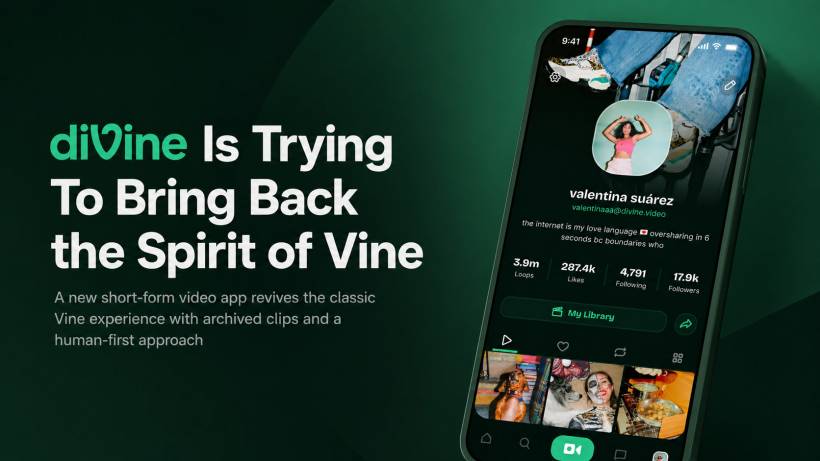
diVine is a new short-form video app that aims to recreate the feel of Vine while building it on newer technology. The project is led by Evan Henshaw-Plath, who is listed as the platform's CEO and founder, with Jack Dorsey also backing the initiative.
At its core, diVine allows users to create and watch short-form videos, similar to the original Vine concept. However, it also brings something extra for longtime fans: access to more than 100,000 archived Vine clips from the platform's earlier days.
That archive is likely to be one of the app's biggest draws. For many people, Vine was not just another social app. It was a time capsule of internet humour before short-form video became heavily polished, monetised, and algorithmically shaped. Being able to revisit some of that content inside a new app gives diVine an immediate nostalgic hook.
However, the team behind diVine has made it clear that the app is not officially affiliated with Vine, Twitter, or X. In other words, this is not a formal revival by the original company. It is a separate project that is trying to bring back the experience and culture associated with Vine, but under a different name and structure.
Beating X To The Vine Archive
One interesting angle is that diVine appears to have moved faster than Elon Musk's own teased plans around reviving Vine-related content. Musk has previously mentioned bringing back the Vine archive in some form, and he has also referred to Grok as an "AI Vine" concept.
diVine, however, is taking a very different position. Instead of embracing AI-generated short videos, the app is explicitly rejecting AI-generated content. Its focus is on human-made videos, with creators remaining in control of what they publish.
That decision is important because short-form platforms today are increasingly filled with automated, recycled, or AI-assisted content. While AI tools can be useful in many creative workflows, there is also growing concern that social feeds may become overwhelmed by low-effort synthetic material. diVine seems to be positioning itself as a space where human creativity remains the main point.
A Platform That Wants Creativity To Come First
Another interesting part of diVine is its approach to the user experience. According to the project's announcement, the front end is designed to prioritise creativity instead of algorithm-driven recommendations.
That may sound simple, but it is actually a major difference compared with most modern social media platforms. Today, many apps are built around engagement loops. The feed is tuned to keep users scrolling, often by showing whatever is most likely to capture attention, regardless of whether it is meaningful, original, or healthy to consume.
diVine appears to be trying to move away from that model. By putting creativity ahead of algorithmic discovery, the app may appeal to users who miss the more organic feeling of older social platforms, where the content itself felt less engineered and more spontaneous.
Of course, the real test will come later. A platform can say it values creativity, but the user experience, discovery tools, community behaviour, and moderation choices will determine whether that vision actually works in practice.
Built On Nostr And Released As Open Source
On the technical side, diVine is also taking a different route from typical social media apps. The platform is built on Nostr, an open protocol often associated with decentralised social networking. It is also being released as open-source software.
This matters because it suggests diVine is not trying to operate like a fully closed, traditional social media platform. By using an open protocol, the app may offer more transparency and flexibility than the usual centralised social networks.
For users, this may not immediately change the everyday experience of watching or uploading videos. But for developers, privacy advocates, and decentralised web supporters, it gives the app a more interesting foundation. It also aligns with the broader movement toward social platforms that are less dependent on a single corporate gatekeeper.
How diVine Plans To Block AI-Generated Content
One of the more unusual parts of diVine is how it plans to enforce its ban on AI-generated videos. The app uses a cryptographic system built on Nostr to help verify the authenticity of uploaded videos.
The idea is to review content and label it accordingly, identifying whether a video is human-made or AI-generated. This could become an important feature if AI-generated video becomes more common across social platforms.
Still, this is also an area where expectations should be realistic. Detecting AI-generated content is not always easy, especially as generative tools improve. Even so, diVine's decision to build verification into the platform from the start shows that it is thinking seriously about the direction of online content.
Instead of waiting until the platform is flooded with questionable material, it is trying to set its identity early: this is meant to be a space for human-created short videos.
Availability And Invite-Only Access
diVine is now available through its live website, as well as on the Apple App Store, Google Play, and Zapstore. However, access is currently invite-only.
That means users may be able to download the app, but not everyone will be able to start using it immediately. The company is planning a wider rollout in the coming months, and interested users can sign up for the waitlist.
This slower rollout makes sense for a new social app. Platforms like this need to manage user growth carefully, especially when they involve video hosting, moderation, creator tools, and community features. A sudden rush of users can easily create technical and moderation problems if the platform is not ready.
Final Thoughts
diVine is arriving at an interesting time. Short-form video has never been bigger, but many users are also tired of overly aggressive algorithms, repetitive content, and social feeds that feel more like attention machines than creative spaces.
By bringing back the spirit of Vine, offering access to a large archive of old clips, rejecting AI-generated content, and building on open technology, diVine is trying to separate itself from the usual short-form video formula. Whether it can truly capture the magic of Vine is another question, because internet culture has changed a lot since 2017.
Still, the idea is appealing. Vine worked because it was simple, fast, and creatively restrictive in a way that made people think differently. If diVine can preserve that energy while solving some of the problems that affected older and newer social platforms, it may have a chance to become more than just another nostalgia-driven app.











Comments 0