

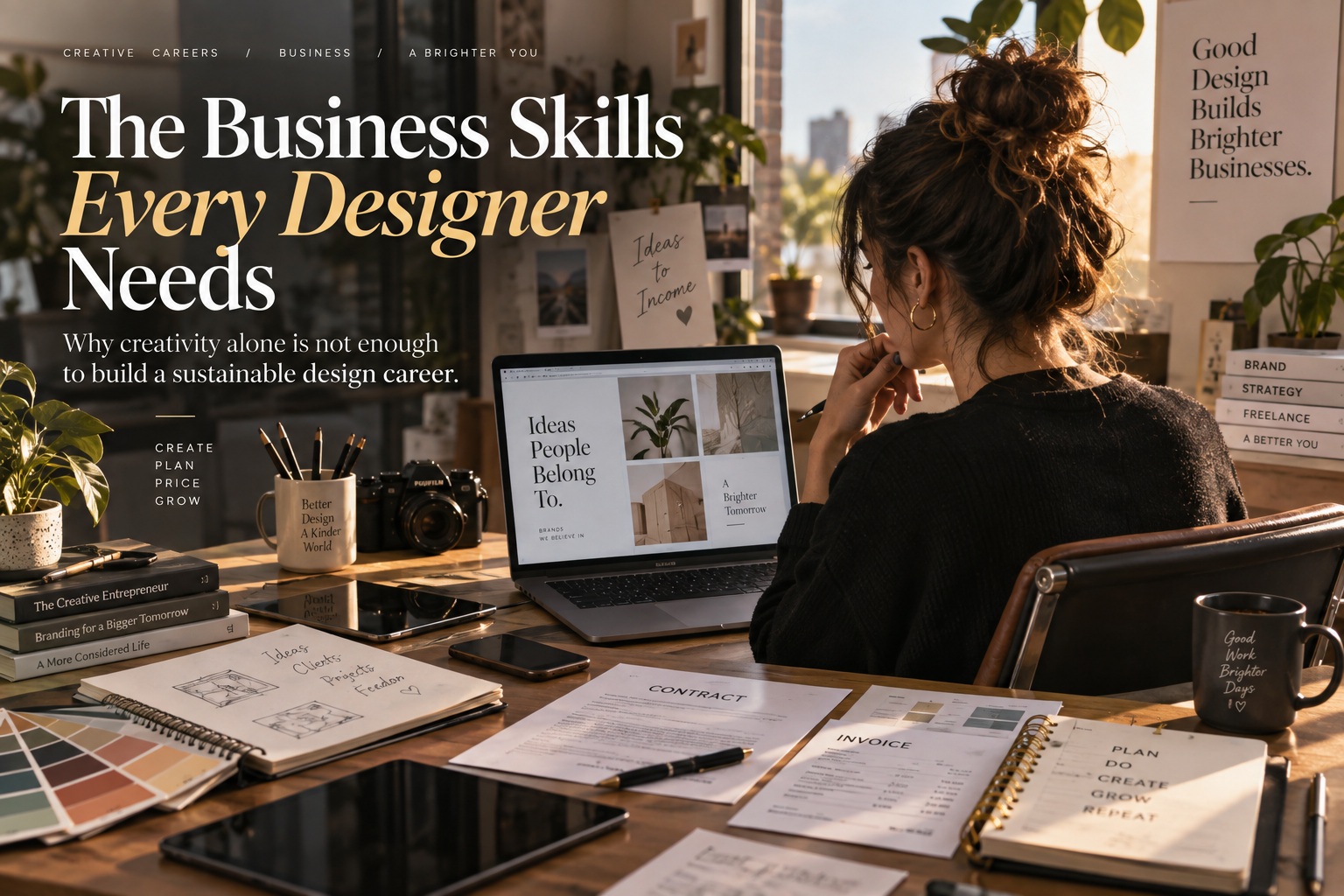
Creativity may be the foundation of a designer's career, but it is rarely enough on its own to build something sustainable. A strong portfolio, a distinctive visual style and confidence with design software can certainly open doors, yet many designers eventually discover that the biggest challenges are not always creative ones. Managing projects, setting prices, dealing with difficult clients, organizing finances and maintaining a steady flow of work can be just as important as producing great design.
This becomes especially obvious for freelancers, small studio owners and designers working in lean in-house teams. In those environments, there is often no dedicated person handling every contract, invoice, schedule or client conversation. Designers are expected to make business decisions alongside creative ones, and those decisions can have a direct impact on income, workload and long-term career growth.
The goal is not to turn designers into accountants or corporate managers. It is to build enough structure around the creative process so that the business side of the work becomes easier to control. When that happens, designers can spend less time dealing with chaos and more time focusing on the kind of work they actually want to create.
Understanding the Real Value of Creative Work
Pricing is one of the first business challenges many designers encounter. New designers often calculate their fees based only on the time spent actually creating the final design, which can lead to rates that are far lower than the true cost of completing the project.
A logo, website interface or branding package does not begin when the designer opens the software. There may already have been hours of research, planning, communication, meetings and concept development before the first polished draft appears. Revisions, file preparation, project management, software subscriptions, equipment costs and years of accumulated experience also contribute to the value of the final result.
That is why pricing creative work requires a broader way of thinking. Designers are not simply selling time; they are also selling judgment, problem-solving, knowledge and the ability to turn an unclear brief into something useful and effective.
There is also no single pricing model that works for every project. Designers may choose from several approaches depending on the client, scope and type of work, including:
Understanding the strengths and weaknesses of each model helps designers avoid undercharging while also making proposals easier for clients to understand.
Managing Money When Income Is Not Predictable
Financial management can feel particularly uncomfortable for creative professionals, especially those who chose design because they were more interested in ideas than spreadsheets. However, irregular income is one of the realities of freelancing and running a small creative business.
Unlike a salaried employee who receives roughly the same amount each month, an independent designer may have a very strong month followed by a much quieter one. Payments may also arrive late, projects can be delayed and unexpected expenses may appear at inconvenient times. Without a basic financial system, it becomes difficult to know whether the business is actually performing well.
Even a simple structure can make a big difference. Designers should be able to see how much money is coming in, what is being spent and how much should be set aside for future obligations. Building an emergency buffer can also reduce pressure during slower periods and make it easier to reject projects that are poorly paid or not a good fit.
Some useful financial habits include:
Technology can make this process much easier. Accounting platforms, expense trackers, budgeting tools and financial planning software can help designers understand patterns in their income and spending without turning financial management into a full-time job.
AI-based financial tools may also help users review different scenarios, identify patterns and organize future goals. However, those tools are best used as support rather than as a substitute for personal judgment or professional financial advice. The real benefit is gaining a clearer picture of the business so that decisions about spending, saving and investment can be made with more confidence.
Learning to Communicate With Clients Properly
Strong communication is one of the most valuable business skills a designer can develop. Many projects become difficult not because the design itself is poor, but because expectations were never clearly defined at the beginning.
A client might imagine one thing while the designer understands the brief completely differently. If those assumptions are not discussed early, the result can be repeated revisions, frustrated conversations and wasted time for both sides.
Experienced designers usually spend more time asking questions before starting creative work. They try to understand what the client is actually trying to achieve, who the intended audience is, what constraints exist and how success will be measured.
Those conversations help designers move beyond simply producing something visually attractive. They make it possible to create work that solves a real problem.
Designers also need to explain their decisions clearly. Clients may not understand why certain typography, spacing, colours or layouts were chosen, and simply saying "this looks better" does little to demonstrate professional value. Explaining the thinking behind a design helps clients understand that creative choices are based on strategy rather than personal preference.
Setting Boundaries Before Problems Appear
Good communication also includes setting boundaries. Designers sometimes make the mistake of trying to be endlessly flexible because they want to keep clients happy, but unclear boundaries can quickly create problems.
A project that originally included two rounds of revisions can suddenly become six. A client may start requesting work outside the agreed scope, or expect instant replies outside working hours. When there is no written agreement, it can become difficult to push back.
This is where contracts, proposals and clear scopes of work become essential. They help define what is included, when the work should be completed, how many revisions are allowed and what happens when the scope changes.
A clear agreement protects both sides. The client knows what they are paying for, while the designer has a reference point if expectations begin to expand beyond the original project.
Building Systems Instead of Depending on Motivation
Creative work often feels most enjoyable when inspiration is high, but a business cannot depend entirely on motivation. There will always be administrative tasks, follow-ups, invoices, emails and deadlines that need attention regardless of whether the designer feels inspired that day.
That is where systems become useful. Repeatable processes make routine work faster and reduce the number of decisions that need to be made repeatedly.
A designer might create standard templates for proposals, contracts, invoices and client onboarding. They might use project management software to track deadlines or establish a fixed workflow for every new project.
For example, a simple design workflow might follow this sequence:
Having a consistent process makes projects easier to manage and gives clients a more professional experience. It also reduces the mental load of remembering what should happen next.
The important point is that systems do not reduce creativity. In many cases, they create more space for it. When routine tasks are organized, designers can spend more energy on problem-solving and experimentation instead of constantly reacting to administrative issues.
Time Management Is Part of the Business Too
Designers often underestimate how much time disappears into activities that are not direct creative work. Emails, meetings, revisions, research and file organization may each seem small, but together they can consume a significant part of the week.
Good time management starts with understanding where that time is actually going. Tracking projects for a few weeks can reveal whether certain clients require unusually high amounts of communication or whether particular types of work consistently take longer than expected.
That information becomes valuable when estimating future projects. A designer who knows that a typical branding project requires 40 hours rather than the 20 originally assumed can price and schedule the next one much more accurately.
Protecting focused creative time is also important. Constant notifications, meetings and interruptions can make difficult design work much slower. Setting aside dedicated periods for uninterrupted work can improve both productivity and quality.
Marketing Is Not Only About Social Media
Many designers associate marketing with constantly posting work online, but effective marketing is much broader than social media activity. At its core, marketing is about making it easy for the right people to understand what you do and why they should work with you.
A good portfolio should therefore do more than display attractive images. It should explain the problem, the process and the result. Case studies can be particularly valuable because they show how design contributed to a practical outcome rather than simply demonstrating visual style.
Relationships are another major source of opportunities. Past clients, former colleagues and other creative professionals can become a powerful referral network if those relationships are maintained.
Designers do not necessarily need a massive audience. A smaller network of people who understand and trust their work can often generate better opportunities than thousands of passive followers.
Learning to Negotiate Without Feeling Uncomfortable
Negotiation is another skill that many designers avoid because it can feel confrontational. In reality, good negotiation is simply a conversation about expectations, value and trade-offs.
If a client says the budget is too high, the solution does not always need to be lowering the price. The scope can be reduced, the timeline can be changed or certain deliverables can be removed.
For example, instead of discounting a full branding package, a designer might offer a smaller package containing only the core brand identity. That preserves the value of the designer's work while giving the client an option that better fits their budget.
Learning to negotiate in this way makes pricing conversations less emotional. The discussion becomes about adjusting the project rather than defending personal worth.
Thinking Like a Business Owner
As a designer's career develops, there is often a shift from simply completing projects to managing a broader creative business. That does not necessarily mean hiring employees or opening a large studio. It means thinking strategically about where work comes from, which clients are most valuable and how time should be allocated.
A designer who thinks like a business owner begins asking different questions. Which projects are profitable? Which clients lead to repeated work? Which services take too much time for too little return? Which areas of expertise could justify higher pricing?
Those questions help designers build careers deliberately rather than simply accepting whatever work appears next.
They also encourage long-term thinking. Instead of focusing only on the next invoice, designers can invest in relationships, education, stronger systems and better positioning within their chosen market.
The Freedom of Creative Work Still Requires Structure
One of the great attractions of a creative career is flexibility. Designers can often choose where they work, which industries they focus on and what kind of projects they want to pursue. Freelancing can provide even more freedom, including control over schedules, pricing and clients.
However, that freedom only works when there is enough structure behind it. Without contracts, pricing systems, financial planning and clear processes, independence can quickly turn into uncertainty.
Business skills provide that structure. They allow designers to make better decisions, protect their time and create a more predictable working environment.
Final Thoughts
Creativity may be what attracts most people to design, but business skills are what often determine whether a creative career remains sustainable over the long term. Pricing, communication, financial management, negotiation, marketing and project systems may not feel as exciting as developing a new concept, but they directly influence the quality of a designer's professional life.
The strongest designers eventually learn to balance both sides. They understand that creative ability produces great work, while business discipline creates the conditions that allow that work to continue.
When the business side is properly organized, designers gain something far more valuable than administrative efficiency. They gain greater control over their time, their clients, their income and the direction of their careers—and that ultimately creates more freedom to do the creative work that matters to them.











Comments 0