

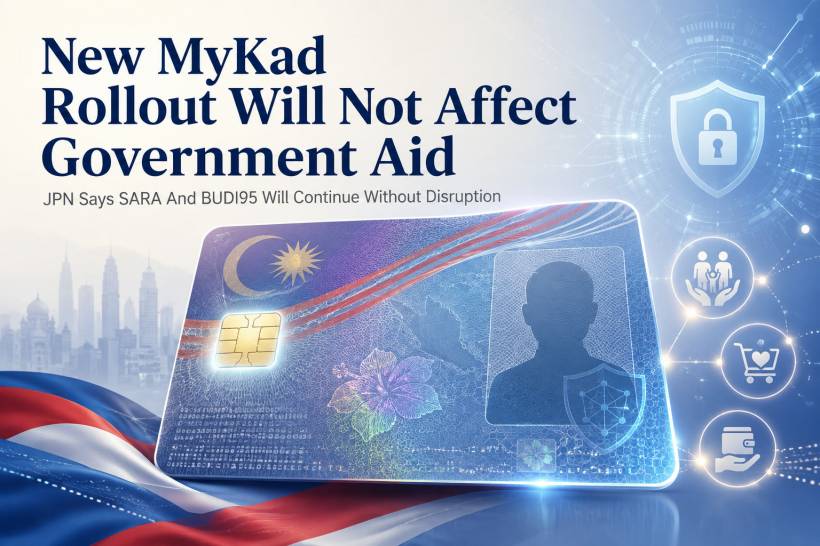
Malaysia's upcoming new MyKad has naturally attracted plenty of public attention, especially since the rollout is expected to begin soon. Whenever a national identity document is updated, people tend to have practical concerns. One of the biggest questions is whether existing government aid programmes linked to MyKad details will be affected during the transition.
For now, the National Registration Department, or JPN, has made it clear that Malaysians do not need to panic. The department has reassured the public that the rollout of the new MyKad will not disrupt government assistance programmes that rely on MyKad verification. This includes aid initiatives such as SARA and BUDI95.
Aid Recipients Will Remain In The System
According to JPN, the list of eligible aid recipients will remain intact throughout the transition to the new MyKad. This is an important clarification because many government aid programmes use identity information as part of their verification and distribution process.
The department explained that information migration will take place automatically through its central database system. In simpler terms, eligible recipients should not need to worry that their assistance will suddenly stop just because a new version of the MyKad is being introduced.
This also means that people who are currently receiving aid should not rush to replace their MyKad purely out of fear that they may lose access to existing benefits. The system is expected to continue recognising eligible recipients during the rollout period.
JPN Warns The Public Not To Believe Rumours
JPN has also advised Malaysians not to be misled by rumours or false information claiming that government aid will be stopped if the MyKad is not replaced immediately. This kind of concern is understandable, especially when identity documents are tied to many important services, but the department has stressed that the replacement process will not happen all at once.
Instead, the new MyKad rollout will be done in phases. This phased approach gives the government time to manage the transition properly while allowing citizens to replace their cards according to the official schedule. More details on the application and replacement process are expected to be announced later.
This is a sensible move, especially for a nationwide identity card update. A sudden mandatory replacement exercise would likely cause long queues, public confusion, and unnecessary pressure on JPN offices. A phased rollout gives both the public and government agencies more time to adjust.
A Four-Phase Transition Before Full Replacement
Following the earlier announcement, Home Minister Saifuddin Nasution Ismail said that the rollout of the new MyKad would take place in four phases. Only after the final phase will all citizens be required to switch to the new card.
That detail matters because it shows that the existing MyKad will not immediately become obsolete the moment the new version is introduced. For most Malaysians, this means there is no urgent need to rush unless their category is included in the relevant phase or unless JPN later provides specific instructions.
A phased transition also helps reduce the risk of administrative disruption. Since the MyKad is used across many areas of daily life, from government services to banking and identity verification, the replacement process needs to be handled carefully.
Improved Security Features On The New MyKad
One of the main reasons behind the new MyKad is security. National Registration Director-General Datuk Badrul Hisham Alias previously said that the new version will come with 53 security elements, a major increase from the 23 found on the current card.
These upgraded features are expected to include laser engraving, ultraviolet elements, holograms, guilloche patterns, microtext, enforcement-related QR codes, and a chip with stronger encryption technology. Taken together, these improvements are meant to make the card harder to forge, tamper with, or misuse.
This is especially important in an era where identity fraud and digital verification risks are becoming more complex. A stronger identity card can help protect citizens while also improving confidence in official verification processes.
Touch 'n Go Functionality Will Be Removed
However, the new MyKad will also lose one familiar feature: Touch 'n Go functionality. For many Malaysians, this may be the most noticeable practical change because the current MyKad can still function as a Touch 'n Go card in certain situations.
While the removal may disappoint some users, it appears that the government is prioritising identity security and card integrity over payment convenience. Given how much the digital payment landscape has changed, with eWallets, bank cards, and mobile payment systems now widely used, the Touch 'n Go function on MyKad may no longer be as central as it once was.
Still, it is understandable if some people see this as a step back in convenience, especially those who appreciated having one card serve multiple purposes.
Final Thoughts
The upcoming MyKad rollout is a major national update, but JPN's reassurance should help calm concerns among Malaysians who depend on government aid programmes such as SARA and BUDI95. The key point is simple: aid eligibility will remain in the system, and assistance should continue for those who qualify.
At the same time, the government will need to communicate the rollout clearly and consistently. Since the MyKad is closely tied to everyday identity verification, public confusion can easily spread if official information is not easy to understand. The phased rollout is the right approach, but it must be supported by clear instructions, proper timelines, and active efforts to counter misinformation.
Overall, the new MyKad appears to be a security-focused upgrade rather than an urgent replacement exercise for everyone. Malaysians should wait for official announcements from JPN, avoid relying on rumours, and replace their MyKad only when their phase or situation requires it.











Comments 0