

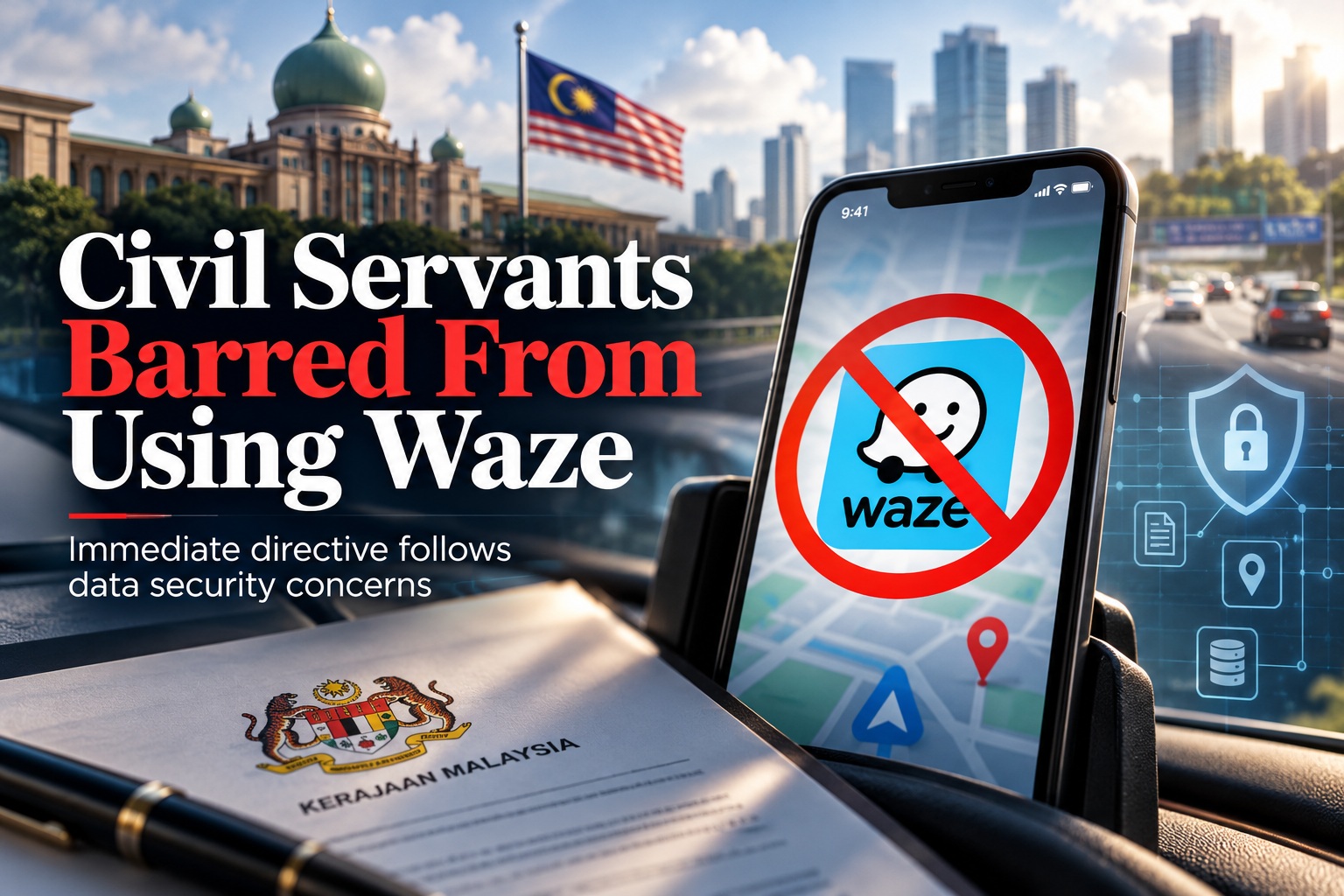
The Malaysian government has ordered civil servants to stop using the Waze navigation application with immediate effect, escalating concerns over the handling of location and movement data by foreign digital platforms. The directive was confirmed by National Cyber Security Agency chief executive Megat Zuhairy Megat Tajuddin and follows Prime Minister Datuk Seri Anwar Ibrahim's recent recommendation that Malaysians consider using the locally developed TuJu navigation app instead.
The restriction specifically applies to government officers for now, with ministries and departments instructed to ensure that personnel under their supervision comply immediately. The decision reflects the government's broader focus on cybersecurity, digital sovereignty and the protection of sensitive information as more public-sector activities depend on connected digital services.
Directive Issued To Ministries And Government Departments
According to a circular dated 20 October 2026, Chief Secretary to the Government Tan Sri Shamsul Azri Abu Bakar instructed all ministry secretaries-general and heads of departments to inform their officers about the prohibition. Government agencies are expected to implement the directive immediately rather than waiting for a transitional period.
The circular followed discussions during a meeting of the National Cyber Security Committee, or JKSN, chaired by Anwar. The meeting examined a range of cybersecurity issues affecting Malaysia, with the use of foreign navigation platforms becoming one of the areas receiving attention.
For civil servants, the instruction effectively means Waze should no longer be used as the navigation platform for official or routine purposes covered by the directive.
Movement Data Is At The Centre Of The Concern
The government's concern appears to revolve primarily around the amount of location and movement information navigation applications are capable of processing. Apps such as Waze depend heavily on real-time location information to calculate routes, estimate travel times, identify congestion and recommend alternative roads.
Over time, this creates large datasets containing information about where users travel, which routes they commonly use and how traffic moves across different locations. While this information is necessary for navigation services to operate effectively, aggregated mobility information can become more sensitive when viewed from a national-security perspective.
For government personnel in particular, patterns of movement could potentially reveal more than ordinary consumer activity. This helps explain why public-sector users are being treated differently from the general public.
The Government Previously Encouraged Malaysians To Use TuJu
The ban follows Anwar's earlier encouragement for Malaysians to consider switching from Waze to TuJu, a locally developed navigation application created by the Malaysian Highway Authority in collaboration with Prosignal Consortium Sdn Bhd.
At the time, the Prime Minister raised concerns surrounding information and movement data, while also referring to the legal jurisdiction surrounding Waze. The government has positioned TuJu as a locally controlled alternative that may provide greater confidence over how Malaysian mobility information is handled.
However, the earlier statement to ordinary Malaysians remained a recommendation rather than a nationwide prohibition. The latest directive for civil servants therefore represents a much stronger policy response.
TuJu Is Malaysia's Homegrown Highway Navigation Platform
TuJu was introduced in November 2025 and is designed specifically around Malaysia's highway network. The application provides many of the basic functions users would expect from a navigation service, including route guidance, estimated travel times and journey distances.
Its local focus also allows it to provide several features particularly relevant to Malaysian motorists. These include toll calculations, toll plaza locations, information about rest and service areas, nearby petrol stations and details about available facilities.
TuJu also includes highway traffic information and access to CCTV snapshots, allowing drivers to check selected road conditions directly. Users can also report road incidents, giving the platform a crowdsourced element similar to other navigation services.
Government Adoption Could Help TuJu Grow Faster
One challenge faced by any navigation platform is the importance of scale. Real-time traffic applications become more useful when large numbers of drivers actively use them because more devices contribute traffic and movement information.
Waze built much of its reputation around this network effect, with a large user community continually supplying data about congestion and road incidents. TuJu is considerably newer and therefore does not yet benefit from the same scale.
Government encouragement and mandatory adoption among civil servants could potentially accelerate TuJu's growth. A larger user base may improve the amount of real-time information available to the platform, which could in turn make the service more useful for everyone else.
The Ban Is Currently Limited To Civil Servants
For now, the government has not announced a nationwide ban preventing ordinary Malaysians from using Waze. The immediate prohibition applies to civil servants, while members of the public have been encouraged rather than ordered to consider TuJu.
This distinction is important because public-sector employees may handle information, travel to sensitive locations or perform duties where movement patterns carry additional security implications. Government agencies can therefore apply stricter technology policies to their employees than would normally be imposed on the wider population.
Whether similar restrictions will eventually be extended to government-linked entities or other categories of users remains unclear.
Cybersecurity Concerns Extend Beyond Navigation Apps
The JKSN meeting that resulted in the directive also covered a much broader range of cybersecurity issues. Navigation data is only one part of Malaysia's expanding effort to protect digital infrastructure and sensitive information.
Among the areas discussed were the security of MyDigital ID, implementation of the Cyber Security Act 2024 and protection of National Critical Information Infrastructure. These systems are becoming increasingly important as more government services move online and digital identity becomes more closely integrated with everyday transactions.
The government has also been examining emerging risks from autonomous artificial intelligence and future quantum computing capabilities. These technologies introduce new challenges that existing security policies may not have been designed to address.
Malaysia Is Increasingly Focused On Digital Sovereignty
The Waze directive also fits into a wider policy direction surrounding digital sovereignty. Malaysia has recently placed greater emphasis on ensuring that strategically important information remains under appropriate domestic control.
For example, classified public-sector information is subject to strict rules regarding overseas cloud environments, while government agencies are expected to minimise and anonymise data when using artificial intelligence platforms. Encryption and government-controlled cryptographic keys are also becoming increasingly important parts of public-sector cybersecurity requirements.
Restricting the use of certain navigation services by government employees follows the same basic principle: sensitive information should not unnecessarily leave the environments where Malaysia has appropriate control over it.
Local Technology Needs To Compete On Quality Too
Security policy may encourage adoption, but TuJu will still need to compete as a product. Drivers ultimately expect navigation software to provide accurate routing, reliable traffic information and an interface that works consistently when they need it.
The platform's Malaysian highway focus gives it several natural advantages, especially for toll information, rest stops and highway CCTV access. Those features can provide useful local context that larger global applications may not prioritise.
Long-term adoption, however, will depend on whether users find the overall navigation experience reliable enough to make TuJu their default choice rather than something they install only because it was recommended.
Government Agencies Will Need Clear Implementation Guidance
The immediate nature of the civil-service ban also means government departments will need to communicate clearly how the restriction should be implemented. Officers may already have Waze installed on personal smartphones and may use the same devices for both private and work-related travel.
Agencies will therefore need clear internal rules determining whether the prohibition covers only official duties or all use by government personnel. Device-management policies may also need to distinguish between government-issued equipment and privately owned devices.
Clear implementation will be important to ensure that employees understand exactly what is expected rather than interpreting the directive differently across departments.
The Broader Debate Is About Trust In Foreign Platforms
The issue also raises a wider question that governments around the world increasingly face: how much strategically important information should be entrusted to technology platforms headquartered outside their own jurisdiction?
Cloud services, navigation apps, social networks and AI platforms all provide enormous convenience, but they also process large amounts of information about their users. Governments therefore need to consider not only whether a service works well but also which laws apply to the provider and where data may ultimately be processed.
Malaysia's approach appears to be increasingly cautious when government data or government personnel are involved. That does not necessarily mean rejecting foreign technology altogether, but it does suggest stronger scrutiny over which platforms are appropriate for sensitive use cases.
Final Thoughts
Malaysia's decision to prohibit civil servants from using Waze represents a significant step beyond the government's earlier recommendation that Malaysians consider switching to TuJu. The immediate directive shows that movement data is now being treated as part of the country's broader cybersecurity and digital-sovereignty concerns.
For ordinary Malaysians, Waze has not been banned and remains available, while TuJu is being promoted as a locally developed alternative with features specifically designed around Malaysian highways. The local app's toll calculations, R&R information, petrol station details, CCTV snapshots and incident reporting give it several practical advantages of its own.
The bigger question is whether the restriction will remain confined to the civil service or eventually become part of a wider government policy towards foreign navigation platforms. For now, however, the direction is clear: when public-sector movement information is involved, Malaysia increasingly wants sensitive digital data to remain under stronger domestic control.











Comments 0