

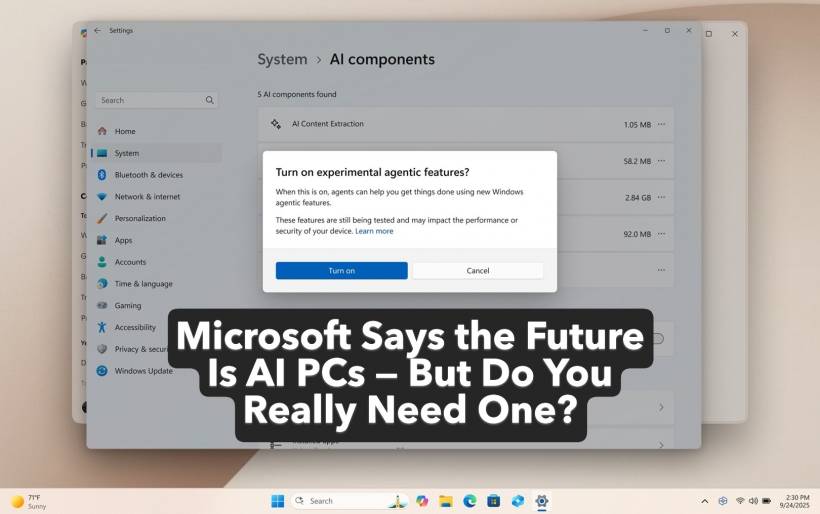
According to Microsoft, if you want to be "ready for the next generation of computing," upgrading your PC may no longer be optional. At least, that's the message coming from the company's latest marketing push. The argument is simple: if you're not using a Copilot+ PC, you're already falling behind.
In Microsoft's view, we've entered a new era where all modern PCs are now "AI PCs." And if your hardware doesn't meet that bar, you're supposedly missing out on an entirely new class of computing.
What Exactly Is a Copilot+ PC?
Microsoft draws a clear line between regular Windows 11 machines and what it calls Copilot+ PCs. As the company puts it, all Copilot+ PCs run Windows 11, but not every Windows 11 PC qualifies as Copilot+.
So what makes the cut?
To earn the Copilot+ label, a PC needs:
Anything below that threshold, even relatively new hardware, doesn't qualify. That means some earlier "AI PCs" are already being left out simply because their NPUs aren't powerful enough.
The NPU Obsession
For those unfamiliar, an NPU, or Neural Processing Unit, is a dedicated processor designed specifically for AI and machine learning tasks. Microsoft is heavily betting on NPUs as the foundation for future Windows features, arguing that on-device AI is more secure, faster, and more efficient than cloud-based alternatives.
What Microsoft doesn't emphasize is that many modern GPUs, especially those found in gaming laptops, are already more than capable of running local AI models. But that doesn't fit neatly into the Copilot+ narrative, nor does it help sell a new generation of premium hardware.
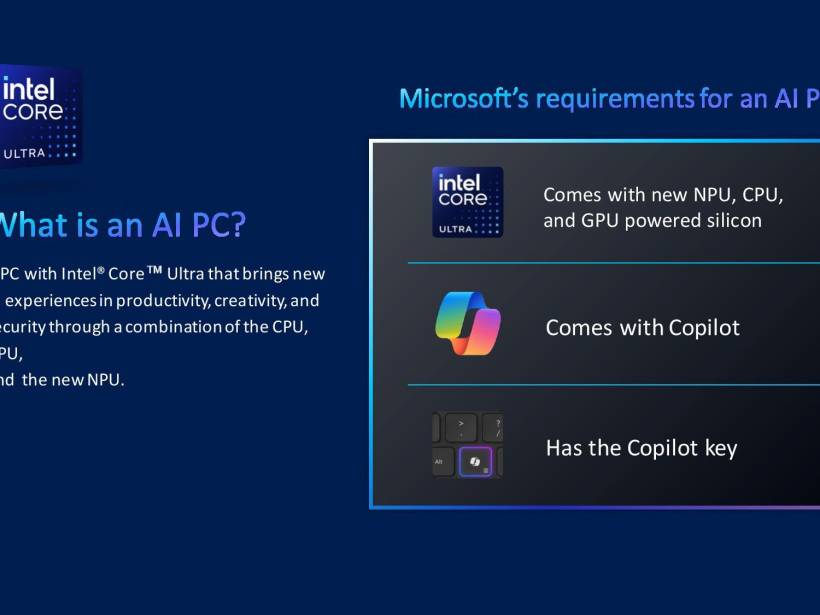
"The Fastest, Most Intelligent Windows PCs Ever"
In its marketing materials, Microsoft describes Copilot+ PCs as the fastest and smartest Windows machines ever made, designed not just for today's AI features but for whatever comes next. The company claims that upgrading now ensures you're prepared for the future of computing.
What's less clear is how this future actually benefits everyday users, especially when the biggest visible impact so far has been rising hardware prices. RAM, GPUs, and now NPUs are all contributing to increasingly expensive PCs, largely driven by AI expectations rather than practical needs.
Productivity, According to Microsoft
Microsoft insists that Copilot+ PCs significantly boost productivity and creativity. It points to several built-in features as evidence.
Copilot itself is front and center, now accessible via a dedicated keyboard key on newer devices. From summarizing content to generating text and images, Microsoft positions it as a constant assistant baked into the operating system.
Then there's Recall, a feature that quietly faded from the spotlight for a while but has resurfaced. Recall periodically captures snapshots of your screen to build a searchable timeline of your activity, allowing you to ask questions like what you were working on last week. While powerful in theory, it has also raised eyebrows over privacy and data security.
Other highlighted features include live captions with real-time translation, AI-powered image generation in Paint, object removal and background blur in Photos, and Windows Studio Effects that enhance video calls with lighting correction and background effects.
Some of these tools are genuinely useful. Others feel more like incremental conveniences than must-have reasons to replace perfectly good hardware.
Are AI PCs Really the Only Path Forward?
Despite Microsoft's confidence, not everyone in the PC industry seems fully convinced. Some manufacturers, including Dell, appear to be easing back on an AI-only message, instead refocusing on build quality, performance, and gaming — areas consumers have consistently cared about long before AI became the buzzword of the moment.
For now, Copilot+ PCs are clearly here to stay, at least while the AI hype cycle continues. Whether they truly represent the next generation of computing, or just the next wave of expensive upgrades, remains an open question.
And for users who are perfectly happy with their current machines, the future might not look quite as urgent as Microsoft would like it to seem.










Comments