

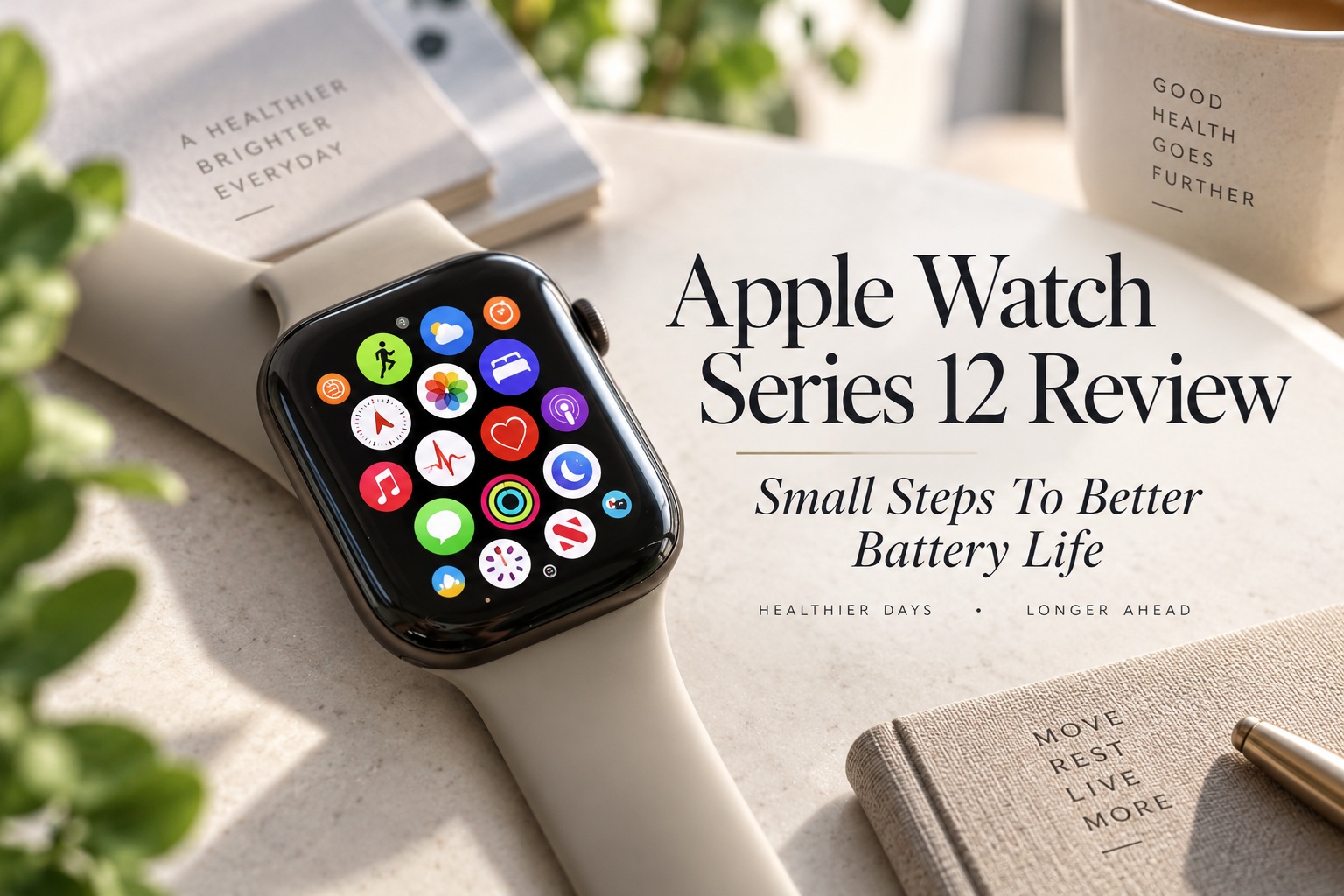
Apple introduced the Watch Series 12 alongside the Watch Ultra 4 last September, bringing a new S11 chipset, redesigned health sensors and improved battery endurance to its mainstream smartwatch lineup. On paper, the changes sound meaningful, but visually the Series 12 remains very familiar. Apple has once again chosen refinement over reinvention, keeping the overall design largely unchanged while improving the things happening underneath the surface.
After spending time with the 42mm version, the Series 12 feels exactly like what you would expect from a mature Apple Watch. It is polished, responsive and extremely easy to live with, but it does not dramatically change the experience for anyone coming from the last couple of generations. The most worthwhile improvements are concentrated around health monitoring, the new Readiness Score and battery life, although whether those are enough to justify an upgrade depends heavily on which Apple Watch you already own.
A Familiar Design With Very Few Surprises
If you have used an Apple Watch over the last several years, the Series 12 will immediately feel familiar. Apple continues to offer the watch in 42mm and 46mm sizes, with aluminium and titanium finishes available depending on configuration. The new gold aluminium option adds some freshness, but otherwise, the overall appearance remains close to its predecessors.
The 42mm model feels comfortable enough to wear throughout the day and overnight. It is relatively light, the silicone strap is easy to put on and remove, and the smaller size works nicely for users who do not want something bulky sitting on their wrist. Those with larger wrists will probably find the 46mm version more proportionate.
The display remains one of the better parts of the experience. It can reach up to 2,000 nits of brightness outdoors while dropping as low as one nit in darker environments. That gives it enough range to remain readable under bright sunlight without becoming distracting when checking the time at night.
S11 Chip Brings New Hardware Underneath
Inside, the Series 12 runs on Apple's new S11 chipset, which draws on technology from the A20 Pro architecture used in the iPhone 18 Pro. The additional performance helps keep the interface consistently smooth, although the difference is not especially obvious during normal day-to-day use.
Apps open quickly, scrolling remains fluid and interactions generally feel instantaneous. That is good news, but it also highlights how capable the Series 11 already was. For someone coming directly from last year's model, the Series 12 does not suddenly feel dramatically faster.
Where the new hardware becomes more interesting is in supporting Apple's expanded health monitoring and background processing.
Health Tracking Is Where The Bigger Improvements Are
Apple has redesigned the heart-rate sensing hardware and claims the Series 12 delivers its most accurate readings yet. It is difficult to independently verify such claims without medical-grade equipment, but the watch certainly collects considerably more health information than before.
Background heart-rate measurements now occur approximately every five seconds, while heart-rate variability, or HRV, can be measured up to 24 times more frequently than on previous models. This creates a much richer picture of how the user's body behaves throughout the day and especially overnight.
That additional data feeds into Apple's broader wellness metrics, including Sleep Score and the new Readiness Score.
The Watch Became Surprisingly Useful While I Was Sick
One thing that made the health tracking more noticeable during testing was getting the flu.
During periods of fever, coughing and generally feeling terrible, the Series 12 picked up significant changes in heart rate. Watching those changes develop throughout the illness provided a useful indication that the body was clearly under more stress than usual.
That does not prove that the new sensors are more accurate than the previous generation, nor should anyone treat the Apple Watch as a medical diagnostic device. Still, there is something reassuring about having continuous measurements available when you are feeling unwell.
Instead of relying entirely on how you think you feel, you have another set of data points showing that something has changed.
Readiness Score Makes Health Data Easier To Understand
The new Readiness Score is one of the more useful additions because it attempts to turn several different health metrics into something easier to interpret.
The score ranges from zero to 10 and considers factors such as:
• Sleep quality
• Vital signs
• Training load
• Recent physical activity
Apple then translates the result into categories including Recover, Pace Yourself, Ready, and Go For It.
The concept is straightforward: instead of digging through multiple graphs and trying to interpret them individually, you get a quick summary of whether your body appears ready for harder activity or whether it might be better to take things easier.
You Need A Week Of Data Before It Becomes Useful
Readiness Score does not work immediately after putting the watch on. Much like Sleep Score, the Series 12 needs around seven nights of sleep data before it can establish a personal baseline.
That makes sense because the watch needs to understand what normal looks like for you before it can identify meaningful deviations.
Once that baseline exists, Readiness Score becomes more useful because the result is based on your own patterns rather than a generic benchmark.
Even then, these scores should be treated as guidance rather than medical advice. They can help make you more aware of sleep, recovery and activity patterns, but they should not replace proper medical evaluation when something feels wrong.
ECG And Blood Oxygen Tracking Remain Available
Existing health features such as ECG and blood oxygen monitoring remain part of the Series 12 experience.
For long-term Apple Watch users, these features may no longer feel particularly new, but together they contribute to what is now a fairly comprehensive consumer wellness platform.
Apple's advantage here is less about any single sensor and more about how all the measurements gradually build a picture of the user's daily health.
Heart rate, HRV, sleep, activity, ECG and blood oxygen can all contribute useful context when viewed over weeks or months.
Workout Detection Remains Convenient
Automatic workout detection is still one of those features you appreciate most when you forget to start tracking manually.
If the Series 12 detects an activity such as walking for around five to 10 minutes, it can suggest starting a workout session. Importantly, the watch has already been tracking the movement before the prompt appears, so you do not completely lose the first part of the activity.
Users who find those notifications annoying can disable them, but having the option is useful.
For casual fitness users, automatic detection removes some of the friction involved in tracking everyday exercise.
Single Tap Joins Double Tap And Wrist Flick
Apple has also expanded gesture controls with a new single-tap gesture, joining the existing double-tap and wrist-flick interactions.
These gestures can be used to navigate Smart Stack widgets, dismiss notifications, silence timers and return to the watch face without touching the screen.
None of these functions sounds revolutionary, but they can become surprisingly convenient once they become part of muscle memory. Being able to interact with the watch while your other hand is carrying something, cooking or occupied with another task is where gesture control starts to make sense.
The feature works particularly well alongside Apple Pay, media controls and remote camera functions, all of which reinforce the Apple Watch's role as a convenient extension of the iPhone.
Battery Life Is Better, But Still Not Great
Battery life remains the most obvious weakness of the Apple Watch experience.
The good news is that the Series 12 genuinely improves things. Apple claims more than two days of usage, or approximately 50 hours, and that was achievable during relatively casual testing.
That makes overnight sleep tracking far easier because there is less pressure to charge the watch every evening.
However, the result is still nowhere near the multi-day endurance offered by many competing smartwatches.
Two Days Is Better Than One, But Five Would Be Better
For a casual user, two days of battery life is perfectly manageable. You can wear the watch throughout the day, sleep with it overnight and still have enough battery to continue well into the following day.
Heavy GPS use, frequent workouts or more intensive features will naturally shorten that endurance.
Charging is reasonably fast, with a full top-up taking roughly an hour during testing. That helps, but the proprietary charging puck still needs to remain somewhere nearby.
A future Apple Watch capable of lasting five days without requiring users to disable features would make a much bigger difference to everyday convenience.
For now, the Series 12 is better, but battery anxiety has not completely disappeared.
Extended Battery GPS Modes Give Athletes More Flexibility
Apple has also introduced revised Extended Battery GPS and Max Extended Mode options.
These are designed to stretch battery life during longer activities where GPS usage would normally consume a significant amount of power.
That could make the Series 12 more useful for long-distance walking, cycling or outdoor activities without requiring users to move up to the larger Apple Watch Ultra.
Casual users may rarely need these modes, but they improve flexibility for those who want longer endurance without sacrificing GPS tracking completely.
Some Health App Icons Could Still Be Clearer
Most of the watchOS experience is intuitive, but there are still a few small interface issues.
Some health-related icons, particularly those for Blood Oxygen and Cycle Tracking, may not be immediately obvious to new Apple Watch users. People familiar with the ecosystem will learn them quickly, but first-time owners may need to open several apps before remembering which icon belongs to which feature.
Switching to Grid View can make things easier by providing a more recognisable visual layout, although this remains a relatively minor complaint.
Audio Intelligence Is Interesting, But Also Slightly Uncomfortable
Apple is also expanding what it calls Audio Intelligence, and this is probably where the Series 12 becomes more controversial.
Sound Recognition can already listen for environmental sounds such as sirens, doorbells or a baby crying. Instant Shazam can identify music simply by raising the wrist.
Those features are relatively easy to understand.
Upcoming capabilities such as Live Rewind and Siri Recap, however, push the idea considerably further.
Live Rewind Can Capture The Previous 15 Seconds Of Speech
Live Rewind is designed to transcribe the previous 15 seconds of spoken audio.
The idea is that if someone says something important and you miss it, the watch can help recover what was just said.
Technically, that could be extremely useful in certain circumstances.
Privacy is the obvious concern.
For Live Rewind to function, the watch needs to maintain enough awareness of surrounding audio to reconstruct the recent conversation. Even if processing occurs entirely on the device, some users will understandably feel uncomfortable about having a wearable continuously listening to ambient speech.
Siri Recap Could Summarise Conversations
Siri Recap goes a step further by summarising detected speech or conversations and turning the information into notes on the user's iPhone.
Apple says the processing happens locally and that users can configure or disable individual Audio Intelligence features independently.
That helps from a privacy perspective, but it may not completely reassure people who already dislike the idea of phones or smart assistants constantly listening.
For many users, these features may simply fall into the category of interesting technology they never enable.
Apple's Redesigned Health App Is Coming Later
Apple is also preparing a redesigned Health application scheduled to arrive later in the year.
Upcoming functionality includes:
• AI-generated health summaries
• Health Age
• Additional wellness metrics
These could eventually make the Series 12 considerably more useful because the large amount of data collected by Apple Watch becomes more valuable when software can explain it clearly.
However, it rarely makes sense to buy hardware primarily based on future software.
Until those features actually launch and can be evaluated properly, they should be treated as potential bonuses rather than reasons to purchase the watch today.
So, Who Should Upgrade?
The answer depends heavily on which Apple Watch you currently own.
For users with a Series 9 or older, the cumulative improvements across several generations make the Series 12 worth considering. The better health tracking, brighter display, gesture controls and improved battery life add up to a noticeably more capable experience.
For someone already using a Series 10 or Series 11, the argument becomes much weaker.
The new health metrics are useful, but the overall watch experience remains extremely similar. Unless the Readiness Score or additional heart-rate monitoring is particularly important to you, there is little urgency to upgrade.
Recent Apple Watch Ultra owners have even fewer reasons to move across.
RM1,799 Is Still A Significant Investment
The Apple Watch Series 12 starts at RM1,799, keeping it firmly in premium smartwatch territory.
The price is hardly surprising for an Apple wearable, but it becomes more difficult to justify when existing Series 10 and Series 11 models already provide most of the same experience.
Older generations could actually become more appealing as retailers reduce prices following the launch of the Series 12.
For someone entering the Apple Watch ecosystem for the first time, comparing the latest model against discounted previous-generation hardware may therefore be worthwhile.
The Apple Ecosystem Remains Its Biggest Strength
One thing specifications cannot fully capture is how smoothly the Apple Watch integrates with the rest of Apple's ecosystem.
Notifications, Apple Pay, music control, iPhone camera control, health information and other services all work together with relatively little effort.
For iPhone users, that integration remains one of the strongest reasons to choose an Apple Watch over competing wearables.
The Series 12 does not fundamentally change that formula. It simply makes an already polished ecosystem slightly better.
Final Thoughts
The Apple Watch Series 12 is another refinement rather than a major reinvention. Its redesigned health sensors, more frequent heart-rate and HRV monitoring, new Readiness Score and improved battery endurance all move the platform forward, but none completely transforms the experience.
Battery life exceeding two days is probably the improvement users will notice most in everyday life, particularly those who regularly track sleep. Even so, Apple still has plenty of room to improve when competing smartwatches can operate for several days or even a full week between charges.
For anyone using a Series 9 or older Apple Watch, the accumulated improvements make the Series 12 a compelling upgrade. Series 10 and Series 11 owners can comfortably wait another generation unless the new health features genuinely matter to them.
Ultimately, the Series 12 is arguably the best mainstream Apple Watch Apple has produced so far. It just happens to arrive at a point where the previous models were already very good, making the question less about whether the Series 12 is worth buying and more about whether your current Apple Watch actually needs replacing.











Comments 0