

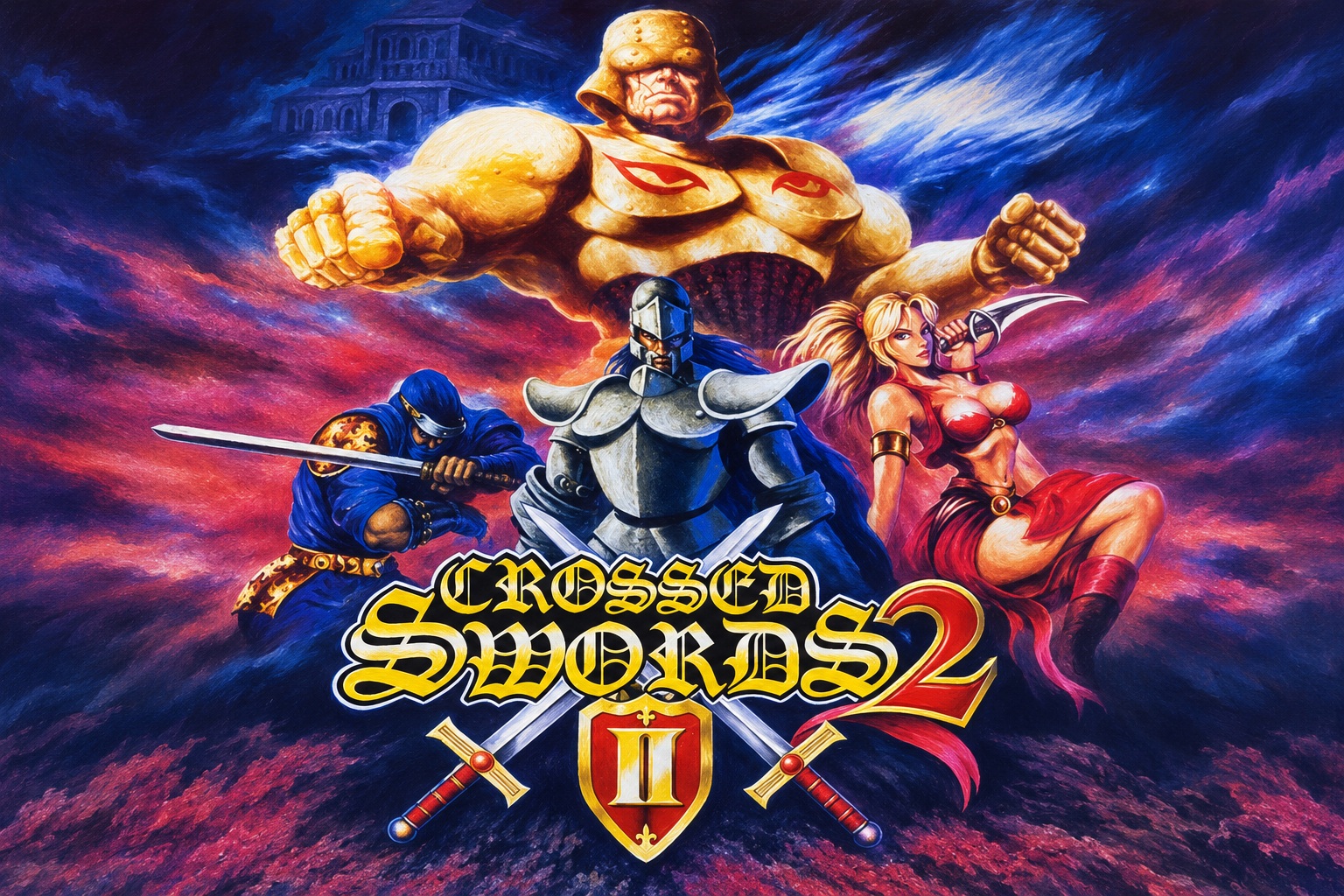
Crossed Swords II expands the unusual sword-fighting formula of the original Crossed Swords into a faster and more flexible fantasy action RPG. Developed by ADK and released in 1995 for the Neo Geo CD, the sequel returns to the kingdom of Belkana after the apparent defeat of the demon Nausizz. Peace does not last, however, as the demonic castle rises once again and hostile forces begin threatening the kingdom. Three warriors answer the call, giving players more choice than the single heroic archetype of the original adventure.
The distinctive behind-the-character viewpoint remains central, with the player represented by a semi-transparent warrior positioned directly in front of approaching enemies. Combat still rewards careful observation, high and low blocking, well-timed counterattacks, and strategic use of magic, but Crossed Swords II introduces jumping and dashing to make movement significantly more dynamic. Dash attacks can stun enemies and open opportunities for follow-up strikes, while aerial attacks provide another way to pressure opponents. The result keeps the deliberate defensive structure of Crossed Swords while allowing much more aggressive play.
Now playable online through Lemon Web Games, Crossed Swords II brings its fantasy sword combat, three playable heroes, improved movement, defensive blocking, RPG progression, magic, cooperative action, story campaign, and Karividu Arena directly into the web browser. Players can choose a combat style, learn enemy attack patterns, earn experience, strengthen their warrior, and push deeper into the forces surrounding Nausizz. The sequel is immediately recognizable to anyone familiar with the first game, yet the additional mobility and character selection make battles feel considerably more varied. For fans of unusual Neo Geo action games, Crossed Swords II is a fascinating refinement of one of ADK's most distinctive ideas.
Belkana Faces Nausizz Once Again
The story takes place after the kingdom of Belkana had seemingly been saved from Nausizz. With the demon defeated, the land finally appeared capable of returning to peace.
That peace proves temporary when Nausizz and his forces return. The reappearance of the demonic castle signals that the earlier victory did not permanently eliminate the threat.
This gives the sequel a straightforward reason to return to the world of Crossed Swords while allowing the developers to expand the combat system. The kingdom is familiar, but the warriors sent to defend it now have more abilities available.
Three Heroes Offer Different Fighting Styles
Crossed Swords II allows players to choose between the Knight, Dancer, and Ninja. Each provides a different balance of strength, speed, and overall combat ability.
The Knight is the more powerful option, favouring stronger attacks and a straightforward approach. The Dancer emphasizes speed and agility, while the Ninja provides a more balanced combination of offensive and defensive capabilities.
Character choice therefore influences the rhythm of the entire adventure. Players who struggled with one style may find another hero much better suited to the way they naturally approach combat.
The Transparent Warrior Perspective Returns
The sequel preserves the unusual viewpoint that defined the original Crossed Swords. The player's character remains partly transparent in the foreground while enemies stand directly ahead.
This allows incoming attacks to remain visible even though the hero occupies a large portion of the screen. It also makes every battle feel more personal than a traditional side-scrolling beat 'em up.
The perspective still resembles a pseudo-first-person sword duel despite using sprite-based arcade graphics. Very few action RPGs use anything comparable, even today.
High and Low Blocking Remain Essential
Defence is still one of the most important skills in Crossed Swords II. Enemies can attack different parts of the body, requiring players to choose the correct block height.
Holding the wrong defence can result in damage even when the player recognized that an attack was coming. This makes reading enemy animation extremely important.
Later enemies mix their attacks more aggressively and punish predictable defensive habits. Successful players learn to identify the attack first and respond second rather than simply blocking continuously.
Dashing Makes Combat Much Faster
One of the biggest improvements is the ability to dash. The new movement gives players a faster way to close distance, reposition, or create offensive momentum.
A dash can lead into a horizontal sword attack capable of stunning opponents and creating opportunities for additional strikes. This makes aggressive movement much more practical than in the original game.
Dashing also helps the player control spacing. Instead of waiting passively for every enemy to approach, the hero can now influence when and where an exchange begins.
Jumping Adds Vertical Movement
Crossed Swords II also introduces jumping, giving the player another way to evade danger and attack from a different angle.
Aerial movement can lead into a strong downward sword strike, providing another offensive option against enemies that are difficult to approach normally. Jumping also helps the sequel feel less mechanically restricted than its predecessor.
The ability should still be used carefully. An unnecessary jump can create vulnerability if the landing is poorly timed, especially against faster opponents.
Sword Attacks Still Depend on Timing
Despite the added mobility, Crossed Swords II does not become a button-mashing action game. Regular sword attacks remain most effective after the player creates a clear opening.
Blocking an enemy successfully and responding with a quick counter is often safer than starting an exchange blindly. Stronger enemies can punish careless attacks almost immediately.
The sequel therefore preserves the original game's duel-like rhythm. New movement options expand what the player can do without removing the importance of patience.
Magic Provides Powerful Support
Magic remains available when ordinary sword attacks are not enough. It can help against dangerous enemies, crowded encounters, or bosses where maintaining close range is especially risky.
Because magical power is limited, timing matters. Using a powerful spell against an ordinary opponent may leave the player without enough resources when a much stronger enemy appears.
The best approach is to treat magic as another tactical tool rather than the default attack. Saving it for difficult situations can dramatically improve survival.
RPG Progression Rewards Continued Combat
Experience gained throughout the adventure allows the chosen warrior to become stronger. This progression separates Crossed Swords II from pure arcade brawlers.
Defeating enemies contributes toward long-term improvement rather than simply clearing another screen. The character gradually becomes better prepared for the increasingly dangerous opposition ahead.
This also makes survival more satisfying. The warrior who reaches later areas reflects all of the battles already completed.
The Nausizz Counterattack Is the Main Story Mode
The primary campaign is built around stopping Nausizz's renewed assault on Belkana.
Players travel through a sequence of fantasy environments, fight increasingly dangerous enemies, and gradually approach the central threat. The structure remains focused enough to preserve an arcade pace while still providing RPG-style development.
Boss encounters provide major milestones and demand stronger defensive timing than ordinary battles. They often expose weaknesses in a player's technique very quickly.
Karividu Arena Adds a Survival Challenge
Crossed Swords II also includes the Karividu Arena, giving players another way to test the combat system outside the normal story campaign.
The arena focuses on fighting increasingly dangerous opponents one after another. With fewer distractions from exploration or story progression, combat skill becomes the entire focus.
This mode is particularly useful for players who already understand blocking, dashing, jumping, and counterattacking. It provides a straightforward test of how long those skills can survive against escalating opposition.
Enemy Patterns Matter More Than Raw Aggression
Different opponents attack at different heights, ranges, and speeds. Recognizing those patterns gradually makes difficult encounters more manageable.
The first meeting with an unfamiliar enemy may feel dangerous because its timing is unknown. After several encounters, the same creature becomes easier to read.
This creates a traditional arcade learning curve. Character progression helps, but player knowledge remains equally important.
Bosses Demand Strong Defence
Boss encounters usually have enough durability to survive reckless attempts at overwhelming them. Players need to remain disciplined and wait for safe openings.
Dashing and jumping provide additional opportunities, but neither mechanic removes the need for proper blocking. Using movement carelessly can simply create another way to take damage.
Magic becomes particularly valuable during these battles. A well-timed spell can shorten a difficult fight or recover momentum after a mistake.
Two-Player Co-Op Returns
Cooperative play allows a second warrior to join the fight, bringing classic Neo Geo multiplayer energy into the adventure.
Two players can divide enemy attention and create additional pressure during difficult encounters. Bosses also become easier to manage when both warriors coordinate attacks instead of competing for the same opening.
Co-op does not eliminate the need for timing, however. Both players still need to defend properly and avoid wasting limited resources.
The Dark Fantasy Presentation Remains Distinctive
Crossed Swords II retains the medieval fantasy atmosphere of the original, with armoured warriors, demons, monsters, magic, castles, and hostile environments forming the backdrop to the campaign.
The Neo Geo presentation gives enemies and characters large sprites with strong visual presence. The transparent player character remains one of the most recognizable elements.
Combined with the unusual perspective, the fantasy setting helps Crossed Swords II stand apart from the fighting games and shooters more commonly associated with Neo Geo hardware.
Playing Crossed Swords II Online Today
Through Lemon Web Games, Crossed Swords II can now be played directly in your web browser with no downloads or setup required. Features of the web-based version include:
New players should still treat defence as the foundation of combat. Learn how each enemy signals high and low attacks before experimenting heavily with dashes and jumps. The new movement options are strongest when they are used to exploit an opening rather than replace careful blocking.
Players should also experiment with all three heroes. Their differences can significantly change how comfortable the game feels, and a faster Dancer or more balanced Ninja may suit someone who finds the Knight's heavier approach too deliberate.
Who Should Play Crossed Swords II
Crossed Swords II is particularly suitable for players who enjoyed the first game but wanted greater movement freedom. Dashing and jumping make combat more flexible without abandoning the unusual defensive swordplay that gave the original its identity.
It should also appeal to players exploring lesser-known Neo Geo releases. Its combination of RPG progression, pseudo-3D combat, selectable heroes, fantasy atmosphere, and cooperative play remains unusual within the system's library.
Play Crossed Swords II Online Now
Crossed Swords II returns to Belkana with Nausizz once again threatening the kingdom, but this time the warriors have far more ways to fight back. Choose the Knight, Dancer, or Ninja, block incoming attacks, dash toward openings, leap into aerial strikes, use magic, and strengthen your hero as the campaign pushes closer to the demonic castle.
Through Lemon Web Games, players can experience Crossed Swords II directly in the browser and discover a sequel that expands nearly every important idea from the original. The strange viewpoint remains, but combat is faster, more mobile, and better suited to different play styles.
Final Thoughts
Crossed Swords II is a strong example of a sequel improving its predecessor without abandoning what made it unusual. The transparent behind-the-character viewpoint, defensive swordplay, magic, and RPG progression remain intact, while dashing, jumping, three playable heroes, and the Karividu Arena create much greater variety.
The result feels noticeably faster without losing the importance of observation. Enemies still need to be read carefully, blocks still need to match the attack height, and reckless offence still creates problems. The new mechanics simply provide more ways to take advantage once the correct opening appears.
Through Lemon Web Games, Crossed Swords II can now be enjoyed directly in the browser as one of ADK's most distinctive fantasy action games. For players who enjoy sword duels, character progression, co-op combat, and unusual arcade experiments, the return to Belkana remains well worth experiencing.











Comments 0