

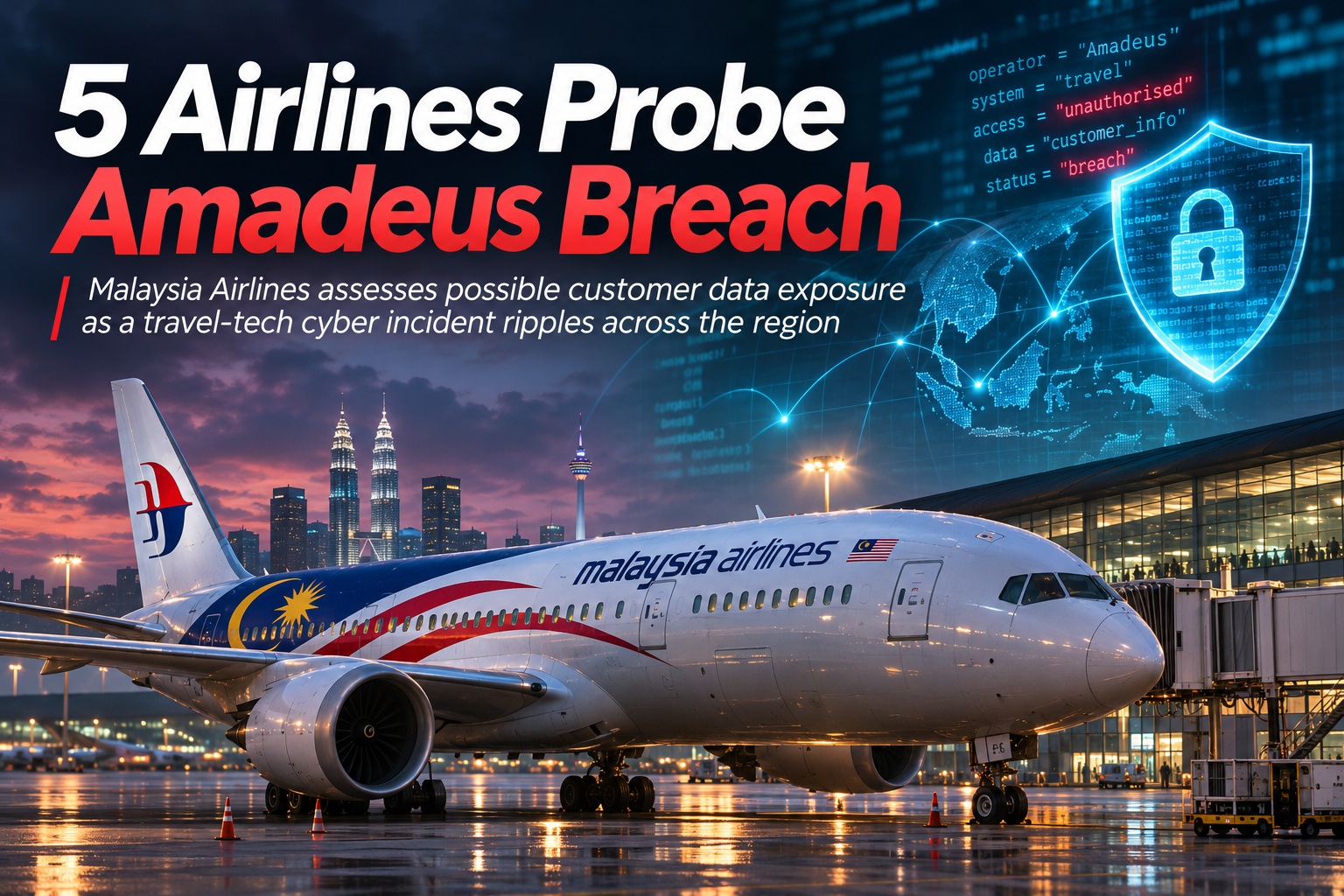
Malaysia Airlines has become one of several major Asia-Pacific carriers caught up in a cybersecurity incident involving Amadeus, the global travel technology provider used extensively for airline reservations, booking management and other passenger-related services. The breach did not originate from Malaysia Airlines' own systems, but the airline has acknowledged that certain customer information processed through Amadeus may have been affected. That distinction is important because an airline can maintain secure internal systems while still facing customer-data exposure through a third-party technology provider.
The incident is also affecting or being investigated by several other airlines, including Qantas, Japan Airlines, ANA, Cathay Pacific, Korean Air and Asiana. Details remain limited, with airlines releasing information at different times as they work with Amadeus to determine what information was accessed and which passengers may have been affected. For Malaysia Airlines customers, the most important issue now is understanding what information may have passed through Amadeus and whether that information could be useful to criminals even if payment details were not compromised.
Malaysia Airlines Says Certain Customer Information May Have Been Affected
Malaysia Airlines has said that certain customer information processed through Amadeus may have been impacted by the incident. Based on the information currently available, the potentially affected data appears to relate to information handled through Amadeus between August 2023 and September 2026, creating a potentially lengthy exposure window that spans more than three years.
Exactly which categories of Malaysia Airlines customer information were involved have not been fully detailed in the available information. This means passengers should avoid assuming that every booking or every customer during the stated period was compromised. At the same time, the length of the possible processing window makes the incident significant enough to justify close monitoring until Malaysia Airlines and Amadeus provide more precise information.
The Amadeus Incident Does Not Mean Malaysia Airlines' Own Systems Were Hacked
One of the most important distinctions is where the unauthorised access occurred. The incident involves an Amadeus system, rather than evidence that attackers directly breached Malaysia Airlines' internal infrastructure. Airlines rely heavily on external reservation and travel technology platforms, meaning passenger information can exist both inside the airline's own systems and within systems operated by service providers.
This creates a familiar cybersecurity problem known as third-party or supply-chain risk. An organisation may maintain strong internal cybersecurity controls and still become affected when a vendor processing its data experiences a breach. For passengers, the practical consequence can be the same: information associated with their booking may potentially be exposed even though the airline's own environment remains secure.
What Is Amadeus And Why Does It Matter To Airlines?
Amadeus provides technology used throughout the global travel industry, including reservation systems, passenger processing, distribution and other services connecting airlines, travel agencies and booking platforms. This type of infrastructure allows different organisations involved in a journey to access the information required to issue tickets, manage reservations and support travellers.
The advantage is enormous efficiency, but the concentration of data also creates cybersecurity risk. When one widely used technology provider suffers a compromise, the incident can potentially affect multiple airlines simultaneously. Instead of attacking each airline individually, an attacker who gains access to shared infrastructure may reach information connected to several carriers through one point of compromise.
Several Major Airlines Are Investigating The Same Incident
The reports surrounding the Amadeus incident involve multiple airlines across the Asia-Pacific region. The exact status differs between each carrier because investigations are being conducted independently and disclosures are arriving at different times.
| Airline | Reported Status |
| Malaysia Airlines | Says certain customer information processed through Amadeus may have been affected |
| Qantas | Investigating impact on bookings; says its own systems and databases remain secure |
| Japan Airlines | Reported as impacted or potentially impacted |
| ANA | Reported as impacted or potentially impacted |
| Cathay Pacific | Reported as impacted and has acknowledged the incident |
| Korean Air | Reported as impacted or potentially impacted |
| Asiana | Reported as impacted or potentially impacted |
The important point is that these airlines appear connected through the same technology provider rather than through a common compromise of their individual networks. This is exactly why large shared technology platforms can create concentration risk across an entire industry.
Malaysia Airlines Provides One Of The Clearest Exposure Windows So Far
Malaysia Airlines' description provides one of the more useful pieces of information currently available because it identifies the period during which customer information processed through Amadeus may have been affected. The stated range extends from August 2023 until September 2026, although this should not automatically be interpreted as confirmation that attackers had uninterrupted access for that entire period.
A processing window and a confirmed intrusion period are not necessarily the same thing. The dates may represent the range of records potentially exposed based on what existed inside the affected Amadeus environment rather than the exact amount of time an attacker maintained access. More detailed forensic information would be needed before drawing conclusions about how long the intrusion lasted.
Amadeus Says The Incident Was Contained In September
Amadeus has reportedly told airline customers that the issue was contained in September. Containment means the company believes the unauthorised access has been stopped, but it does not necessarily explain when the attacker first entered the environment or how long access persisted beforehand.
This distinction matters greatly during breach investigations. Knowing when an incident was contained tells us when malicious activity was stopped, while knowing when initial access occurred determines the actual exposure period. Until Amadeus provides a complete timeline, there remains uncertainty over how long the compromised environment may have been accessible.
No Evidence Of Payment Or Financial Data Access So Far
One reassuring element is that Amadeus has said there is no evidence that payment records or financial information were accessed. That reduces the immediate concern around direct credit card theft or financial fraud originating from the breach, although customers should still monitor their accounts as a normal precaution.
The wording "no evidence" is important because cybersecurity investigations can change as additional forensic analysis becomes available. It is stronger than having no information at all, but it is not necessarily equivalent to independently proving that payment information could not have been accessed under any circumstances. For now, however, there is no indication that financial data forms part of the known exposure.
Booking Information Can Still Be Valuable Without Payment Data
The absence of payment information does not make booking data harmless. Airline reservation information can include names, travel dates, routes, booking references and other details capable of making phishing attacks significantly more believable. An attacker who knows a passenger is travelling to London next week can create a much more convincing fake message about a schedule change than someone sending random airline-themed spam.
Booking references can also be sensitive depending on how airlines and travel services use them. Even when they do not provide direct account access, they can give criminals contextual information useful for impersonation or social engineering. This makes travel data valuable even when no card numbers are involved.
Malaysian Travellers Should Be Alert For Highly Convincing Phishing
Malaysia Airlines passengers should be particularly cautious about emails, SMS messages or WhatsApp messages that appear to reference genuine travel details. A scammer who possesses a traveller's name, destination and departure date could imitate Malaysia Airlines or a travel agent and claim that payment, rebooking or identity verification is required.
The safest approach is to avoid clicking unexpected links contained in messages about bookings. Instead, customers should open the Malaysia Airlines application or type the airline's website address directly into their browser. If something appears unusual, contacting the airline through an official customer-service channel is safer than responding to information contained inside an unsolicited message.
What Malaysia Airlines Customers Currently Know And Do Not Know
There is still a significant difference between information that has been confirmed and questions that remain unanswered. Separating the two helps prevent speculation from being repeated as fact.
| Question | Current Status |
| Was there unauthorised access to an Amadeus system? | Confirmed |
| Could Malaysia Airlines customer information be affected? | Malaysia Airlines says certain information may have been affected |
| Possible Malaysia Airlines data-processing period | August 2023 to September 2026 |
| Was Malaysia Airlines' own network breached? | No such breach has been established in the provided information |
| Were payment or financial records accessed? | Amadeus says there is no evidence of this |
| Exact number of Malaysia Airlines customers affected | Not confirmed |
| Exact types of Malaysia Airlines data affected | Not fully confirmed |
| Was Malaysia Airlines customer information actually extracted? | Not publicly confirmed |
| Who carried out the attack? | Not confirmed |
| Exact date attackers first gained access | Not confirmed |
The amount of uncertainty means customers should be careful about dramatic claims circulating online. Until Malaysia Airlines or Amadeus publishes more detailed findings, record counts and exact data categories should not be guessed.
Third-Party Breaches Can Affect Airlines Without Touching Their Networks
The incident demonstrates why modern cybersecurity cannot stop at the organisation's own perimeter. Airlines need external providers for reservations, loyalty programmes, airport operations, payments, messaging and countless other functions. Each provider potentially handles information originating from the airline and its customers.
If that supplier suffers a compromise, the airline may need to notify customers even though none of its servers were directly attacked. This can be frustrating for organisations because much of the security responsibility sits outside their direct control, yet customers understandably still associate the breach with the company they originally gave their information to.
Malaysia Airlines Depends On A Wider Technology Supply Chain
A modern airline is effectively a large digital ecosystem connecting reservation technology, airports, travel agencies, payment platforms and third-party service providers. Customer information needs to move across these systems so that flights can be booked, changed and processed efficiently.
That interconnected environment creates multiple opportunities for third-party risk. Security therefore depends not only on protecting Malaysia Airlines' own infrastructure but also on ensuring suppliers maintain appropriate controls around the information they receive. Vendor security assessments and contractual security requirements become increasingly important as more passenger processing moves through external platforms.
One Supplier Can Become A Concentration Risk
The fact that several major airlines are connected to the same incident demonstrates the concentration risk created by widely used technology providers. One compromise can create consequences simultaneously across carriers in Malaysia, Australia, Japan, Hong Kong and South Korea.
This does not mean airlines should avoid shared platforms entirely because doing so would be unrealistic. Instead, the industry needs stronger controls around how much data suppliers retain, how systems are segmented and how quickly airlines receive notifications after unauthorised activity is detected.
Data Retention Is Another Important Question
The reported Malaysia Airlines exposure period stretching back to August 2023 raises an important question about how long travel information is retained by technology providers. Organisations should generally avoid keeping customer information longer than required for legitimate operational or regulatory reasons.
The more historical data stored within a platform, the larger the potential impact when that system is compromised. Data minimisation therefore reduces both privacy risk and the amount of information attackers can obtain during a breach. Companies should regularly review whether every stored data field still serves a legitimate business purpose.
The Attack Shows Why Vendor Monitoring Matters
Traditional vendor security assessments often happen when a contract is first signed and then receive limited attention afterwards. That approach is increasingly inadequate because a supplier's security environment can change significantly over several years.
Critical technology vendors should be continuously assessed based on vulnerabilities, security incidents and changes to the services they provide. Airlines also need clearly defined notification requirements so that they are informed quickly if customer information may be affected. Delayed notification can make incident response significantly harder.
Cyber Incidents In Aviation Can Have Wide Consequences
Airlines hold an unusual combination of personal information and highly specific travel data. Reservation systems can contain enough context to reveal where someone is travelling and when. For executives, government officials or other high-profile travellers, that information may be particularly sensitive.
Cybercriminals could potentially combine leaked booking information with data stolen from unrelated sources to build detailed profiles of individual passengers. The risk is therefore not limited to one leaked record but how several pieces of information can be combined.
Travel Information Can Strengthen Social Engineering
A generic phishing email saying "your flight has changed" may be easy to ignore. The same message containing the traveller's correct name, airline, destination and departure date becomes considerably more convincing.
Attackers frequently use information from breaches to personalise scams because credibility increases the chance someone will click a malicious link or provide additional information. Malaysia Airlines customers should therefore treat any unexpected communication about bookings with extra caution until the scope of the Amadeus incident becomes clearer.
Businesses Should Pay Special Attention To Corporate Travellers
Companies whose employees travel frequently should also consider the potential impact. Business travel records can reveal where executives or technical staff will be at particular times, creating opportunities for highly targeted impersonation attempts.
A criminal might pretend to be an airline, hotel or travel coordinator and send a message shortly before departure when the employee is already busy and more likely to react quickly. Corporate security teams may therefore want to remind frequent travellers about the incident and reinforce verification procedures around travel-related messages.
Passengers Should Use Official Channels To Check Bookings
Customers worried about their travel plans should access their booking directly through Malaysia Airlines' official app or website rather than following links received in unexpected messages. This provides a simple way to confirm whether a flight has actually changed.
If the booking appears normal inside the official platform, an email claiming urgent action is required should immediately be treated with suspicion. Taking a few seconds to verify independently is considerably safer than responding directly to a message that may have been constructed using leaked travel information.
Unique Passwords Remain Important
The incident does not currently indicate that Malaysia Airlines passwords were exposed, but using a unique password for every important service remains good practice. Attackers frequently combine information from different breaches, meaning credentials stolen from one unrelated service may later be tested against airline or loyalty accounts.
Using unique passwords prevents one compromised account from becoming a key to several others. A reputable password manager can make this considerably easier because users no longer need to memorise every password themselves.
Enable Multi-Factor Authentication Where Available
Multi-factor authentication provides another layer of protection against stolen credentials. Even if an attacker discovers the correct password, the additional verification step can prevent them from logging into the account.
Customers should enable stronger authentication where Malaysia Airlines or connected travel services support it. The same applies to email accounts because controlling a traveller's email can allow an attacker to reset passwords and access booking confirmations.
Customers Should Continue Monitoring Financial Accounts
Although Amadeus says there is no evidence that payment or financial records were accessed, routinely monitoring bank and credit card statements remains sensible. Suspicious transactions should be reported to the financial institution immediately.
This recommendation should not be interpreted as evidence that card details were compromised. It is simply normal security practice following any incident involving customer information, especially when forensic investigations remain ongoing.
Do Not Confuse Booking Data With Payment Data
Consumers sometimes hear that payment information was not exposed and assume the breach therefore has little significance. Travel records can still contain enough information to enable scams, impersonation or targeted fraud even without financial information.
Cybercriminals do not need a complete identity record from one database. They frequently combine smaller pieces from multiple sources. A passenger name and itinerary from one incident could be combined with a phone number or password exposed elsewhere.
Qantas Is Also Investigating The Amadeus Incident
Qantas confirmed that Amadeus informed it about unauthorised access to one of the provider's systems. The Australian carrier says its own systems and databases remain secure while it works with Amadeus to determine whether any Qantas booking information was affected.
This provides another example of the same third-party issue facing Malaysia Airlines. The airlines themselves may remain technically uncompromised while passenger information stored or processed by their common technology provider becomes part of an investigation.
Qantas Has Not Confirmed The Number Of Affected Bookings
At present, there is no confirmed number of Qantas customer records affected by the Amadeus incident. The airline is still assessing potential booking exposure, and reports have not established whether Qantas information was actually extracted.
This uncertainty is similar to the situation surrounding Malaysia Airlines, where the existence of potential exposure has been acknowledged but the detailed scope remains incomplete. Investigations of large technology providers can take time because customer data must be traced across many connected systems.
This Incident Is Separate From Qantas' 2025 Breach
The current Amadeus incident should not be confused with the separate cyber incident involving Qantas customer records in 2025. That earlier case involved approximately 5.67 million customer records and is a completely different event.
Carrying that figure into reporting about the Amadeus investigation would therefore be misleading. The current incident has no confirmed Qantas record count, and Malaysia Airlines similarly has not provided a confirmed number of affected customers in the information available.
Other Asian Carriers Are Also Involved
Reports have linked Japan Airlines, ANA, Cathay Pacific, Korean Air and Asiana to the Amadeus incident as affected or potentially affected carriers. Their involvement highlights how widely the travel technology provider is embedded within the aviation industry.
Each airline will need to conduct its own analysis because different carriers may store different information within Amadeus. One airline's confirmed exposure cannot automatically be applied to another.
The Full Picture May Take Weeks To Emerge
Large third-party breaches often produce fragmented disclosures because every affected customer organisation investigates independently. One airline may quickly confirm affected fields while another requires more time to understand which data was stored inside the compromised system.
This means the initial days after disclosure often contain more questions than answers. Passengers should expect additional details from Malaysia Airlines and Amadeus as the investigation develops rather than assuming the first statements represent the final picture.
Malaysia Airlines Should Provide More Detail Once The Investigation Progresses
For Malaysian customers, the most useful future update would be a clear explanation of what information was affected, how many passengers were involved and whether there is evidence that data was actually extracted. Customers should also be told whether specific groups of passengers need to take additional action.
Transparency is particularly important during third-party breaches because customers can become confused over which organisation actually suffered the compromise. Malaysia Airlines may not have been the entry point, but it remains the company with which Malaysian passengers have the direct relationship.
No Confirmed Threat Actor Has Been Identified
The information currently available does not identify who was responsible for gaining unauthorised access to the Amadeus system. There is also no confirmed link to a specific ransomware group, state-backed organisation or other known threat actor.
This is another area where speculation should be avoided. Attribution can require extensive forensic and intelligence work, and attackers frequently use infrastructure intended to hide their true identity.
There Is No Evidence The Breach Was Related To Other Recent Airline Attacks
The aviation industry has experienced several unrelated cyber incidents over recent years, but there is currently no evidence connecting the Amadeus breach to those campaigns. Similar timing or similar targets does not prove the same attackers were responsible.
Cybersecurity reporting needs to distinguish between an industry experiencing many attacks and several attacks being part of one coordinated operation. At present, the Amadeus incident should be considered separately unless investigators provide evidence linking it elsewhere.
The Incident Reinforces The Need For Strong Vendor Contracts
Organisations using critical technology providers should ensure contracts clearly define how security incidents are handled. Vendors should be required to notify customers quickly, explain which systems were affected and provide enough forensic information for customers to assess their own exposure.
Contracts should also establish responsibilities around data retention, security testing and incident cooperation. These requirements cannot prevent every breach, but they can dramatically improve the speed and quality of the response afterwards.
Airlines Should Know Exactly What Data Suppliers Hold
One of the most important questions any airline should be able to answer is what passenger information each supplier stores. If a company cannot quickly identify which fields Amadeus holds, determining the impact of an incident becomes much more difficult.
Maintaining accurate data maps helps security and privacy teams understand where customer information travels. It also allows unnecessary data sharing to be reduced before an incident occurs.
Third-Party Access Should Be Minimised
Technology providers should receive only the information necessary to perform the service they have been contracted to provide. The more data shared unnecessarily, the larger the potential consequences when the provider suffers a compromise.
Data minimisation does not eliminate third-party risk, but it reduces the amount attackers can potentially access. The same principle applies across industries, not only aviation.
Malaysia Airlines Customers Do Not Need To Panic
There is currently no evidence suggesting every Malaysia Airlines customer has been compromised, nor is there evidence of payment information being accessed. The appropriate response is awareness rather than panic.
Customers should remain cautious about suspicious messages, verify bookings through official channels and pay attention to future updates from Malaysia Airlines. These steps provide sensible protection while investigators determine the actual scope of the incident.
The Bigger Lesson Is About Supply-Chain Cybersecurity
The Amadeus incident is another reminder that an organisation's cybersecurity is increasingly dependent on the security of the companies connected to it. Businesses can invest heavily in protecting their own networks while still suffering consequences when an external provider is compromised.
For airlines, this challenge is particularly significant because global travel depends on interconnected systems. Reservation platforms, airports, payment providers and partner airlines all need to exchange information quickly, meaning completely isolating systems is not realistic.
The answer is therefore not eliminating third-party technology but managing the risk much more carefully.
Final Thoughts
Malaysia Airlines is among several Asia-Pacific carriers dealing with the consequences of unauthorised access to an Amadeus travel technology system. The airline has said that certain customer information processed through Amadeus may have been affected, with the potentially relevant processing period extending from August 2023 to September 2026.
There is currently no confirmed number of affected Malaysia Airlines passengers and no complete public breakdown of the information involved. Amadeus has said there is no evidence that payment records or financial information were accessed, which is encouraging, but booking information can still create meaningful privacy and phishing risks.
Other airlines including Qantas, Japan Airlines, ANA, Cathay Pacific, Korean Air and Asiana are also investigating or have been linked to the incident. The fact that multiple airlines became involved through one provider demonstrates the concentration risk created by shared travel infrastructure.
For Malaysia Airlines passengers, the sensible approach is to remain alert rather than assume the worst. Unexpected messages mentioning real travel details should be treated cautiously, bookings should be checked through official Malaysia Airlines channels and future statements from the airline should be followed closely.
The bigger cybersecurity lesson extends far beyond aviation. A company can secure its own servers and still face a customer-data incident through a trusted supplier. In an interconnected digital economy, protecting customer information increasingly means protecting the entire chain of companies that handle it.











Comments 0