

Microsoft's June 2026 Patch Tuesday is not the kind of update that IT teams can casually ignore. This month's security release covers a massive 206 vulnerabilities across Microsoft's software ecosystem, making it one of the largest Patch Tuesday updates to date.
The update includes fixes for three publicly disclosed zero-day vulnerabilities, several critical remote code execution bugs, multiple privilege escalation issues, and security bypass flaws affecting important Windows components such as the kernel, HTTP.sys, DHCP Client, BitLocker, and Windows Defender.
For organisations running Windows servers, endpoint fleets, web services, or systems exposed to network traffic, this is a high-priority patch cycle.
A Record-Breaking Patch Tuesday
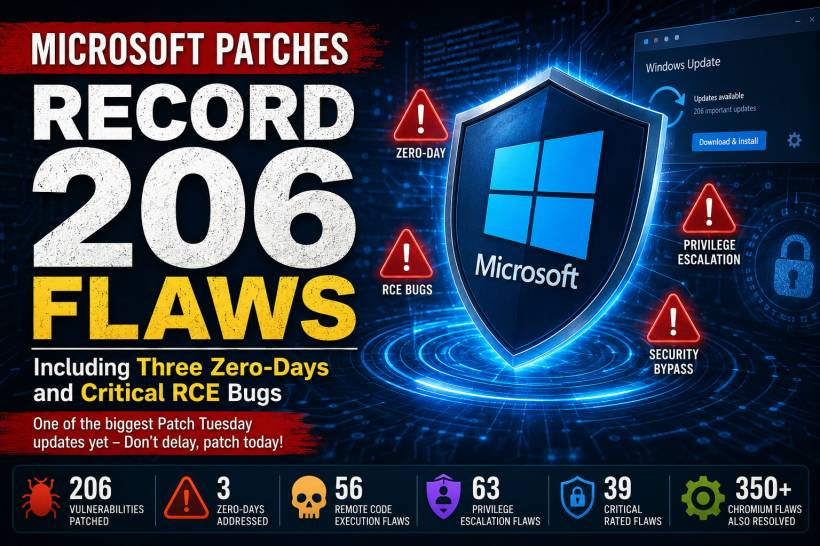
Out of the 206 vulnerabilities addressed, Microsoft rated 39 as Critical and 167 as Important. The flaws span several categories, including privilege escalation, remote code execution, information disclosure, spoofing, security feature bypass, denial-of-service, and tampering.
The sheer number of fixes is significant because it reflects how broad the Windows and Microsoft software ecosystem has become. Modern Microsoft environments are no longer just about desktops and servers. They often include cloud-connected identity systems, browsers, development tools, security features, web services, firmware-level protections, and enterprise management components.
This month's release also includes two non-Microsoft CVEs, covering a Windows Kernel privilege escalation flaw and a UEFI Secure Boot security feature bypass. On top of that, Microsoft Edge also receives security coverage through the Chromium project, where Google has addressed hundreds of additional issues.
For administrators, this means June 2026 is not simply a "Windows update" month. It is a wider security maintenance cycle affecting multiple layers of the environment.
Critical Remote Code Execution Bugs Take Priority
Among the most serious flaws fixed this month is CVE-2026-45657, a Windows Kernel vulnerability with a CVSS score of 9.8. This is especially concerning because it involves a use-after-free issue that could allow remote code execution.
In practical terms, Microsoft says an attacker could send specially crafted network traffic to a vulnerable Windows system. If the attack succeeds, the flaw could allow code to run with system-level privileges without requiring the attacker to sign in or trick a user into clicking anything.
That kind of vulnerability is dangerous because it reduces the attacker's effort. No stolen password, no phishing email, and no user interaction may be needed. A vulnerable system that processes the malicious traffic could potentially be compromised directly.
Two other critical remote code execution vulnerabilities also stand out:
• CVE-2026-47291, an integer overflow or wraparound vulnerability in Windows HTTP.sys
• CVE-2026-44815, a stack-based buffer overflow vulnerability in Windows DHCP Client
Both carry a CVSS score of 9.8, putting them in the highest-risk category.
The DHCP Client flaw is particularly important because DHCP is a basic network function used almost everywhere. If a vulnerability exists in a service that many systems depend on automatically, the potential exposure can be wide. A successful exploit could allow attackers to execute code remotely, disrupt services, deploy malware, steal data, or move deeper into the network.
Systems handling DHCP traffic, web traffic, or core internal network functions should be treated as priority patch targets.
BitLocker Bypass Flaws Raise Physical Security Concerns
This month's update also addresses multiple BitLocker-related security feature bypass vulnerabilities. One of the most notable is CVE-2026-45585, which has already had proof-of-concept exploit details released publicly under the name YellowKey.
Microsoft also fixed other BitLocker bypass issues, including CVE-2026-45655, CVE-2026-45658, and CVE-2026-50507. These vulnerabilities are not the same as a remote compromise over the internet, but they are still serious in the right threat scenario.
The main concern is physical access. If an attacker has access to a target device, a successful BitLocker bypass could potentially allow them to access encrypted data on the system storage device.
This matters for lost laptops, stolen endpoints, shared workstations, exposed kiosks, and any organisation that relies on BitLocker as part of its data protection strategy. Encryption is only useful if the protection cannot be bypassed easily, so these fixes should not be delayed on mobile devices or sensitive endpoints.
Security researcher Will Dormann has also linked CVE-2026-50507 to a BitLocker bypass known as bitskrieg, which reportedly allows full access to encrypted data. This makes the BitLocker fixes especially important for organisations with strict data security, compliance, or privacy requirements.
Three Publicly Disclosed Zero-Days Included
Microsoft's June 2026 release includes three vulnerabilities listed as publicly disclosed zero-days:
• CVE-2026-50507, a BitLocker security feature bypass
• CVE-2026-49160, an HTTP.sys denial-of-service vulnerability
• CVE-2026-45586, a Windows Collaborative Translation Framework privilege escalation vulnerability
Public disclosure does not always mean active exploitation, but it does increase risk. Once technical details, proof-of-concept code, or exploit techniques become public, attackers and security researchers can study the weakness more easily.
That creates pressure for defenders. Even if a flaw is not widely exploited on day one, public knowledge can shorten the timeline between disclosure and real-world abuse.
HTTP.sys and the HTTP2/Bomb Problem
CVE-2026-49160 is tied to an attack technique known as HTTP2/Bomb, which can be used to knock web servers offline very quickly by abusing how HTTP/2 requests are processed.
In one reported test, an IIS server exhausted 64 GB of RAM in around 45 seconds. That kind of result shows how a denial-of-service flaw can become more than just a minor availability issue. For businesses that rely on public-facing websites, portals, APIs, or internal web applications, a rapid resource exhaustion attack can cause serious disruption.
To reduce the risk, Microsoft introduced a new registry setting called MaxHeadersCount. This setting allows administrators to limit the number of headers in HTTP/2 and HTTP/3 requests.
The idea is straightforward: by enforcing reasonable header limits, servers can better protect themselves from excessive memory use, high CPU consumption, and denial-of-service conditions. This is especially relevant because HTTP/2 and HTTP/3 use more complex compression and request processing mechanisms compared with older HTTP versions.
For administrators managing IIS or Windows-based web services, this is one area worth reviewing carefully after patching.
Windows CTFMON and Privilege Escalation Risks
Another publicly disclosed issue, CVE-2026-45586, affects the Windows Collaborative Translation Framework, commonly associated with CTFMON. This vulnerability is a privilege escalation issue, meaning an attacker would typically need some level of initial access before using it to gain higher privileges.
Although privilege escalation bugs may sound less urgent than remote code execution vulnerabilities, they are extremely useful in real-world attacks. Many intrusions begin with limited access. Once inside, attackers often look for ways to elevate privileges, disable security tools, access sensitive data, or move laterally across the network.
CVE-2026-45586 is suspected to be related to an exploit released under the name GreenPlasma by security researcher Chaotic Eclipse. That public exposure makes it another vulnerability that security teams should not leave unpatched for long.
MiniPlasma and the Importance of Complete Fixes
The June 2026 update also addresses MiniPlasma, a separate issue described as an incomplete fix for CVE-2020-17103, which Microsoft originally patched back in December 2020.
This is a useful reminder that vulnerability management is not always a one-time event. Sometimes an original patch may reduce the risk but not completely eliminate the underlying weakness. When researchers later discover bypasses or incomplete fixes, vendors may need to revisit old vulnerabilities and release additional protections.
Microsoft is recommending that users install the June 2026 Windows updates to comprehensively address the issue connected to CVE-2020-17103 and MiniPlasma.
For IT teams, this reinforces the importance of staying current with cumulative updates. Skipping updates for long periods can leave systems exposed not only to new flaws, but also to improved fixes for older vulnerabilities.
AI Is Changing the Vulnerability Discovery Landscape
One of the bigger stories behind this Patch Tuesday is not just the number of vulnerabilities, but why the number keeps increasing.
Security researchers have pointed to AI-assisted vulnerability discovery as one reason for the growing volume of reported flaws. As AI models become more capable, they can help researchers identify patterns, review code paths, and accelerate parts of the vulnerability research process.
This does not mean AI is magically finding every bug on its own. However, it can speed up the discovery process and allow researchers to scale their work more effectively.
Satnam Narang from Tenable described this as a trend that is likely to continue, suggesting that the number of vulnerabilities reported across the industry may keep rising as more advanced AI-assisted techniques become available.
Dustin Childs from TrendAI's Zero Day Initiative also noted that Microsoft's CVE count this year has already exceeded the total number shipped in all of 2018. That is a striking comparison, and it shows how much the vulnerability disclosure landscape has changed.
However, there is another side to this. When a vendor releases a very large number of patches in a single month, IT teams may also worry about patch quality, testing pressure, and the possibility of update-related issues. Security teams want systems protected quickly, while operations teams need to ensure critical services do not break after deployment.
That balance is becoming more difficult as patch volumes grow.
Microsoft Defender Also Comes Under the Spotlight
The June 2026 update arrives as Chaotic Eclipse released another proof-of-concept exploit targeting Microsoft Defender. The issue, named RoguePlanet, has been described as a race condition that could potentially allow a Windows command prompt to run with SYSTEM privileges.
Microsoft Defender is a core security component for many Windows environments, so any potential weakness involving elevated privileges deserves attention. Even though organisations may use third-party endpoint protection tools, Defender often remains active in some form across Windows systems.
This again highlights why endpoint security cannot depend on a single layer. Patching, endpoint protection, least privilege, monitoring, application control, and proper configuration all need to work together.
What IT Teams Should Do Now
For organisations, the June 2026 Patch Tuesday should be handled as a priority release. The presence of critical remote code execution flaws, publicly disclosed zero-days, BitLocker bypasses, and HTTP.sys denial-of-service risks makes this more urgent than a typical monthly update.
A practical response should include:
• Prioritising internet-facing servers, Windows web services, DHCP-related systems, and endpoints exposed to untrusted networks
• Testing and deploying Windows cumulative updates as soon as possible
• Reviewing BitLocker-protected devices, especially laptops and mobile endpoints
• Checking IIS and HTTP.sys configurations, including the new MaxHeadersCount mitigation where relevant
• Monitoring for signs of exploitation, privilege escalation, unusual service behaviour, or abnormal network traffic
• Ensuring Microsoft Edge and Chromium-based components are also updated
Patch management is not just about installing updates. It also requires understanding which systems carry the highest risk and which vulnerabilities could have the biggest operational impact.
Final Thoughts
Microsoft's June 2026 Patch Tuesday is a clear example of how fast the security landscape is moving. A single monthly release now contains more than 200 fixes, multiple zero-days, critical network-based vulnerabilities, and security bypasses affecting core Windows protections.
For home users, the best step is simple: install the latest Windows updates as soon as they are available. For businesses, the response needs to be more structured. Critical systems should be prioritised, patches should be tested quickly, and high-risk services such as DHCP, IIS, HTTP.sys, and BitLocker-protected devices should receive special attention.
The bigger picture is also hard to ignore. AI-assisted vulnerability research is likely to increase the number of flaws being discovered and reported. That may be good for long-term security, but it also means organisations will need stronger patch management, better testing processes, and more realistic vulnerability prioritisation.
This Patch Tuesday is not just another monthly update. It is a reminder that Windows security is now a continuous race between discovery, disclosure, patching, and exploitation.











Comments