

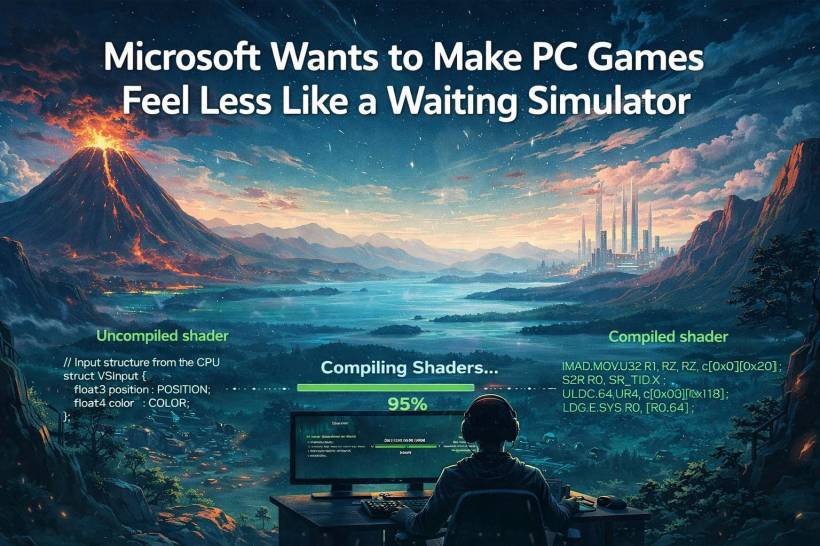
If you have spent any time gaming on PC, you probably already know the routine. You install a new game, launch it with excitement, and then immediately get greeted by a shader compilation screen that takes anywhere from a few seconds to several minutes. Even worse, some games still hitch, pause, or stutter during gameplay as new effects are compiled in the background. It has become such a common part of PC gaming that many players almost treat it as normal.
Microsoft clearly does not think it should be normal.
At GDC 2026, the company announced that its Advanced Shader Delivery technology is coming to Windows later this year through Agility SDK 1.619. The goal is straightforward: reduce those annoying shader-related delays, cut down in-game stutter, and help developers deliver a smoother experience from the very first launch.
Why Shader Compilation Has Been Such a Pain on PC
The root of the problem is that PC gaming is far messier than console gaming. On a console, developers are targeting a fixed hardware setup. On Windows PCs, they are dealing with a huge mix of GPUs, drivers, chipsets, and system configurations. That flexibility is great for consumers, but it also creates a headache for developers trying to optimize performance.
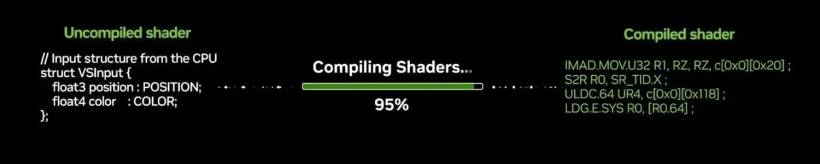
This is one of the reasons PC games often compile shaders at runtime. The game needs to prepare certain graphics instructions so they work correctly with the player's specific hardware and driver environment. That is why some games show a pre-compilation screen before you even reach the main menu, and why others still suffer from sudden hitches when a new visual effect appears for the first time. Microsoft described long shader compilation times and in-game shader stutter in D3D12 games as two of the biggest ongoing problems in PC gaming.
For players, the frustration is easy to understand. You may have a fast CPU, a strong GPU, and a brand new NVMe SSD, yet the experience can still feel clunky because the game is busy preparing graphics data instead of just letting you play.
What Microsoft Is Actually Changing
Microsoft's new approach is to shift more of that work away from the player's machine during gameplay. With Advanced Shader Delivery, developers can generate a state object database, or SODB, and then use an offline compiler to turn that into a precompiled shader database, known as a PSDB. In plain English, this means developers can prepare more of the shader work ahead of time rather than forcing the player's PC to do it live while loading or during gameplay.
The bigger idea here is distribution. Microsoft wants those precompiled shaders to be delivered in a way that matches the player's hardware more intelligently. Instead of every system having to build everything from scratch again and again, the operating environment can provide shader data that is already prepared for a specific GPU and driver combination.
That may sound like a behind-the-scenes technical tweak, but for gamers it could translate into something much more noticeable: less waiting at launch, fewer ugly stutters in the middle of play, and a more console-like smoothness on Windows.
A Bigger Push for Console-Like Convenience on PC
What makes this announcement more interesting is that Microsoft is not framing Advanced Shader Delivery as a small isolated fix. It is presenting it as part of a broader effort to improve the entire Windows gaming ecosystem.
According to Microsoft, new APIs in Agility SDK 1.619 include an app registration API and a stats API. The app registration side helps games identify themselves consistently to D3D12 and graphics drivers, while the stats API gives developers visibility into how well a precompiled shader database is actually performing on specific hardware. Microsoft also said PIX support is coming in May 2026 so developers can monitor these shader delivery metrics in real time.
That is important because it shows this is not just about creating a shiny new feature and hoping for the best. Microsoft is also building the tools developers need to measure whether it is working properly in the real world.
Hardware Partners Are Already On Board
Another reason this matters is industry support. Microsoft says it has been working with AMD, Intel, NVIDIA, and Qualcomm to expand Advanced Shader Delivery across the PC ecosystem. Public statements from those companies suggest they see this as a meaningful step toward reducing shader load times and compilation stutter for Windows gamers. Epic has also indicated early testing and exploration around support from the Unreal side.
That does not mean every game will suddenly become flawless overnight. Adoption still depends on developers, engines, stores, and driver support all moving in the same direction. But Microsoft is clearly trying to solve this as an ecosystem problem rather than leaving each studio to fight it alone.
What This Could Mean for Everyday Gamers
For the average player, the promise is pretty simple. You install a game, launch it, and spend less time staring at a progress bar. You move through the world, trigger new effects, and the game is less likely to cough, freeze, or hitch because a shader is being compiled at the worst possible moment.
That may not sound as flashy as ray tracing, frame generation, or a new upscaling buzzword, but honestly, it could end up being more important to the day-to-day experience of PC gaming. Smoothness is one of those things players notice immediately, especially when it is missing.
And if Microsoft can help reduce the ritual of repeated shader compilation every time a game boots up, that alone would be a welcome quality-of-life improvement.
The Real Test Will Be Adoption
Of course, the idea sounds better on paper than it has yet proven in the wild. The real question is how quickly developers embrace it, how broadly GPU vendors support it, and whether game storefronts and distribution systems can make shader delivery seamless enough that players barely notice it happening.
PC gaming has always been a balancing act between openness and convenience. You get endless hardware choices and flexibility, but that freedom often comes with friction. Microsoft's Advanced Shader Delivery feels like an attempt to keep the freedom while removing some of the pain.
If it works as intended, one of the most annoying parts of launching a modern PC game may finally start fading into the background.
Final Thoughts
Shader compilation stutter has been one of those long-running PC gaming annoyances that people complain about, joke about, and sadly learn to live with. Microsoft's new Advanced Shader Delivery initiative suggests the company finally wants to tackle it in a more serious and coordinated way.
It is still early, and success will depend on how quickly the ecosystem rallies around it. But if this rollout goes well, Windows gaming could start feeling a lot less like waiting for your hardware to catch up, and a lot more like jumping straight into the game the moment you click Play.











Comments 0