

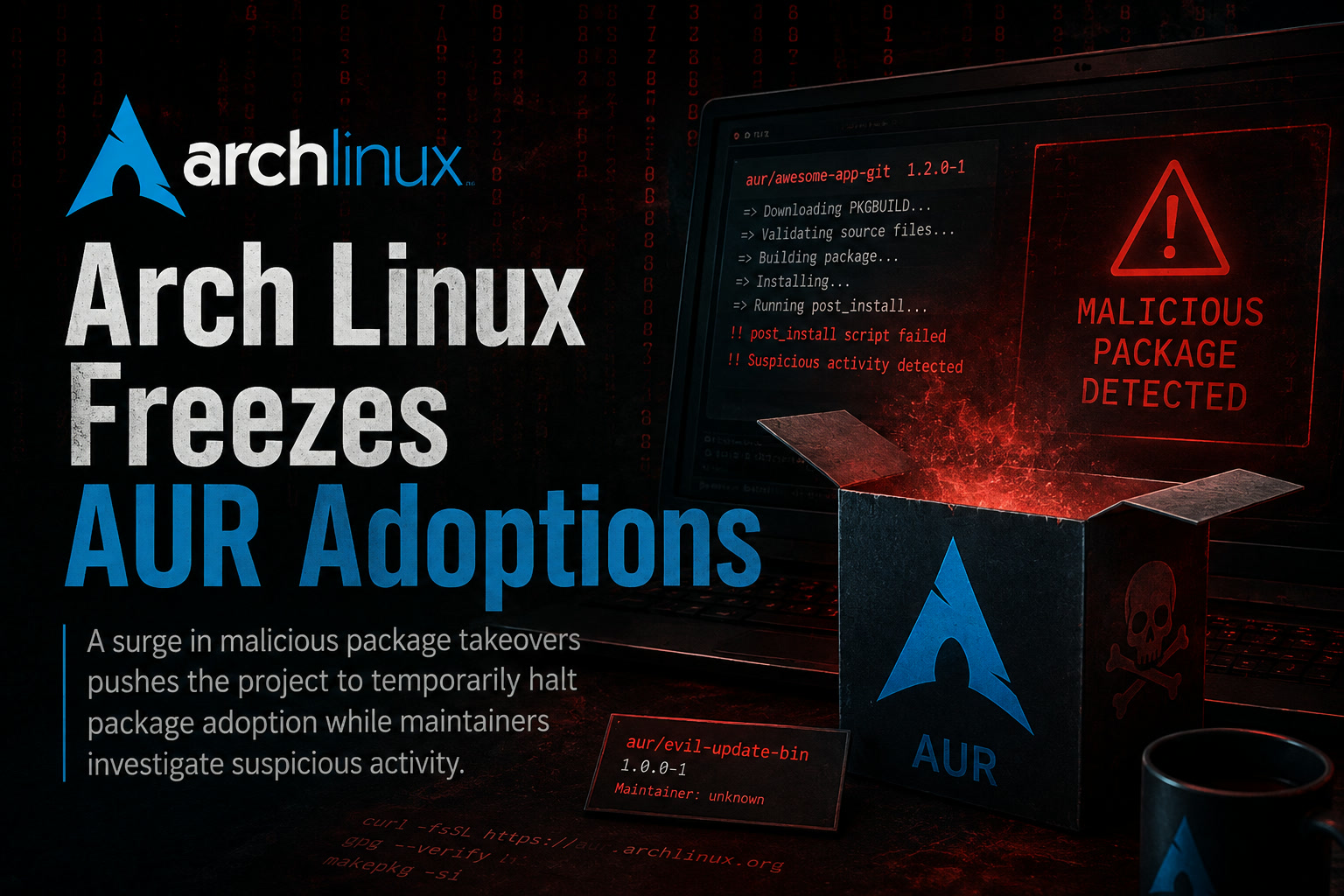
Arch Linux has imposed emergency restrictions on the Arch User Repository after attackers repeatedly took control of community-maintained packages and inserted malicious updates. The project initially disabled package adoption on July 30, 2026, preventing users from immediately taking ownership of orphaned packages. Two days later, the Arch Linux DevOps team escalated the response by temporarily disabling all AUR pushes while it continued investigating and removing suspicious changes.
The incident is another reminder that familiar package names do not automatically guarantee safe software. A package may have been legitimate for years, but its risk can change quickly when an abandoned project is adopted by a new maintainer or an existing account is compromised.
What the Arch User Repository Actually Is
The AUR is not the same as Arch Linux's official package repositories. It is a community-operated platform containing user-submitted package build instructions, commonly known as PKGBUILD files.
These files tell Arch Linux how to download, build and install software that may not be available through the official repositories. The system is extremely useful because it gives users access to an enormous selection of applications, development tools, drivers and experimental software.
However, the AUR itself warns that its packages are user-produced content and are used at the user's own risk. Unlike official Arch packages, AUR submissions are not automatically guaranteed to have undergone the same review, signing and maintenance process.
The repository relies heavily on transparency. Users can inspect a package's PKGBUILD, installation scripts and update history before building it. The problem is that many users rely on automated AUR helpers and approve upgrades without carefully reviewing what has changed.
Why Package Adoption Became an Attack Route
When an AUR maintainer no longer wants to support a package, it may become orphaned. Another registered user can then adopt it and continue maintaining it.
That feature is valuable when used responsibly. Without it, many useful packages would remain abandoned, outdated or broken after their original maintainers leave.
Unfortunately, it also creates an attractive supply-chain attack route. A malicious user can adopt an orphaned package that already has an established name and an existing user base. The attacker can then publish an update containing dangerous commands or files.
Users may trust the update because they recognise the package and have installed previous versions safely. They may not realise that ownership changed shortly before the new release appeared.
Arch Linux said it was experiencing an influx of malicious package adoptions followed by harmful commits, which is why adoption was initially suspended while the project dealt with the situation.
Arch Linux Eventually Disabled All AUR Pushes
Disabling adoption blocked one of the most obvious takeover methods, but it did not prevent every possible malicious update.
Existing maintainers could theoretically continue pushing changes to packages already under their control. If a maintainer account had been compromised—or if a malicious account had adopted a package before the freeze—the attacker might still have been able to submit another update.
On August 1, Arch Linux contributor Robin Candau announced that the project had temporarily disabled pushes altogether. This broader restriction effectively placed the AUR into a more limited state while administrators investigated suspicious activity and worked on containment.
The measure is disruptive for legitimate maintainers, but it is understandable during an active supply-chain incident. Temporarily delaying ordinary package updates is preferable to allowing more users to build and execute malware through trusted-looking package names.
A Two-Stage Linux Malware Chain
Independent analysis of malware connected with the latest activity describes a two-stage infection designed specifically for Linux x86-64 systems.
The first stage acts as a loader. Before fully activating, it checks whether it may be running inside a debugger, malware-analysis sandbox, virtual machine or continuous integration environment. These checks are intended to reduce the likelihood that the malicious behaviour will be observed by automated security systems.
When the loader believes it is running on an ordinary system, it copies itself into a less obvious location and attempts to remain active through systemd services or scheduled cron tasks. It then prepares a Tor connection and retrieves the larger second-stage payload from an .onion service.
This is considerably more sophisticated than a simple malicious script that downloads one file and immediately runs it. The use of multiple stages helps attackers conceal the full capabilities of the malware from anyone who only performs a quick inspection of the initial package.
Tor Was Disguised as a Normal System Process
The loader reportedly downloads a legitimate Tor software bundle and launches it using the process name dbus-daemon.
dbus-daemon is a familiar Linux system process, so using that name may help the Tor client blend into a process list during a casual inspection. The loader then uses the local Tor connection to contact its hidden server and retrieve the next payload.
Tor itself is legitimate privacy software. The security concern comes from the way the malware uses it to conceal communication with its command-and-control infrastructure.
Because the connection is routed through Tor, defenders cannot simply identify the attacker's ordinary server address. It may also be more difficult to block the communication using a conventional list of suspicious IP addresses.
The Second Stage Targets Valuable Credentials
The second-stage payload was analysed as a Rust-based information stealer, remote-access tool and SSH worm.
Its targets reportedly include browser login data, cookies, cryptocurrency wallets, password-manager information, messaging-platform sessions and developer credentials. It also searches for cloud configuration files, source-control tokens, environment files and API keys associated with AI and development services.
This makes developer computers particularly attractive targets. A personal workstation may contain SSH keys, GitHub or GitLab access tokens, cloud credentials, deployment secrets and connections to other systems.
Compromising one developer device could therefore give an attacker far more than a collection of browser passwords. It may provide access to source-code repositories, remote servers, cloud environments or software-delivery pipelines.
Stolen SSH Keys Could Help It Spread
The malware does not appear to stop after collecting information from its first victim.
The technical analysis found functionality that searches for SSH private keys and known-host records. It can then attempt to copy and execute itself on other systems accessible through those stolen credentials.
This introduces the possibility of lateral movement. A compromised laptop used to administer several Linux servers could become the starting point for a much larger incident.
The risk is especially serious in development environments where the same SSH key has access to multiple servers or where users have broad privileges across production, staging and internal infrastructure.
Strong access separation can limit the damage. A developer account should not automatically have unrestricted access to every server, and one stolen key should not provide control over an entire environment.
Why Automated AUR Helpers Increase the Risk
AUR helpers are convenient because they search for packages, retrieve build files, resolve dependencies and manage updates in a workflow that feels similar to an ordinary package manager.
The danger is that this convenience can make an AUR package appear more trusted than it really is.
When users repeatedly approve updates without reading the differences, malicious changes can pass unnoticed. A familiar package name may create a false sense of safety, even though its maintainer or build process has changed.
The appropriate question is not merely, "Have I used this package safely before?" It is also, "What changed in this particular update, and who submitted the change?"
Arch Linux has repeatedly advised AUR users to review all PKGBUILD and installation-script changes when updating, particularly during active malicious-package incidents.
Package Removal Does Not Undo an Existing Infection
Removing or correcting a compromised AUR package prevents future users from building that same malicious version, but it does not reverse code that has already executed.
Once malware has run, it may have copied itself elsewhere, created a background service, scheduled a recurring task or stolen credentials. Reinstalling the corrected package would not necessarily remove those changes.
Users who built suspicious AUR packages during the affected period should therefore not assume they are safe simply because the package page now looks normal.
The stage-one analysis identified potential warning signs such as an unexpected Tor process appearing under the name dbus-daemon, unexplained persistent systemd services, unusual cron entries and a staged payload under shared-memory or temporary locations.
Any device showing credible signs of compromise should be isolated from sensitive systems and investigated. Passwords, SSH keys, API tokens and cloud credentials potentially accessible from that machine may also need to be replaced from a separate, trusted device.
Reports About Hundreds of Packages Remain Unverified
Community members tracking the incident have claimed that a large number of AUR packages may have been affected. However, a complete, independently verified list has not been published.
That distinction matters. Repeating every package named in social-media discussions could wrongly imply that all of them have been conclusively proven malicious.
The confirmed official position is broader but less specific: Arch Linux reported a high volume of malicious adoptions and updates, disabled adoption, and subsequently suspended all pushes while the incident was handled.
Until Arch Linux or trusted researchers publish a validated affected-package list, users should avoid treating unofficial lists as definitive. At the same time, uncertainty is not a reason to ignore the incident. Users should examine their own AUR installation and update histories instead of waiting for a list that may never be fully complete.
This Is a Supply-Chain Attack, Not an Arch Linux Kernel Flaw
The malware campaign does not mean that the Arch Linux operating system or Linux kernel itself has suddenly become insecure.
The attack targets the software supply chain surrounding community packages. Attackers abuse the trust users place in package names, maintainers and automated update workflows.
A similar attack model can affect almost any software ecosystem. Community repositories for programming languages, browser extensions, development tools and application plug-ins all depend on maintainers and account security.
The common weakness is trust. Users may assume that an update is safe simply because it arrives through a familiar platform.
The AUR is unusually transparent because its build instructions and histories are visible. Yet that transparency only protects users when somebody actually examines the changes.
Arch Linux Had Already Been Strengthening AUR Access
This latest restriction follows earlier malicious-package activity that prompted Arch Linux to temporarily limit account registration and other AUR functions.
The project subsequently introduced tighter registration controls, including mandatory email verification and rejection of disposable email addresses. Those improvements can make it harder to create large numbers of short-lived malicious accounts, but they cannot completely prevent account compromise or abuse by an already registered user.
The adoption system itself may now require more substantial redesign.
Possible long-term approaches could include a waiting period before newly adopted packages can be updated, manual review of ownership changes, stronger account protection and prominent warnings when a package changes maintainer.
Every additional control creates inconvenience for legitimate volunteers, so Arch Linux must find a balance between openness and security. However, repeated malicious takeovers suggest that unrestricted instant adoption may no longer be appropriate for a repository with such a large audience.
What AUR Users Should Learn from the Incident
The most important lesson is that AUR packages should be treated as source code obtained from third parties—not as automatically trusted binaries from Arch Linux.
Before building an update, users should examine changes to the PKGBUILD, source locations, checksums and installation scripts. Particular caution is warranted when an update introduces opaque precompiled files, unexpected network downloads, heavily encoded commands or new installation hooks.
Users should also pay attention to ownership changes. A package that has suddenly been adopted by an unfamiliar account deserves additional scrutiny, even when the software itself is popular.
For systems used to manage websites, servers, software projects or cloud infrastructure, it may be safer to separate experimentation from sensitive work. Installing unreviewed community packages on a machine containing production credentials creates unnecessary risk.
The Wider Linux Community Should Take This Seriously
Linux users are sometimes assumed to be safer from malware because the platform has a smaller desktop market share and generally strong permission controls.
That view overlooks the value of Linux developer and administrator workstations.
One compromised Linux machine may contain access to web servers, cloud consoles, source repositories, container registries, CI/CD pipelines and entire fleets of remote systems. Attackers do not need millions of ordinary desktop victims when one developer device can provide entry into a valuable organisation.
The capabilities described in the analysed payload—credential theft, remote control and SSH-based spreading—appear designed around that reality.
Final Thoughts
Arch Linux made the correct decision to disable AUR package adoption when malicious takeovers began appearing, and the later decision to suspend all pushes reflects how serious the situation became. The restrictions inconvenience maintainers, but they help prevent further dangerous commits while administrators investigate the repository.
The incident does not make the AUR useless. It remains one of Arch Linux's most valuable community resources, offering access to software that might otherwise be difficult to install. However, its convenience has always depended on users understanding that community packages are not the same as officially maintained packages.
The most concerning aspect of the campaign is not simply the number of packages that may have been affected. It is the sophistication of the malware reportedly delivered through them: anti-analysis checks, persistent background services, Tor-based communication, credential theft, remote control and SSH-enabled spreading.
A familiar package name should never replace verification. The maintainer may change, the download source may change and one seemingly ordinary update may introduce an entirely different threat.
Arch Linux can strengthen adoption controls, registrations and repository monitoring, but users must also play their part. In an open community repository, reading what an update will execute is not unnecessary paranoia—it is a fundamental part of installing software safely.











Comments 0