

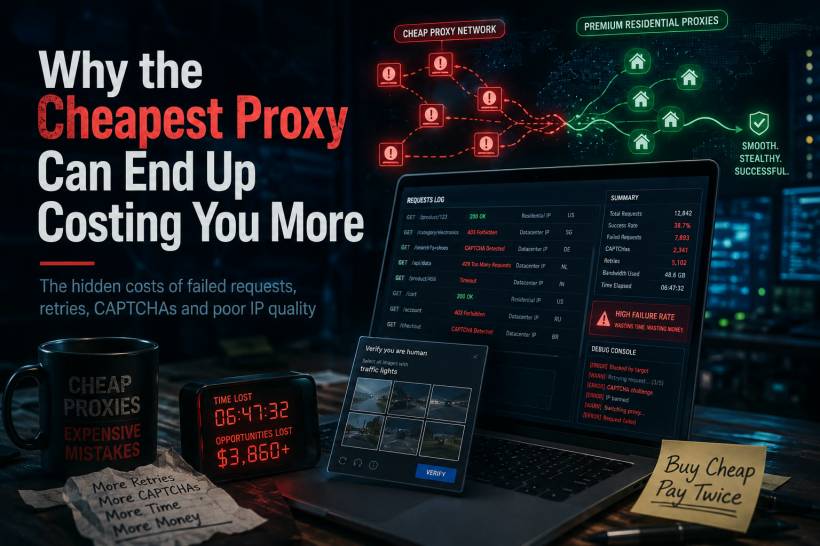
When people compare proxy providers, the first thing they usually notice is the price per gigabyte. It is simple, visible, and easy to place side by side. A provider charging less per GB appears to be the obvious bargain. But in real-world proxy usage, that number rarely tells the full story.
The actual cost of a proxy network is not only about how much traffic you buy. It is also about how much traffic gets wasted, how often requests fail, how many retries your systems need to make, how often CAPTCHAs appear, and how much time your team spends investigating blocks and inconsistent results.
A proxy package that looks cheap at checkout can become expensive very quickly when it delivers poor success rates. In many cases, a higher-quality residential proxy network can produce a lower cost per completed task, even when its advertised bandwidth price is slightly higher.
The Price Per GB Is Only the Starting Point
Proxy providers commonly advertise traffic pricing because it is easy to understand. You pay for a certain amount of bandwidth and use it as needed.
However, a successful request and a failed request do not cost the same in practice.
When a request reaches its target successfully on the first attempt, the traffic is used efficiently. But when a request is blocked, times out, or triggers a CAPTCHA, that traffic has already been consumed. Most systems do not simply stop after one failed attempt either. They retry.
This means one failed request can become two, three, or even more requests before the workflow eventually succeeds or gives up entirely. The bandwidth cost increases, the job takes longer, and the overall efficiency of the proxy pool drops.
A provider with a 90% success rate may not sound dramatically worse than one with a 99% success rate. But across thousands or millions of requests, that difference becomes significant. The lower-success pool creates more retries, more wasted traffic, and more operational friction.
Failed Requests Quietly Drain Your Budget
Every failed request has a hidden cost attached to it.
Imagine a scraping, ad-verification, market research, or automation workflow that needs to complete 100,000 requests. A clean proxy pool that succeeds on the first attempt most of the time will use far less bandwidth than a lower-quality pool that repeatedly gets blocked.
The failed requests still consume traffic. The retries consume more traffic. In some cases, the system may rotate IPs several times before finding one that works.
What looked like a cheaper per-GB rate can quickly turn into a much higher cost per successful response.
This is why the more useful question is not, "How much does one GB cost?" It is, "How much does it cost me to complete a successful request?"
That is the number that matters when you are managing real workloads.
Engineering Time Is Often More Expensive Than Bandwidth
Bandwidth is measurable, but the time spent dealing with unreliable proxies is often ignored.
When proxy quality drops, someone has to investigate. Logs need to be reviewed. Retry settings may need adjustment. Proxy sessions might need to be rebuilt. A job may need to be restarted from the beginning.
That work can consume hours.
A proxy provider may save you a small amount per GB, but those savings disappear quickly when an engineer, developer, or operations team member has to spend half a day troubleshooting blocked requests and unstable sessions.
Reliable infrastructure is not just about avoiding technical headaches. It also protects your team's time.
For smaller businesses, that may mean fewer interruptions and faster delivery. For larger operations, it can mean more predictable workflows, fewer delayed reports, and less pressure on technical teams.
CAPTCHAs, Blocks and Account Restrictions Add More Risk
Poor-quality IP addresses can create problems that go beyond failed requests.
When websites detect suspicious behaviour or recognise an IP address with a poor reputation, they may trigger CAPTCHAs, rate limits, temporary blocks, or full access restrictions. For certain permitted workflows, that can slow down operations significantly.
CAPTCHAs may require manual intervention or a paid solving service. Rate limits can delay data collection. Account-based activities can become riskier when a platform repeatedly sees traffic from IPs that have already been associated with abuse or automation.
The impact is especially important for tasks involving e-commerce monitoring, advertising verification, social media management, travel pricing, brand protection, or regional website testing.
A low-quality IP pool may be cheaper to buy, but it can increase the chances of interruptions that cost more than the initial savings.
IP Quality Determines Whether a Proxy Network Feels Reliable
The biggest difference between proxy providers often comes down to the quality and source of their IP addresses.
Not all residential proxies are equal. Some providers operate with transparent sourcing and well-managed residential networks. Others may rely on heavily recycled IPs, unclear sourcing practices, or addresses that have already been overused across many customers.
When an IP has been repeatedly used for aggressive activity, websites may already recognise it as suspicious. That makes it more likely to be blocked before your request even has a chance to complete.
Clean residential IPs generally have a stronger chance of behaving like normal household connections because they are less likely to carry a damaged reputation.
This does not mean every task requires premium residential traffic. Some low-risk or low-security websites may work perfectly well with affordable datacenter proxies. The issue appears when cheap proxy pools are used for targets with stronger anti-bot systems.
That is when the apparent bargain can become an expensive mistake.
Why Published Performance Metrics Matter
When comparing providers, it helps to look beyond the price list.
A trustworthy provider should be able to explain where its IPs come from, what kind of network it operates, and what performance levels customers can reasonably expect.
Success rate, uptime, response time, session stability, geographic availability, and IP sourcing are all more useful indicators than price alone.
For example, IPcook advertises residential traffic starting from US$3.20 per GB, alongside a claimed 99.99% uptime figure and global response times below 0.5 seconds. These figures should still be tested against your own workflow, but the important point is that clear performance claims give buyers something measurable to evaluate.
Other providers may charge similar or higher rates while offering fewer details about actual success rates. A higher price does not automatically mean better service, especially when the provider does not clearly explain how its IPs are sourced or how reliably they perform.
The best provider is not necessarily the cheapest or the most expensive. It is the one that gives you the highest number of successful, stable requests for the money you spend.
The Difference Between Sticker Price and Real Cost
| Cost Area | Low-Quality Proxy Pool | Clean Residential Proxy Network |
| Advertised price per GB | Usually lower | May be slightly higher |
| Success rate | Often unclear or inconsistent | More likely to be published and measurable |
| Wasted bandwidth | Higher due to retries and failed requests | Lower because requests succeed more often |
| CAPTCHA frequency | Can be higher | Often reduced with cleaner IP reputation |
| Debugging effort | Frequent monitoring and troubleshooting | More stable day-to-day operations |
| Account and access risk | Greater on sensitive targets | Lower when IP quality is stronger |
| Lower when IP quality is stronger | Often higher than expected | Often lower over time |
The final row is the one worth focusing on.
A low per-GB price can look attractive, but it does not matter much when a large part of the purchased traffic is being wasted on retries, failed sessions, blocked connections, and CAPTCHAs.
How to Choose Proxies Based on Real Value
The best way to evaluate a proxy provider is to stop treating price per GB as the main decision point.
Start by asking about success rates and sourcing. A provider that is transparent about where its IPs come from and how its network performs is easier to evaluate. Vague answers about either area should be treated carefully.
Next, test the service against your actual target websites and permitted use cases. A proxy network can look excellent in a general benchmark but perform differently depending on the websites, countries, session duration, and request volumes involved.
A trial is particularly useful because it lets you compare actual success rates, response speeds, CAPTCHA frequency, and bandwidth use before committing to a larger package. Some providers, including IPcook, offer trial traffic that can be used without an immediate long-term commitment.
It is also worth matching the proxy type to the task.
Low-risk targets may work well with datacenter proxies. More protected sites may justify the higher reliability of premium residential traffic. Splitting budgets by task or team can also help prevent demanding workloads from consuming all available traffic unexpectedly.
The Smartest Proxy Purchase Is Not Always the Cheapest One
The proxy industry encourages buyers to focus on a number that is easy to compare but often misleading.
Price per GB matters, but it is only one part of the equation. The more important costs are hidden in failed requests, repeated retries, wasted bandwidth, CAPTCHAs, troubleshooting time, blocked access, and account risk.
A provider with cleaner IPs, transparent sourcing, higher success rates, and better session stability can deliver a much lower real-world cost, even when its bandwidth price initially looks higher.
Before choosing the cheapest proxy plan available, look at what happens after the first failed request. Count the retries. Consider the engineering time. Measure the success rate against your own workload.
That is where the true cost becomes visible.
The better long-term choice is usually the proxy network that helps your requests succeed the first time, rather than the one that simply looks cheapest on the pricing page.











Comments