

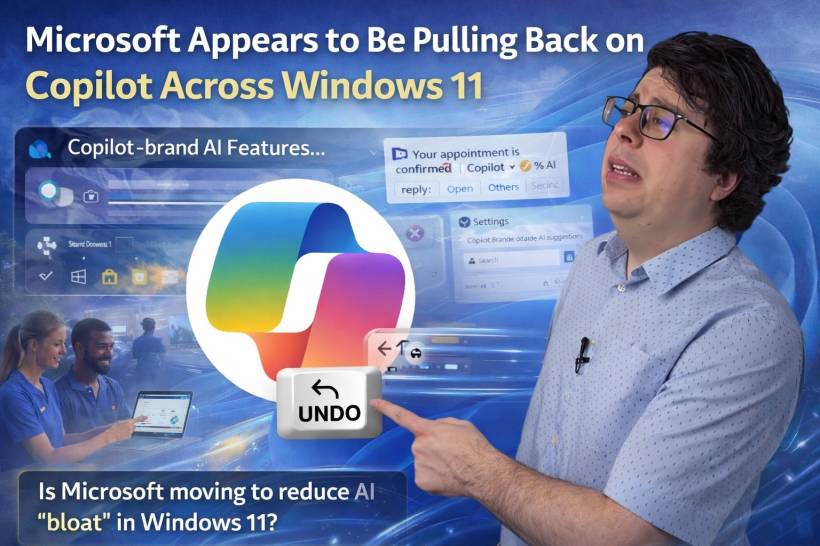
There was a point when Microsoft seemed ready to place Copilot almost everywhere inside Windows 11. It was presented as a major part of the company's AI future, with plans to weave it into core parts of the operating system such as Settings, notifications, and File Explorer. At the time, the message was clear: Copilot was supposed to become a more visible and more deeply embedded assistant across the Windows experience.
But that vision now appears to be fading.
Instead of pushing Copilot further into every corner of Windows 11, Microsoft seems to be taking a step back. A number of AI-powered features that were announced earlier never actually arrived, and the company now appears to be rethinking how aggressively AI should be inserted into the operating system.
For many users, that may actually be welcome news.
A Different Direction From What Was Originally Promised
When Microsoft first outlined its broader Copilot ambitions in 2024, it gave the impression that Windows 11 would soon become much more AI-centric at a system level. Copilot was not just being positioned as a standalone assistant. It was being framed as a kind of umbrella identity for AI across the operating system.
That meant users were shown a future where Copilot could appear in more places than just a sidebar or app window. It was supposed to show up in practical, everyday parts of Windows, helping with actions directly from Settings, File Explorer, and even notifications.
Yet despite those early demonstrations and confident announcements, many of those features never reached users. They did not arrive publicly, and they did not meaningfully appear even in preview form. As time passed, it became increasingly obvious that Microsoft's original rollout plan had changed.
Why the Rollout Seems to Have Stalled
A big part of this apparent shift seems tied to Microsoft's wider AI turbulence, especially around Recall.
Once Recall faced delays and criticism, Microsoft's attention appeared to move toward damage control and re-evaluation. When a major AI feature hits a wall, it tends to affect the momentum of surrounding plans as well. In this case, it seems several other Copilot-related ideas were quietly pushed aside while Microsoft focused on stabilising its broader AI strategy.
That helps explain why some features that once looked imminent simply disappeared from view.
Rather than continuing with Copilot as a universal layer spread across Windows, Microsoft seems to have chosen a more cautious path. AI features are still being added, but not always under the Copilot banner, and not in the same all-encompassing way that was originally suggested.
AI Is Still There, Just Less Obviously Branded
What makes this interesting is that Microsoft has not abandoned AI in Windows 11 altogether. Instead, it seems to be changing how those features are presented.
For example, Settings has gained smarter search behaviour and suggestions that help users find the right configuration options more naturally. File Explorer has also picked up AI-related functionality through an actions menu. But these experiences do not feel like the original vision of Copilot acting as a deeply integrated assistant everywhere inside the OS.
That difference matters.
The older pitch implied that Copilot itself would carry out actions more directly, almost as a native intelligence layer inside Windows. What users are seeing instead feels more restrained. AI is still present, but it is either handed off to other apps or tucked into more limited features rather than being front and centre throughout the system.
Even the naming reflects this shift. What was once referred to as the Windows Copilot Runtime has reportedly been renamed to Windows AI APIs, which sounds more technical, less consumer-facing, and far less tied to that earlier Copilot-everywhere narrative.
The Feature That Never Really Showed Up
Among the more ambitious ideas that were discussed, one of the most noticeable missing pieces is Copilot inside notifications.
This concept would have allowed Windows notifications to become more interactive with AI-driven actions, such as responding to a message or opening relevant content with a single click. On paper, that sounded like one of the more practical uses of AI in the operating system because it connected directly to things users already interact with throughout the day.
But that feature never materialised in any meaningful way.
And from the way things are now being described, it sounds increasingly unlikely that it will return in the original Copilot-branded form. The idea itself may not be completely dead, but if it does come back, it will probably look very different from what was first shown.
Microsoft May Be Responding to User Fatigue
Perhaps the most important part of this shift is what it says about Microsoft's current reading of user sentiment.
Over the past year or two, there has been growing frustration among some Windows users who feel the operating system is becoming overloaded with AI branding, prompts, and features they never asked for. For those people, the problem is not necessarily AI itself. It is the sense that AI is being inserted too aggressively into places where it feels unnecessary, distracting, or forced.
That criticism appears to have landed.
Microsoft now seems to be aiming for a more deliberate and selective approach. Instead of flooding the OS with Copilot-branded experiences, it appears to be reducing AI clutter and being more careful about where those features appear. The idea is not to remove AI completely, but to make it less intrusive, more useful, and easier to ignore if users do not want it.
That last part is especially important. Optional and disable-able features tend to be received much better than ones that feel imposed.
A Reputation Problem Microsoft Is Trying to Fix
There is also a broader image issue at play here.
Windows 11 has been criticised from several angles, whether for interface changes, unwanted recommendations, or the general feeling that the operating system has become more crowded over time. AI has only added to that tension. For some users, Copilot came to symbolise Microsoft's habit of pushing new ideas into Windows before people were convinced they were actually useful.
If Microsoft is now scaling back the visibility of Copilot, that may be part of a larger effort to make Windows 11 feel more focused and less bloated.
That does not mean the company is giving up on AI. Far from it. Microsoft is clearly still heavily invested in AI across its products. But within Windows itself, the strategy now seems less about showing AI everywhere and more about deciding where it genuinely adds value.
Final Thoughts
Microsoft's quieter retreat from its original Copilot-everywhere vision says a lot about how the AI conversation inside operating systems is evolving.
At first, the push seemed to be about visibility. AI needed to be seen, named, and placed throughout the Windows experience. Now, the focus appears to be shifting toward restraint. That is probably the smarter move.
Most users do not want AI features just because they are available. They want them when they are useful, unobtrusive, and easy to control. If Microsoft has realised that flooding Windows 11 with Copilot branding was hurting more than helping, then this change in direction may actually improve how people feel about the platform.
In the end, reducing AI bloat may not solve every complaint about Windows 11, but it is at least a sign that Microsoft is starting to understand something important: not every part of the operating system needs to become an AI showcase.











Comments