


In many Malaysian healthcare settings, Code White refers to a major system downtime situation. This may involve an outage affecting the Hospital Information System (HIS), electronic medical records, laboratory or radiology interfaces, PACS, pharmacy systems, billing platforms, internet connectivity, or other digital services that support daily patient care.
While the exact meaning of emergency codes can differ between hospitals and countries, the important part is internal clarity. Every staff member should understand what Code White means in their own organisation, who activates it, what procedures follow, and how patient care continues safely while systems are unavailable.
A Code White event is not only an IT issue. It is an operational continuity issue involving doctors, nurses, allied health staff, registration, pharmacy, laboratory, radiology, finance, security, facilities, communications teams, vendors and hospital leadership. When a system goes down, the hospital must still admit patients, document care, process medication, request investigations, receive results, manage billing and maintain safe clinical decisions.
That is why a well-planned Code White simulation is one of the most practical ways to test whether a hospital's Business Continuity Plan, or BCP, can genuinely work under pressure.
Why Code White Readiness Matters
Hospitals depend heavily on interconnected systems. A disruption may begin with one technical issue, but its effects can spread quickly.
For example, an HIS outage may prevent staff from viewing patient records, registering new patients, entering doctor orders, issuing medication, printing labels or generating bills. If interfaces are affected, laboratory and radiology workflows may also need to revert to manual processes. Even when individual systems remain online, the inability to exchange information can create delays, duplicate work and patient-safety risks.
A good Code White plan recognises that technology may fail unexpectedly. The hospital cannot wait until a real incident happens to discover that downtime forms are outdated, printers are unavailable, staff do not know where the manual registers are kept, or departments are unsure who to call.
The goal is not to assume that every disruption can be avoided. The goal is to ensure that the hospital can continue operating safely, calmly and in a controlled way when a disruption occurs.
Code White Is a Business Continuity Test, Not Just an IT Test
It is easy to treat a system downtime simulation as an IT exercise. The IT team may test servers, backups, disaster recovery platforms, internet redundancy and vendor escalation processes. These are all important, but they are only one part of the picture.
A Business Continuity Plan should answer a larger question: How does the hospital continue delivering essential services when normal systems are unavailable?
During Code White, the focus should move beyond technical recovery and include real operational workflows such as:
• Patient registration and identification
• Admission, discharge and transfer processes
• Clinical documentation and nursing notes
• Doctor orders and medication administration
• Laboratory and radiology request workflows
• Result tracking and critical-result communication
• Operating theatre documentation
• Pharmacy dispensing and stock control
• Cashiering, billing and payment collection
• Emergency contact lists and escalation procedures
• Communication with patients, families and external vendors
The BCP should identify which functions are critical, which can be delayed, and which must continue immediately using manual or alternative processes.
Start With a Clear Simulation Scenario
A useful Code White simulation needs a realistic but controlled scenario. The scenario should be challenging enough to reveal weaknesses, without creating unnecessary risk to real patients or daily operations.
For example, a hospital may simulate a situation where the HIS becomes unavailable due to a server failure, cyber incident, infrastructure issue or network disruption. The simulation can assume that key digital functions are affected, including patient registration, clinical documentation, orders, billing and interfaces to supporting systems.
The scenario should clearly state:
• What systems are unavailable
• Which departments are affected
• Whether internet, phone lines or internal network access are impacted
• Whether the outage is temporary or prolonged
• Which systems remain operational
• When manual workflows must begin
• Who has authority to activate Code White
• What conditions allow the hospital to stand down and return to normal operations
The simulation does not need to recreate every possible disaster. It should test the highest-risk downtime scenario for the hospital and ensure that the BCP works in a realistic setting.
Define the Objectives Before the Drill
A Code White simulation should have measurable objectives. Otherwise, it may become a simple roleplay exercise without clear learning outcomes.
Common objectives may include:
• Confirm that the Code White activation and communication process is understood
• Test whether departments can operate safely using manual forms and registers
• Verify that downtime workstations, printers, labels and stationery are ready
• Check that key staff know their roles, escalation contacts and departmental procedures
• Test the hospital's disaster recovery and system restoration process
• Confirm that patient data recorded manually can be reconciled accurately after recovery
• Identify gaps in staff training, documentation, equipment and communication
The objective is not to prove that the hospital has a perfect plan. A successful simulation is one that identifies weaknesses before they become real patient-care issues.
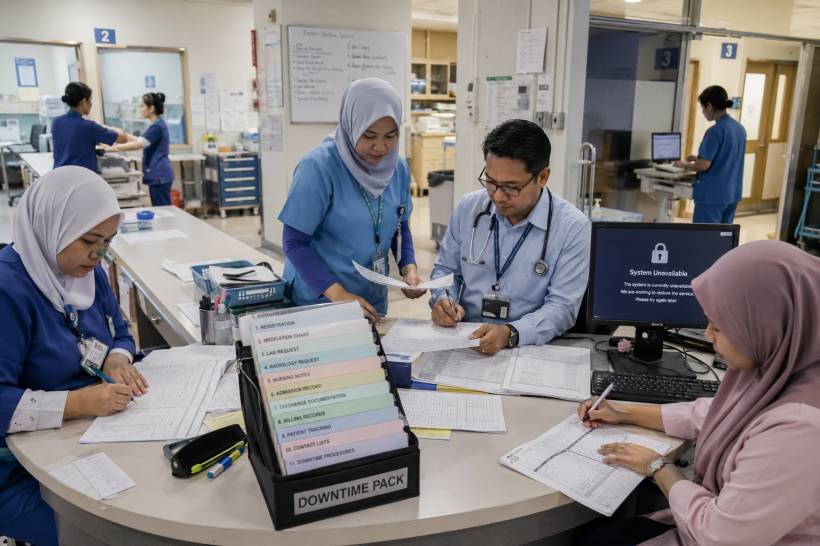
Prepare Departmental Downtime Procedures
Every department should have a practical downtime procedure that can be followed without relying on memory alone. In a real outage, staff may be busy, stressed and handling urgent patients. Long policies hidden in a shared drive will not be useful if the shared drive is also unavailable.
Departments should maintain accessible downtime packs containing relevant forms, registers, contact lists and instructions. These may include manual registration forms, medication charts, laboratory request forms, radiology request forms, nursing notes, admission records, discharge documentation, billing records and patient tracking sheets.
The forms should be reviewed regularly. Outdated forms, missing patient identifiers or unclear fields can create major reconciliation problems after systems recover.
Each department should also know where the following items are located:
• Approved downtime forms and manual registers
• Patient labels or alternative identification tools
• Printers, label printers and backup printing arrangements
• Emergency contact lists
• Departmental escalation guides
• Instructions for post-downtime data entry and reconciliation
A small operational detail, such as a missing printer or unavailable label stock, can cause a large disruption during a real Code White event.
Communication Is One of the Most Important Controls
During a downtime event, uncertainty can become more disruptive than the outage itself. Staff need prompt, simple and consistent updates.
The BCP should define how Code White is activated, who communicates the announcement, which communication channels are used and how departments receive updates. Communication should include what has happened, what systems are affected, what action staff need to take, and when the next update will be provided.
Hospitals should also avoid relying on only one communication method. Messaging applications may be useful, but phone communication, internal announcements, department representatives and escalation trees remain important, especially when network-related issues affect digital tools.
A clear Code White message may include:
• Code White activation time
• Affected systems and departments
• Required switch to manual processes
• Contact point for urgent issues
• Frequency of situation updates
• Instructions not to duplicate or back-enter information prematurely
• Criteria for returning to normal operations
This helps departments act consistently instead of creating their own unofficial workarounds.
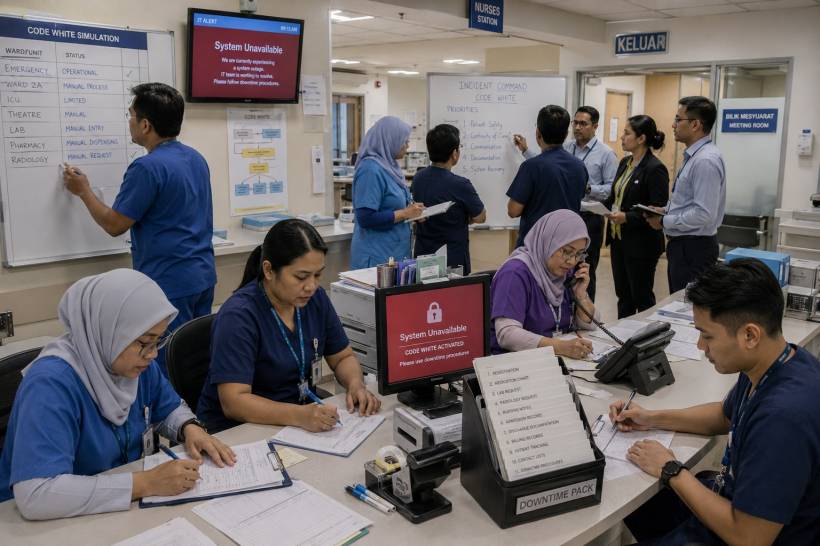
Run the Simulation Like a Real Operational Event
During the drill, the hospital should simulate the actual sequence of events from outage detection to recovery.
The exercise can begin with a notification that a critical system is unavailable. The relevant teams then assess the issue, activate Code White if required, communicate to departments and begin manual procedures.
Departments should be observed while they perform key workflows. For example, registration staff may process a new patient manually, nursing staff may document observations using downtime forms, pharmacy may receive a handwritten medication order, and laboratory or radiology may manage manual requests and result communication.
The simulation should also test leadership coordination. The incident command team or designated management group should review the situation, prioritise patient-care needs, coordinate with IT and vendors, approve updates and decide when it is safe to stand down.
This creates a more realistic test of the hospital's ability to manage both technical recovery and operational continuity.
Recovery Is Not Complete Until Reconciliation Is Finished
One of the most overlooked parts of Code White planning is the return to normal operations.
Restoring the system does not immediately mean that the incident is over. Information recorded manually during downtime may need to be entered back into the HIS, checked for accuracy and reconciled with clinical, pharmacy, laboratory, radiology and billing records.
The BCP should define:
• Who is responsible for back-entry and verification
• Which documents must be entered first
• How duplicate entries are prevented
• How medication, investigation and result records are reconciled
• How billing and financial transactions are verified
• How paper documents are scanned, filed or retained
• How unresolved discrepancies are escalated
The hospital should always protect the integrity of the clinical record. Rushing to catch up without a controlled reconciliation process can create errors that are difficult to detect later.
Measure the Results and Improve the Plan
After the simulation, the hospital should hold a structured debrief. Feedback should be collected from all participating departments, not only IT.
The review should identify what worked well, where delays occurred, what staff found confusing and which resources were missing. Findings should be converted into clear action items with responsible persons and target dates.
Useful measures may include:
• Time taken to detect and escalate the outage
• Time taken to activate Code White
• Time taken for departments to begin manual processes
• Availability of downtime forms and equipment
• Staff understanding of their roles
• Accuracy of manual documentation
• Effectiveness of communication channels
• Time taken for system restoration
• Time taken for reconciliation after recovery
The simulation report should feed directly into the BCP improvement process. A plan that is never updated after a drill will gradually become less useful.
Final Thoughts
A Code White simulation is not about creating disruption for the sake of a test. It is about protecting patient care when normal digital systems are unavailable.
For Malaysian hospitals, where Code White commonly refers to system downtime, the exercise should bring together IT disaster recovery, departmental manual workflows, communication procedures, leadership coordination and post-recovery reconciliation.
The strongest Business Continuity Plans are not the longest documents. They are the plans that staff can understand, access and apply during a real incident. Regular Code White simulations give hospitals the opportunity to test those plans in a controlled environment, improve weak areas and build confidence across the organisation.
When a real system outage happens, preparation can make the difference between confusion and continuity.











Comments