

Microsoft's newer native NVMe path is starting to look like a much bigger deal than a routine driver update. Fresh benchmark coverage from StorageReview shows that the redesigned storage stack in Windows Server 2025 can deliver major gains in random-read performance, noticeable latency improvements in some workloads, and lower CPU usage during sequential transfers. Microsoft has framed the change as a move away from treating modern NVMe storage like older SCSI-style devices, which helps explain why the gains can be so significant on fast SSDs.
What makes this especially interesting is that the story is not just about raw benchmark bragging rights. Faster random reads can improve responsiveness in storage-heavy workloads, while lower CPU overhead means the system spends less processor time shuffling data around. That matters for servers, workstations, and potentially even future consumer systems as SSD performance keeps climbing. StorageReview tested the feature on Windows Server 2025 build 26100.32370 using a dual-AMD EPYC 9754 platform with 768GB of DDR5-4800 memory and 16 Solidigm P5316 30.72TB PCIe 4.0 SSDs in JBOD, so these are serious lab results rather than casual desktop tests.
Why This Driver Matters
For years, Windows supported NVMe drives, but the storage path still carried legacy design baggage. Microsoft says its newer native NVMe support in Windows Server 2025 removes that older translation approach and lets the OS interact with NVMe storage more directly. In practical terms, that can reduce overhead, improve read behavior, and make better use of modern high-performance flash storage.
That is why the biggest jumps show up in areas like random reads and CPU efficiency instead of every single metric across the board. This is not a magical "everything becomes faster" switch. It is more of a structural improvement that helps certain storage patterns a lot, helps some modestly, and can even hurt a few write-latency figures depending on workload and block size.
Bandwidth Results
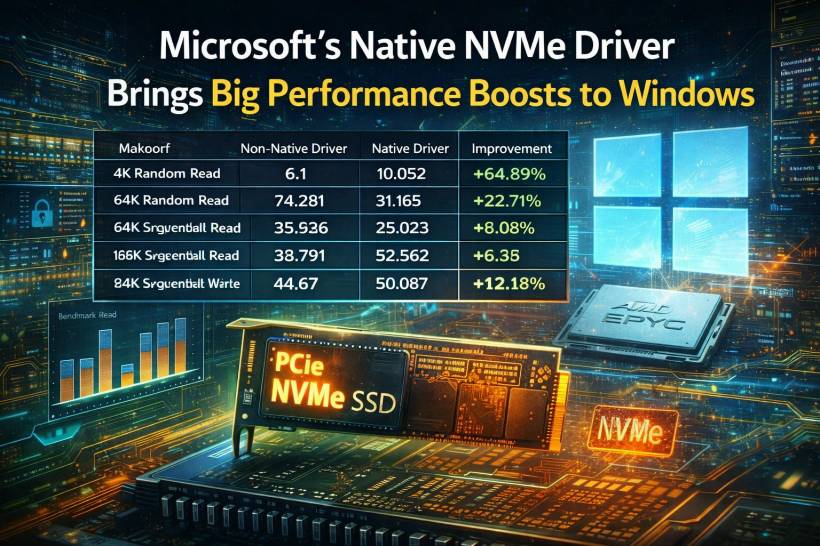
StorageReview's bandwidth results are where the headline numbers really come from. The standout is 4K random read throughput, which jumped from 6.1 GiB/s with the non-native driver to 10.058 GiB/s with the native driver, a gain of 64.89%. 64K random read bandwidth also improved strongly, rising from 74.291 GiB/s to 91.165 GiB/s, or 22.71%. Sequential results were more mixed, with 64K sequential read basically flat, 128K sequential read improving 6.65%, and 64K sequential write rising 12.13%, while 128K sequential write slightly dipped by 0.79%.
| Workload | Non-Native Driver | Native Driver | Improvement |
| 4K Random Read (GiB/s) | 6.1 | 10.058 | +64.89% |
| 64K Random Read (GiB/s) | 74.291 | 91.165 | +22.71% |
| 64K Sequential Read (GiB/s) | 35.596 | 35.623 | +0.08% |
| 128K Sequential Read (GiB/s) | 86.791 | 92.562 | +6.65% |
| 64K Sequential Write (GiB/s) | 44.67 | 50.087 | +12.13% |
| 128K Sequential Write (GiB/s) | 50.477 | 50.079 | -0.79% |
Latency Results
Latency is where the picture gets more nuanced. Random read latency improved meaningfully, which lines up with the bandwidth story. StorageReview measured 4K random read latency dropping from 0.169 ms to 0.104 ms, an improvement of 38.46%, while 64K random read latency improved from 0.239 ms to 0.207 ms, or 13.39%. Those are the kinds of changes that can matter in latency-sensitive environments.
Sequential write latency, however, moved in the wrong direction in these tests. At 64K, write latency rose from 0.399 ms to 0.558 ms, a 39.85% increase. At 128K, it went from 1.022 ms to 1.149 ms, which was still worse, but the increase was smaller at 12.43%. So the native path clearly is not a universal win for every write scenario in this benchmark set.
| Workload | Non-Native Driver | Native Driver | Change |
| 4K Random Read Latency (ms) | 0.169 | 0.104 | -38.46% |
| 64K Random Read Latency (ms) | 0.239 | 0.207 | -13.39% |
| 64K Sequential Write Latency (ms) | 0.399 | 0.558 | +39.85% |
| 128K Sequential Write Latency (ms) | 1.022 | 1.149 | +12.43% |
CPU Efficiency Results
One of the less flashy but more important parts of the story is CPU efficiency. StorageReview found that the native NVMe path lowered CPU usage across all of its sequential read and write tests. For 64K sequential reads, CPU usage dropped from 44.89% to 37.11%. For 128K sequential reads, it fell from 61.56% to 49.56%. Sequential writes also improved, with 64K writes dropping from 70.44% to 57.78% and 128K writes from 58.44% to 47.33%.
That matters because lower storage overhead can free CPU resources for databases, virtualization, analytics, AI workloads, or just background activity. It also supports the argument that this update is about more than benchmark spikes. Efficiency improvements can have real downstream value, especially in enterprise systems where storage and compute are both heavily loaded. The power-consumption angle is more of a reasonable implication than a directly benchmarked result here, but lower CPU involvement often points in that direction.
| Workload | Non-Native Driver CPU Usage | Native Driver CPU Usage | Improvement |
| 64K Sequential Read | 44.89% | 37.11% | -7.78% |
| 128K Sequential Read | 61.56% | 49.56% | -12.00% |
| 64K Sequential Write | 70.44% | 57.78% | -12.66% |
| 128K Sequential Write | 58.44% | 47.33% | -11.11% |
What These Results Actually Mean
The easiest way to read these numbers is this: the native NVMe stack looks especially strong for random-read-heavy workloads and for reducing CPU overhead, while some write-latency tradeoffs still need to be understood properly. That makes the update potentially very attractive for enterprise workloads, but it also means people should not assume every benchmark will improve in every scenario.
It also helps explain why Microsoft has kept the feature opt-in instead of enabling it universally right away. Microsoft says native NVMe support is available in Windows Server 2025 after the relevant cumulative updates and registry enablement, and reporting around Windows 11 25H2 indicates the underlying driver is present there too but not enabled by default. The reason appears to be compatibility caution, especially around the broader ecosystem of storage tooling and third-party vendor support.
The Bigger Picture
This update arrives at a time when SSD performance is moving much faster than old storage assumptions. PCIe 5.0 SSDs are already pushing into very high throughput territory, and the industry is already looking ahead to PCIe 6.0. In that context, Microsoft's move toward a more direct NVMe path feels less like a luxury enhancement and more like overdue plumbing work for modern storage.
So yes, the headline gain of up to 64.89% is eye-catching, but the deeper story is that Windows is finally getting a storage path that better matches what NVMe drives were built for. If future client versions adopt this more broadly and compatibility concerns are resolved, this could end up being one of the more meaningful under-the-hood Windows storage changes in a long time. That last point is an inference based on Microsoft's architectural change and the benchmark direction, not a formal Microsoft claim.
Final Thoughts
Microsoft's native NVMe driver is shaping up to be a genuinely important storage improvement rather than just another background tweak. StorageReview's benchmarks suggest big wins in random reads, solid gains in CPU efficiency, and a more mixed result for write latency depending on block size.
The main takeaway is simple: this looks like a real architectural step forward, not just benchmark noise. But it is also not a one-size-fits-all miracle patch. The performance upside is clearly there, especially for read-heavy and CPU-sensitive workloads, though broader adoption will likely depend on how quickly Microsoft and storage vendors smooth out compatibility and deployment concerns.











Comments